

Short answer: Private label means a specialist factory makes instruments that you sell under your own brand. It gives you a branded range without owning a factory. Success depends on the right maker, clear specifications, agreed responsibilities and steady quality control.
The private label journey
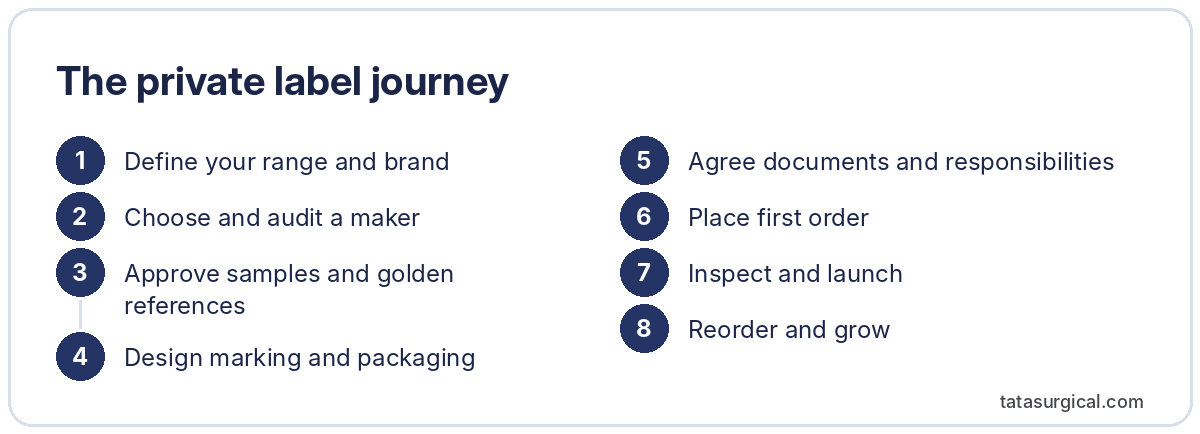
- Define your range and brand
- Choose and audit a maker
- Approve samples and golden references
- Design marking and packaging
- Agree documents and responsibilities
- Place first order
- Inspect and launch
- Reorder and grow
What you control, what the maker controls
| You (brand owner) | The maker |
|---|---|
| Brand, range and pricing | Production and in-process quality |
| Sales, marketing and customers | Material and process records |
| Market registration (depending on setup) | Technical information about the product |
| Complaint handling with customers | Investigation support |
Note: In many markets, including the EU, the company whose name appears on the product may carry the legal obligations of the manufacturer. Agree responsibilities in writing and take regulatory advice for your setup.
Costs to plan
- Laser marking set-up and per-piece cost
- Printed packaging and labels
- Samples and approval rounds
- Minimum order quantities
- Regulatory and documentation costs in your market
Branding options
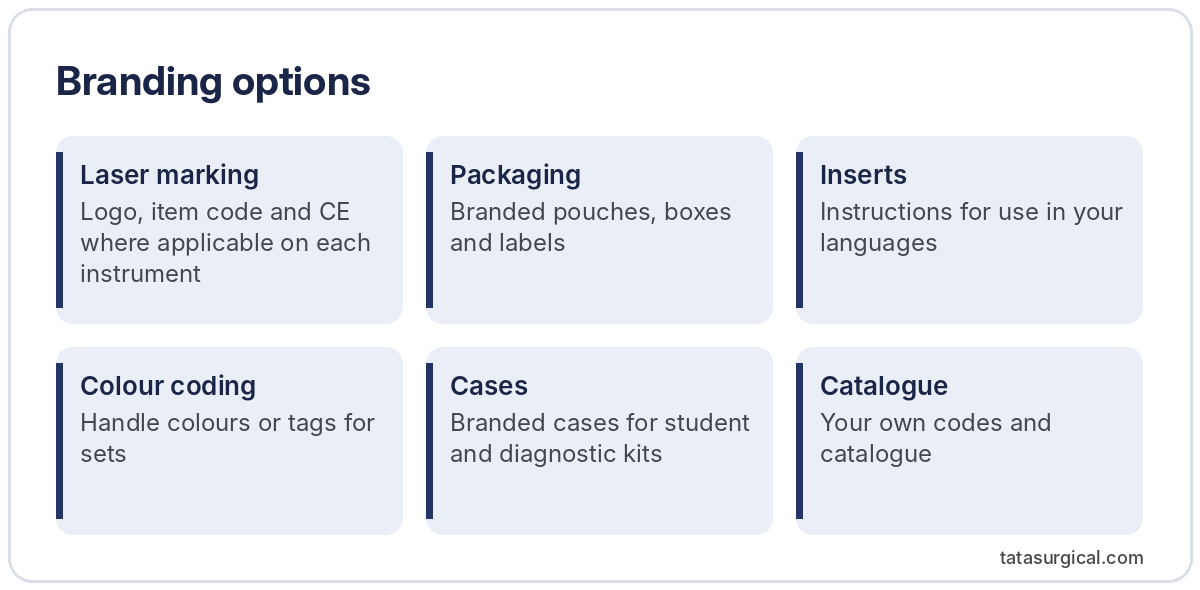
- Laser marking: Logo, item code and CE where applicable on each instrument
- Packaging: Branded pouches, boxes and labels
- Inserts: Instructions for use in your languages
- Colour coding: Handle colours or tags for sets
- Cases: Branded cases for student and diagnostic kits
- Catalogue: Your own codes and catalogue
Quality control
- Golden samples for every item
- Agreed acceptance criteria
- Pre-shipment inspection reports
- Incoming inspection on arrival
- Quality agreement (see Quality agreements with your instrument manufacturer)
Before your first private label order
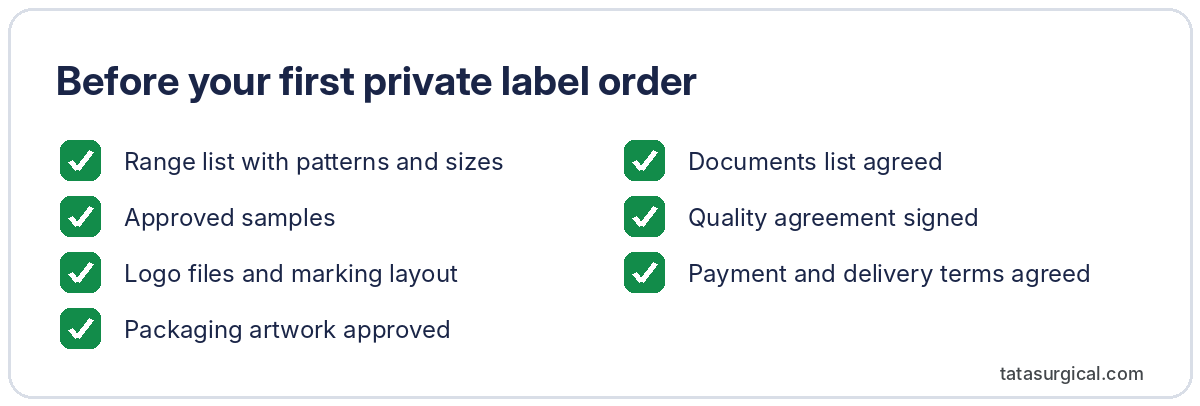
- Range list with patterns and sizes
- Approved samples
- Logo files and marking layout
- Packaging artwork approved
- Documents list agreed
- Quality agreement signed
- Payment and delivery terms agreed
Worked example
A Spanish distributor launches a private label line of 60 general surgery items. It starts with the 20 best sellers, approves samples, marks them with its logo and codes, and uses standard pouches with a branded label. After two successful orders, it adds custom boxes and 40 more items.
Proof box
Proof: EU Regulation 2017/745 (MDR), Article 16, explains when a distributor or importer placing a device on the market under its own name is considered to take on the manufacturer’s obligations. Read it with your regulatory advisor.
In detail: growing a private label range
Successful private label brands start narrow and grow with demand. Track which items sell, which are returned and which customers ask for. Use this data to add new items each year. Keep packaging consistent so customers recognise your brand on every shelf and in every tray.
Protect your brand by registering your trademark in your markets and by agreeing in writing that the factory will not use your logo or packaging for anyone else.
Frequently asked questions
How long does it take to launch a private label range? Often three to six months from samples to first delivery.
Can I use my own item codes? Yes, they can be laser marked and printed on labels.
Can I change factories later? Yes, if you own your brand, artwork and specifications.
Do I need my own certificates? It depends on your market and setup; take regulatory advice.
Glossary
- Brand owner: company whose name appears on the product.
- Artwork: approved design files for labels and packaging.
- Trademark: legal protection of your brand name or logo.
Key takeaways
- Start with best sellers, then grow
- Define responsibilities clearly
- Control quality with golden samples and inspections
Standards and sources
- EU MDR, Regulation (EU) 2017/745
- ISO 13485 quality management
- Related: private label in Europe (see Private label surgical instruments for European brands: how it works), OEM vs private label (see OEM, private label and white label: what is the difference?), starting small (see Starting small: minimum order quantities for private label instruments)
Private label with Tata Surgical
Since 1984. Send us your brand brief.
Looking for instruments like these?
Browse our catalogue or send us your drawing. We reply with prices, lead time and shipping terms.