Short answer: Most manual surgical instruments are Class I devices, and many are exempt from 510(k) premarket notification. But foreign manufacturers still need FDA establishment registration, device listing and a US Agent, and products must meet labelling, UDI and quality system rules. US importers may also need to register. In short, FDA rules focus on registration, listing, labelling and quality systems.
General information only. Check the FDA database and consider a US regulatory consultant.
Bringing an instrument to the US market
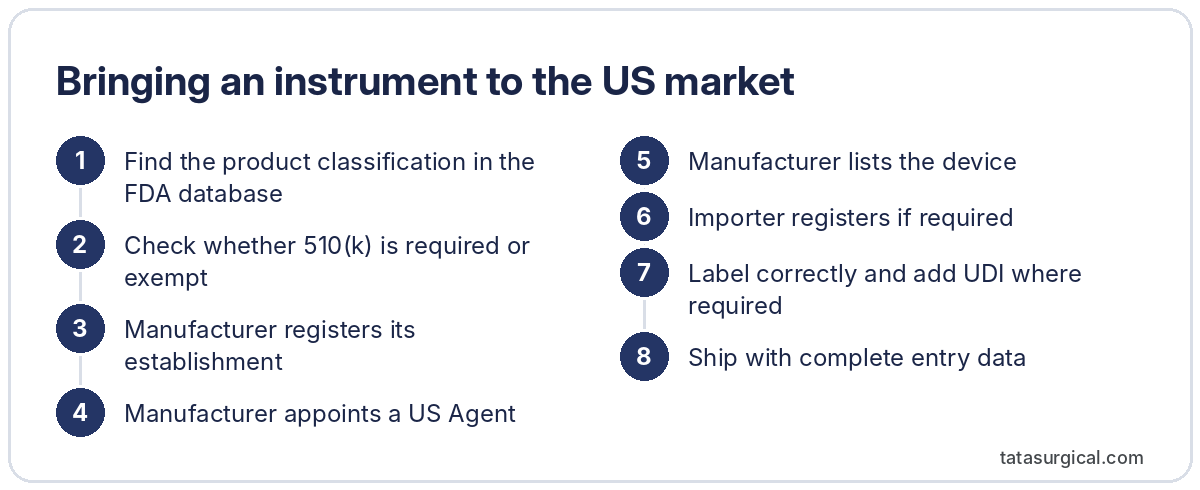
- Find the product classification in the FDA database
- Check whether 510(k) is required or exempt
- Manufacturer registers its establishment
- Manufacturer appoints a US Agent
- Manufacturer lists the device
- Importer registers if required
- Label correctly and add UDI where required
- Ship with complete entry data
Classification at a glance
| Device type | Typical class | 510(k)? |
|---|---|---|
| Manual surgical instruments (scissors, forceps, retractors) | Class I | Often exempt |
| Some specialised instruments and kits | Class I or II | Check each |
| Sterile kits with drugs or special components | May be higher | Check carefully |
Who does what
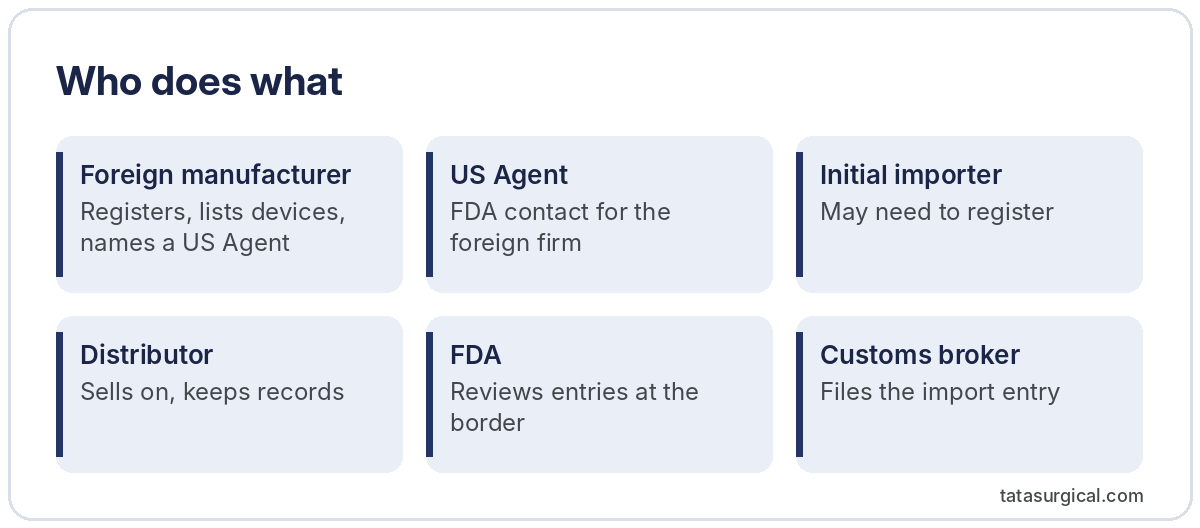
- Foreign manufacturer: Registers, lists devices, names a US Agent
- US Agent: FDA contact for the foreign firm
- Initial importer: May need to register
- Distributor: Sells on, keeps records
- FDA: Reviews entries at the border
- Customs broker: Files the import entry
Labelling and UDI
Labels must be in English and include the manufacturer’s details. The UDI rule requires most devices to carry a unique device identifier on their labels, and certain reusable devices that are reprocessed must carry it directly on the device. Requirements depend on class and compliance dates.
Tariffs
In 2025 the US announced tariffs on Pakistani goods (reported at 19%). Check the current rate with your customs broker, as trade measures change.
US buyer checklist for a new supplier
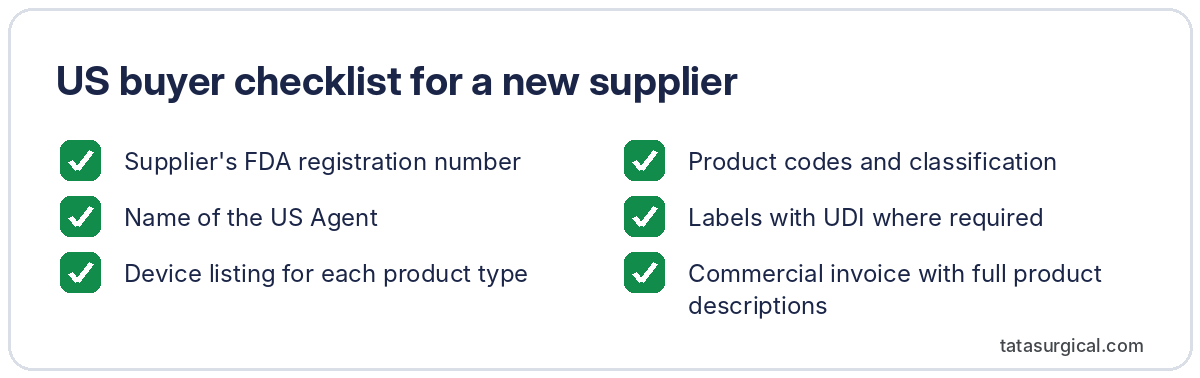
- Supplier’s FDA registration number
- Name of the US Agent
- Device listing for each product type
- Product codes and classification
- Labels with UDI where required
- Commercial invoice with full product descriptions
Worked example
A US veterinary-and-medical distributor wants private label forceps from Sialkot. It confirms the product code is Class I and 510(k) exempt, checks the maker’s registration and listing, adds UDI labels with its brand, and ships via its broker. The first entry clears without holds.
Proof box
Proof: FDA regulations at 21 CFR Part 807 cover establishment registration and device listing; 21 CFR Part 801 Subpart B covers UDI labelling. The FDA Product Classification Database lists each device type and its exemption status.
In detail: avoiding FDA border holds
Common reasons for import holds include missing or incorrect registration and listing information, wrong product codes, incomplete labelling and mismatches between the invoice and the listed device. Before the first shipment, share the supplier’s registration and listing details with your customs broker and check that descriptions on the invoice match the listing.
Frequently asked questions
Does every surgical instrument need a 510(k)? No. Many Class I instruments are exempt, but you must check each product code.
What is a US Agent? A US-based contact the FDA uses for a foreign establishment.
Do importers register? Initial importers generally must register with the FDA.
Is UDI required on Class I devices? UDI requirements apply to most devices, with some exceptions; check FDA guidance.
Glossary
- 510(k): premarket notification for certain devices.
- Product code: FDA code for a device type.
- Device listing: registration of each device type with the FDA.
Key takeaways
- Class I and exempt does not mean “no rules”
- Registration, listing and a US Agent are essential
- Labels and UDI must be right before shipping
Standards and sources
- FDA: Device registration and listing
- FDA: Product classification database
- FDA: Unique Device Identification
- Related: selling in the USA (see Selling surgical instruments in the USA: what US buyers need to know), UDI (see Laser marking and UDI: tracking surgical instruments explained)
Meeting FDA rules with a new supplier
FDA rules apply to the foreign maker as well as the importer. Therefore, check your supplier’s registration and device listings before you order. You can search the official FDA medical devices pages for guidance. In addition, ask for sample labels, so that you can check UDI and country of origin early.
As a result, your first shipment is far less likely to be held at the border. For help planning a US order, contact our export team.
US supply from Tata Surgical
Looking for instruments like these?
Browse our catalogue or send us your drawing. We reply with prices, lead time and shipping terms.