

Short answer: Single-use surgical instruments are supplied sterile, used once and discarded. They remove the cost and risk of reprocessing and are ideal where sterilisation is not available, for simple procedures and for infection-sensitive settings. Quality varies widely, so test samples and choose a maker with clear documentation.
Why single-use is growing
Market reports estimate the global single-use surgical instruments market at roughly US$5.9 billion in 2025, growing around 5 to 6% a year. Drivers include infection control, ambulatory surgery and clinics without sterilisation departments.
Where single-use instruments are used
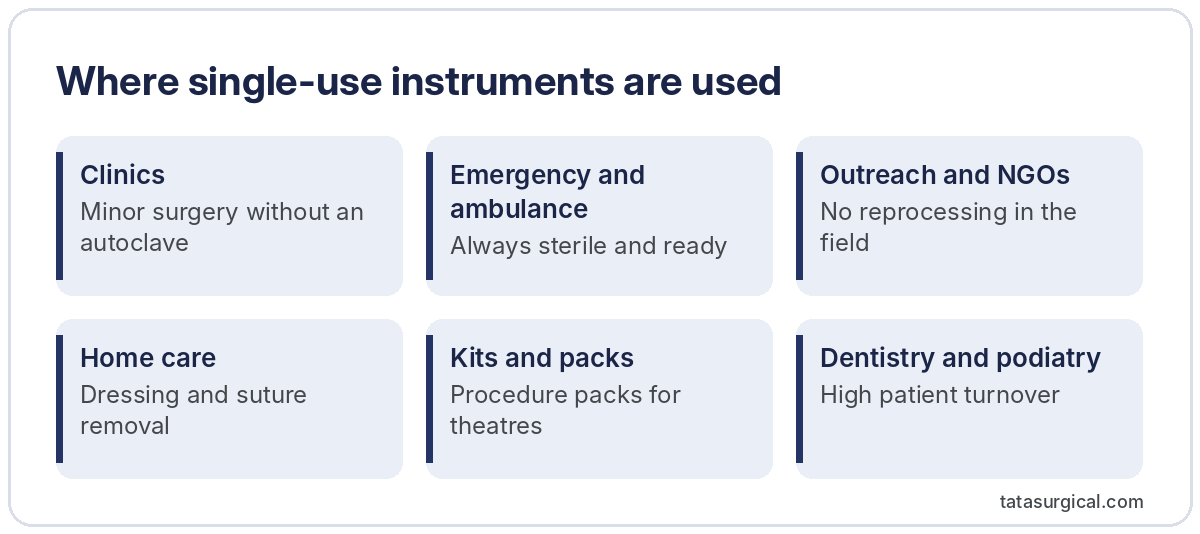
- Clinics: Minor surgery without an autoclave
- Emergency and ambulance: Always sterile and ready
- Outreach and NGOs: No reprocessing in the field
- Home care: Dressing and suture removal
- Kits and packs: Procedure packs for theatres
- Dentistry and podiatry: High patient turnover
Materials
| Material | Pros | Cons |
|---|---|---|
| Stainless steel | Feels like reusable, precise, strong | Higher price |
| Plastic (e.g. ABS, polycarbonate) | Low cost, light | Less precise, can flex |
| Mixed (steel tips, plastic handles) | Balance of cost and function | Varies by maker |
Common single-use instruments
- Scissors: iris, stitch, Mayo, Metzenbaum
- Forceps: dressing, tissue, Adson
- Hemostats: Mosquito, Kelly, Crile
- Needle holders
- Scalpels
- Specula: vaginal, nasal, ear
- Nail nippers and podiatry items
Quality checks for single-use instruments
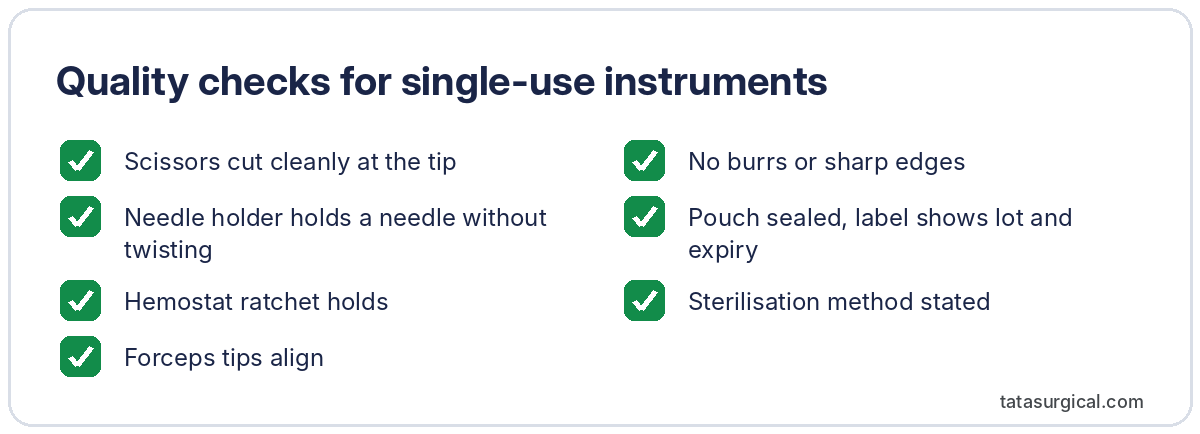
- Scissors cut cleanly at the tip
- Needle holder holds a needle without twisting
- Hemostat ratchet holds
- Forceps tips align
- No burrs or sharp edges
- Pouch sealed, label shows lot and expiry
- Sterilisation method stated
Cost: when does single-use make sense?
Compare cost per procedure (see Cost per procedure: single-use kits vs reusable sets). Single-use usually wins when:
- Procedure volume is low
- No sterilisation department exists
- Reprocessing labour and water/energy costs are high
- Infection risk must be minimised
Reusable usually wins for high-volume procedures in hospitals with efficient reprocessing.
Sustainability
Single-use creates more waste. Ways to reduce it: choose steel items that can enter metal recycling where available, minimise packaging, and use single-use only where it adds value (see Sustainable surgical instruments: what green procurement means for buyers).
Tip: Never re-sterilise single-use instruments. They are not designed or validated for it, and labels mark them for one use only.
Worked example: a clinic switches its suture removal
A community clinic spends staff time cleaning and sterilising 40 suture removal sets a week in a small autoclave. Switching to single-use steel suture removal kits frees about two staff hours a week and removes the bottleneck at the autoclave.
Proof box
Proof: Single-use labelling uses the “Do not re-use” symbol defined in ISO 15223-1 (symbols for medical device labels). Sterile products should state the sterilisation method, for example with the “STERILE EO” or “STERILE R” symbol.
In detail: choosing the right single-use instruments
Start with the procedures where reprocessing is hardest or slowest: suture removal, dressings, minor surgery in satellite clinics, emergency packs and outreach programmes. Compare two or three suppliers’ samples side by side, ideally with the staff who will use them. Check that scissors cut sutures cleanly, that needle holders hold needles without twisting and that packs open easily.
Labels matter too: they should show product name, size, lot, expiry date, sterilisation method and the single-use symbol, in the languages required in your market.
Frequently asked questions
Are single-use steel instruments recyclable? In some regions they can enter metal recycling streams after safe decontamination; check local rules.
Do single-use instruments perform as well? Good steel versions perform very well for the intended procedures.
Who uses most single-use instruments? Clinics, emergency services and kit makers.
Are prices stable? Prices depend on steel, labour and sterilisation costs; contracts can fix them for a period.
Glossary
- Single-use symbol: the crossed-out “2” on labels meaning do not reuse.
- Terminally sterilised: sterilised in its final packaging.
- Lot number: identifies a production batch.
Key takeaways
- Single-use is right for specific settings, not everything
- Steel single-use instruments perform like reusable ones
- Test samples and check packaging and labelling
- Never re-sterilise single-use items
Standards and sources
- ISO 15223-1: Symbols for medical device labels (ISO search)
- ISO 11607: Sterile packaging (ISO search)
- MarketsandMarkets and other research firms on single-use surgical instruments market size (estimates vary)
- Related: steel vs plastic (see Single-use steel vs plastic instruments), cost per procedure (see Cost per procedure: single-use kits vs reusable sets)
Single-use instruments from Tata Surgical
Steel single-use instruments and kits, made alongside our reusable range. Request samples.
Looking for instruments like these?
Browse our catalogue or send us your drawing. We reply with prices, lead time and shipping terms.