

Short answer: Periodontal instruments assess and treat gum disease. Probes measure pocket depth; explorers detect calculus; sickle scalers remove deposits above the gum; universal and Gracey curettes clean above and below the gum. Keeping them sharp is essential. This guide to periodontal instruments therefore follows the order of a typical appointment.
Periodontal kit
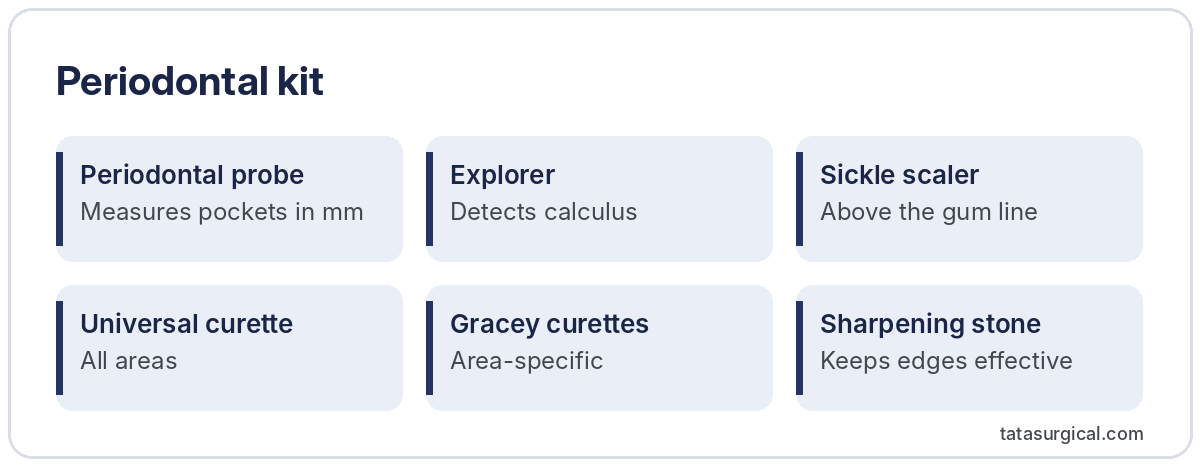
- Periodontal probe: Measures pockets in mm
- Explorer: Detects calculus
- Sickle scaler: Above the gum line
- Universal curette: All areas
- Gracey curettes: Area-specific
- Sharpening stone: Keeps edges effective
Instrumentation sequence
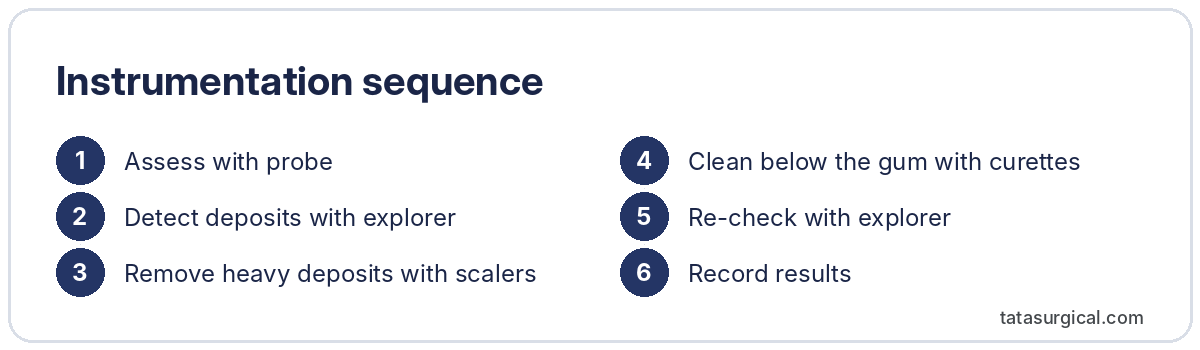
- Assess with probe
- Detect deposits with explorer
- Remove heavy deposits with scalers
- Clean below the gum with curettes
- Re-check with explorer
- Record results
Sharpness and care
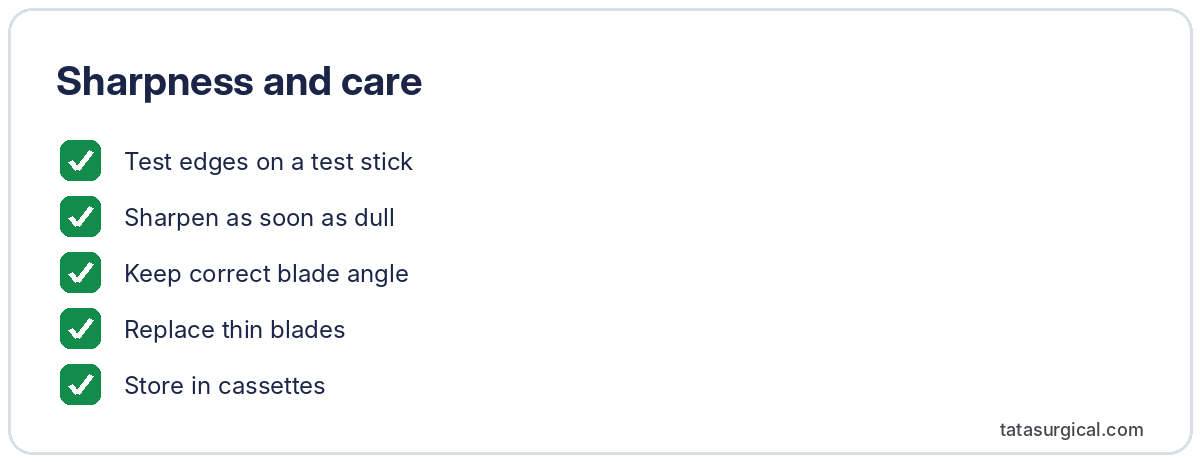
- Test edges on a test stick
- Sharpen as soon as dull
- Keep correct blade angle
- Replace thin blades
- Store in cassettes
Worked example
A hygienist sharpens curettes after each patient using a quick test stick check, reducing hand fatigue and appointment time.
Proof box
Proof: Gracey curettes are designed with an offset blade (about 70 degrees to the shank), making only one edge the working edge.
In detail: ergonomics for hygienists
Hygienists use periodontal instruments for hours each day. Wide, light, textured handles and sharp edges reduce hand strain and the risk of musculoskeletal problems. Sharp instruments need less pressure, protecting both patient and clinician.
Frequently asked questions
What is a Nabers probe? A curved probe for furcation areas.
How many Gracey curettes do I need? A set covering anterior and posterior areas, often 4 to 8 instruments.
What is a mini-Gracey? A Gracey with a shorter blade for tight pockets.
Are ultrasonic scalers a replacement? They complement hand instruments.
Glossary
- Calculus: hardened deposits on teeth.
- Pocket depth: depth between gum and tooth.
- Furcation: area where roots divide.
Key takeaways
- Probe, detect, remove, check
- Sharp instruments work better
- Gracey numbers match tooth areas
Standards and sources
- Related: scaler vs curette (see What is the difference between a dental scaler and a curette?), Universal vs Gracey (see Universal or Gracey curettes: what is the difference?), sharpening (see How often should dental instruments be sharpened?)
Choosing periodontal instruments for your practice
Good periodontal instruments make treatment faster and more comfortable. For example, a sharp curette removes calculus with light strokes, so the hygienist works with less effort. Therefore, quality and sharpness matter more than the number of tools in a kit.
First, build a core kit with a probe, explorers, sickle scalers and a few area-specific curettes. Next, choose handle styles that suit your team, because comfort reduces hand strain over a long day. In addition, plan a regular sharpening routine. As a result, edges stay effective and treatment stays safe.
The periodontology overview explains the treatments these tools support. To order periodontal instruments, request a quote.
Periodontal instruments from Tata Surgical
Looking for instruments like these?
Browse our catalogue or send us your drawing. We reply with prices, lead time and shipping terms.