
Short answer: A washer-disinfector cleans instruments automatically and then disinfects them with hot water (thermal disinfection). It gives repeatable, validated results and reduces staff handling. Correct loading, detergent and water quality are essential.
A typical washer-disinfector cycle
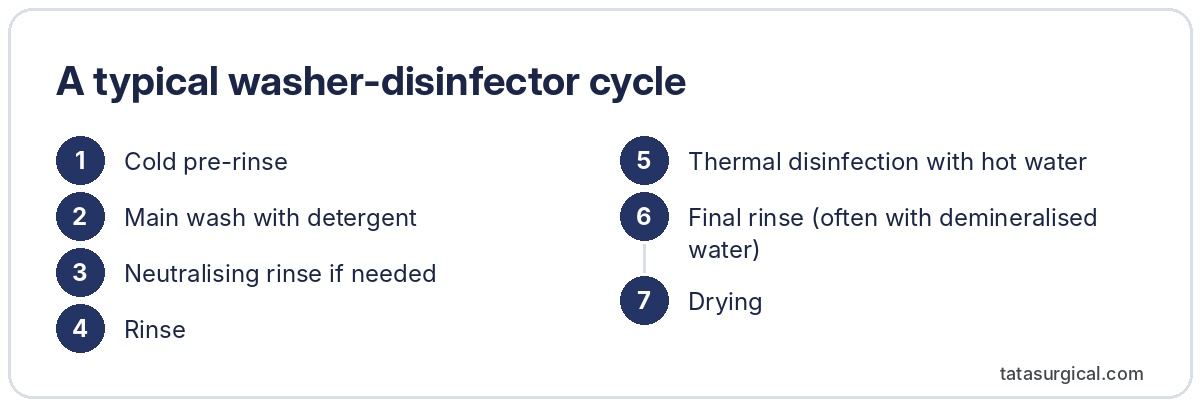
- Cold pre-rinse
- Main wash with detergent
- Neutralising rinse if needed
- Rinse
- Thermal disinfection with hot water
- Final rinse (often with demineralised water)
- Drying
The A0 concept
Thermal disinfection is measured with the A0 value, which links temperature and time. Higher A0 values give higher levels of disinfection. National guidance sets the A0 value required for instruments.
Loading rules
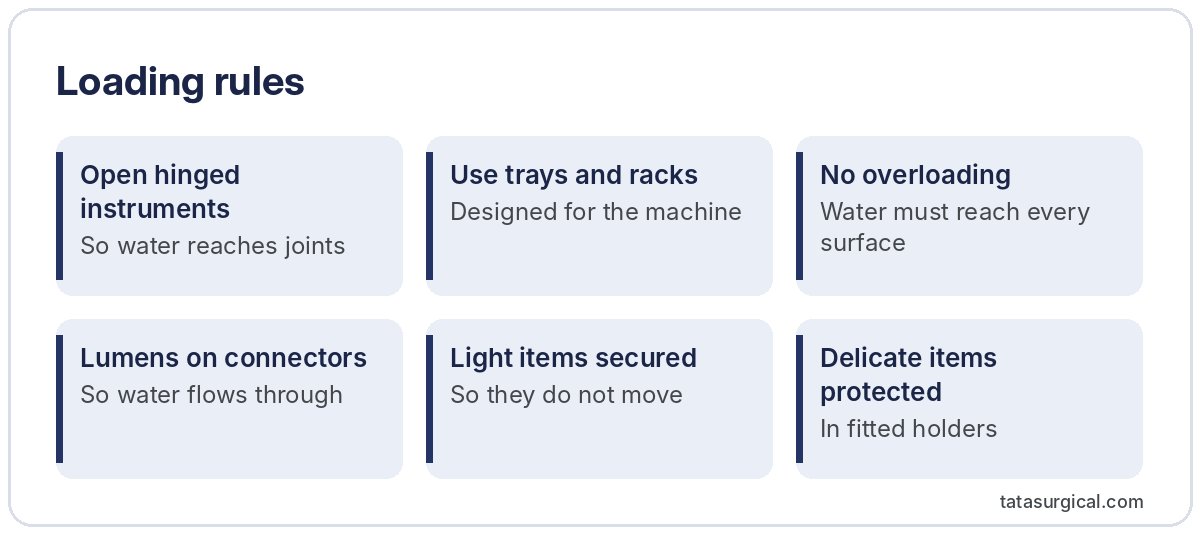
- Open hinged instruments: So water reaches joints
- Use trays and racks: Designed for the machine
- No overloading: Water must reach every surface
- Lumens on connectors: So water flows through
- Light items secured: So they do not move
- Delicate items protected: In fitted holders
Daily checks
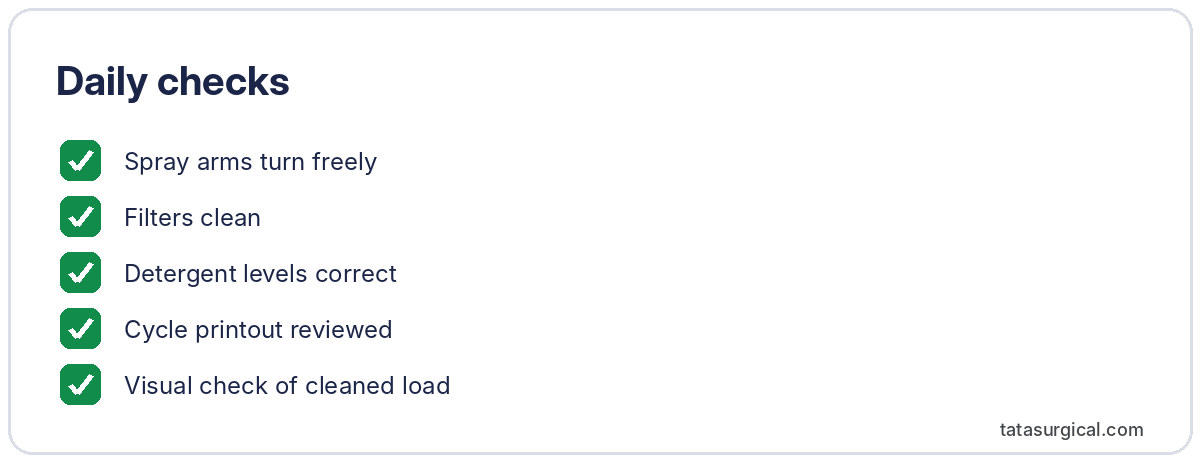
- Spray arms turn freely
- Filters clean
- Detergent levels correct
- Cycle printout reviewed
- Visual check of cleaned load
Validation and testing
Washer-disinfectors are validated when installed and tested routinely, as described in ISO 15883 and national guidance.
In detail: water and detergents
Hard water reduces cleaning and leaves stains. Many departments use softened water for washing and demineralised water for the final rinse. Detergents must match the soil and the machine.
Worked example
A hospital finds residual soil in box locks. Engineers adjust spray arm settings, staff open instruments fully and loading is reduced. Residue tests then pass.
Proof box
Proof: ISO 15883 series sets requirements and tests for washer-disinfectors, including thermal disinfection based on the A0 concept.
Frequently asked questions
Does a washer-disinfector sterilise? No; sterilisation follows.
Can all instruments go in? Most stainless instruments can; check the IFU for delicate items.
What is a residue test? A test showing whether soil remains after cleaning.
Why use demineralised water? To prevent spots and stains.
Glossary
- Thermal disinfection: disinfection with hot water.
- A0 value: measure of disinfection based on temperature and time.
- Spray arm: rotating arm that sprays water.
Key takeaways
- Load correctly
- Control water and detergent
- Test and validate
Standards and sources
- ISO 15883 (ISO search)
- Related: complete cleaning guide (see The complete guide to cleaning and sterilising surgical instruments)
Instruments made for automated cleaning
Looking for instruments like these?
Browse our catalogue or send us your drawing. We reply with prices, lead time and shipping terms.