Short answer: Steam autoclaves sterilise instruments by exposing them to saturated steam at a set temperature for a set time, after removing air. Common cycles run at about 121°C (longer) or about 134°C (shorter). Every cycle should be monitored with physical readings and chemical indicators, with biological indicators used at intervals set by policy.
Phases of a steam cycle
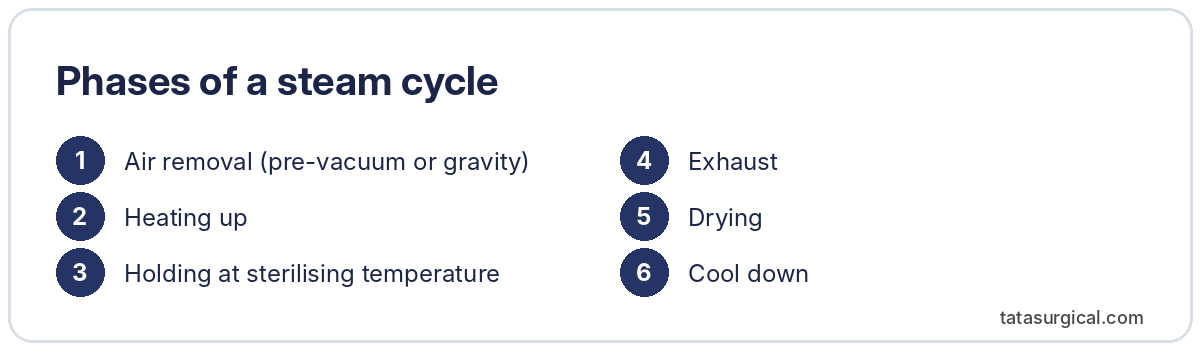
- Air removal (pre-vacuum or gravity)
- Heating up
- Holding at sterilising temperature
- Exhaust
- Drying
- Cool down
Cycle types
| Cycle | How air is removed | Typical use |
|---|---|---|
| Gravity displacement | Steam pushes air out | Simple loads |
| Pre-vacuum / dynamic air removal | Vacuum pulses remove air | Wrapped sets, porous loads, lumens |
Small benchtop sterilisers are often classified as Class B, N or S under EN 13060; Class B runs vacuum cycles suitable for wrapped and hollow loads.
Three levels of monitoring
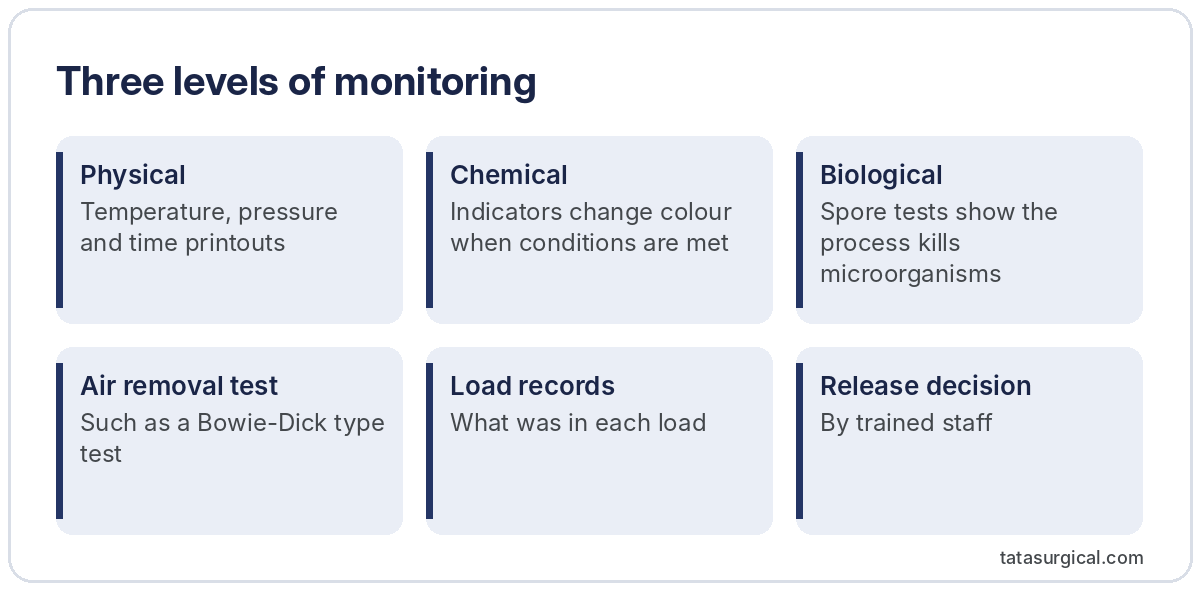
- Physical: Temperature, pressure and time printouts
- Chemical: Indicators change colour when conditions are met
- Biological: Spore tests show the process kills microorganisms
- Air removal test: Such as a Bowie-Dick type test
- Load records: What was in each load
- Release decision: By trained staff
Before releasing a load
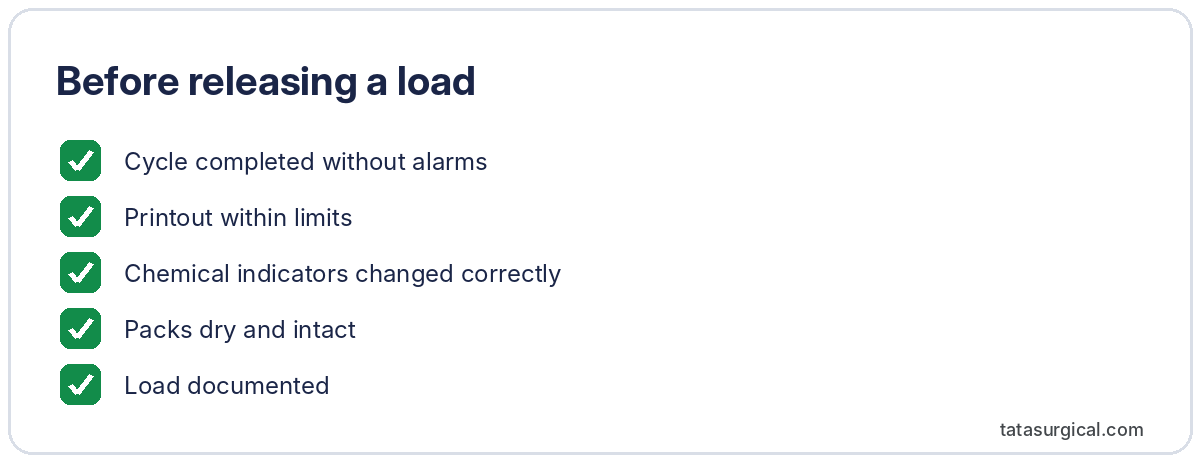
- Cycle completed without alarms
- Printout within limits
- Chemical indicators changed correctly
- Packs dry and intact
- Load documented
In detail: why air removal matters
Air pockets prevent steam reaching surfaces. That is why vacuum cycles and air removal tests are important for wrapped sets and hollow instruments.
Worked example
A clinic using a gravity cycle for wrapped sets switches to a Class B steriliser with vacuum cycles, adds a daily air removal test and solves repeated indicator failures.
Proof box
Proof: ISO 17665 covers moist heat sterilisation; EN 285 covers large steam sterilisers and EN 13060 small steam sterilisers.
Frequently asked questions
121°C or 134°C? Follow the IFU and your steriliser’s validated cycles.
What is a Bowie-Dick test? An air removal and steam penetration test for vacuum sterilisers.
How often are biological indicators used? As your national guidance and policy require.
Why are packs wet? Overloading, poor drying, or wet instruments loaded.
Glossary
- Saturated steam: steam at the right temperature and pressure.
- Chemical indicator: strip that changes colour.
- Biological indicator: spore test.
Key takeaways
- Remove air, hold temperature, dry
- Monitor every load
- Keep records
Standards and sources
- ISO 17665 (ISO search) · EN 13060 · EN 285
- CDC: Disinfection and sterilization guideline
- Related: sterilising instruments (see How do you sterilise surgical instruments?)
Autoclavable instruments from Tata Surgical
Looking for instruments like these?
Browse our catalogue or send us your drawing. We reply with prices, lead time and shipping terms.