

Short answer: Surgical scissors are chosen by the tissue they cut. Heavy scissors (Mayo) cut tough tissue and sutures; fine scissors (Metzenbaum, iris, tenotomy) cut delicate tissue. Tip shape, curve, length and edge type complete the choice.
Five things that define a scissor
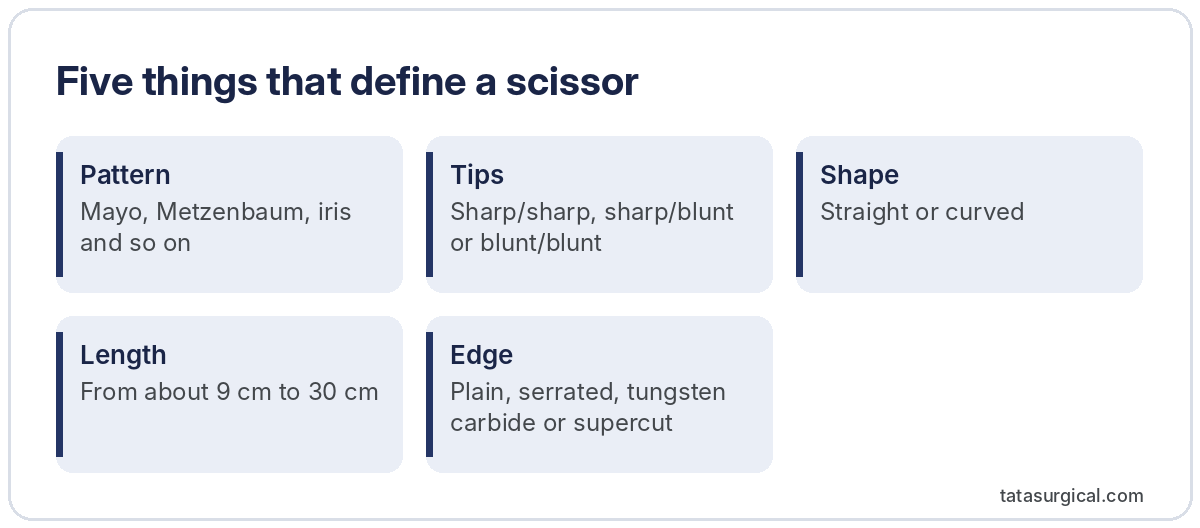
- Pattern: Mayo, Metzenbaum, iris and so on
- Tips: Sharp/sharp, sharp/blunt or blunt/blunt
- Shape: Straight or curved
- Length: From about 9 cm to 30 cm
- Edge: Plain, serrated, tungsten carbide or supercut
The main patterns
| Pattern | Typical length | Use |
|---|---|---|
| Mayo | 14 to 23 cm | Straight: sutures. Curved: fascia, muscle |
| Metzenbaum | 14 to 30 cm | Fine dissection |
| Iris | 10 to 12 cm | Fine cutting, plastic, eye, dermatology |
| Tenotomy (e.g. Stevens) | 10 to 12 cm | Very fine dissection |
| Potts-Smith | 18 to 19 cm | Vascular work, angled blades |
| Spencer stitch | 9 to 13 cm | Suture removal |
| Lister bandage | 14 to 20 cm | Cutting bandages |
| Episiotomy (Braun-Stadler) | about 14 cm | Episiotomy |
Tip shapes
- Sharp/sharp: Precise, fine cutting
- Sharp/blunt: One protective tip
- Blunt/blunt: Safe in deep or delicate areas
Edge types
| Edge | Benefit |
|---|---|
| Plain | Standard, economical |
| Micro-serrated | Holds tissue, prevents slipping |
| Tungsten carbide (gold handles) | Stays sharp much longer, replaceable inserts |
| Supercut (often black handles) | One razor blade for very smooth cuts |
How to test scissors
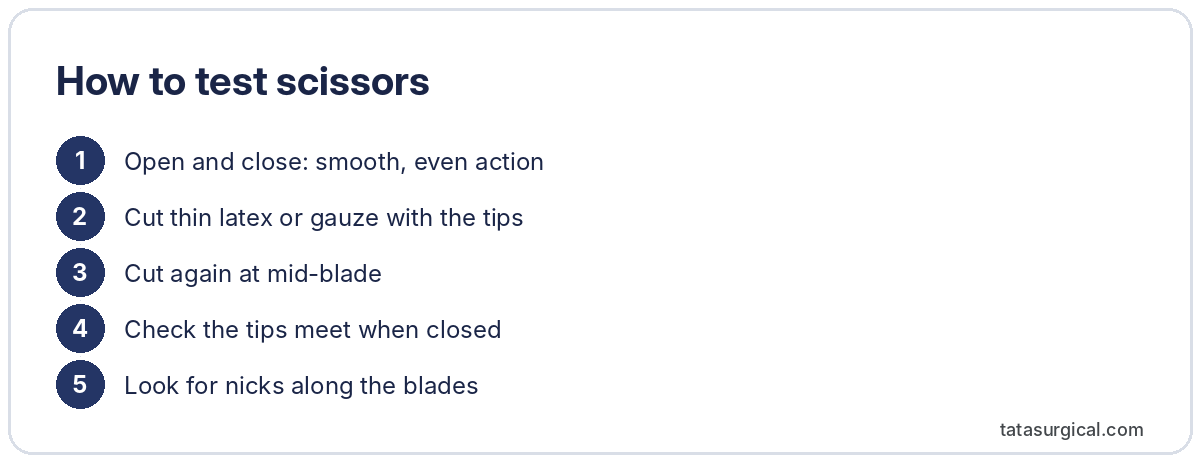
- Open and close: smooth, even action
- Cut thin latex or gauze with the tips
- Cut again at mid-blade
- Check the tips meet when closed
- Look for nicks along the blades
Sharpening
Reusable scissors can be sharpened several times by professionals (see Can surgical scissors be sharpened?). Never sharpen them at home.
Tip: Keep one pair of straight Mayo scissors for sutures only. It protects your fine scissors from early wear.
Care
- Clean blades and joint carefully
- Lubricate the joint
- Protect fine tips with caps
- Store separately from heavy instruments
Worked example: choosing scissors for a plastic surgery clinic
The clinic needs fine, precise cutting with long sharpness. It chooses: 2 iris (curved, sharp), 2 Metzenbaum 14 cm (curved, supercut), 2 tenotomy, 1 straight Mayo (for sutures only) and 2 Spencer stitch scissors.
Scissors by tissue
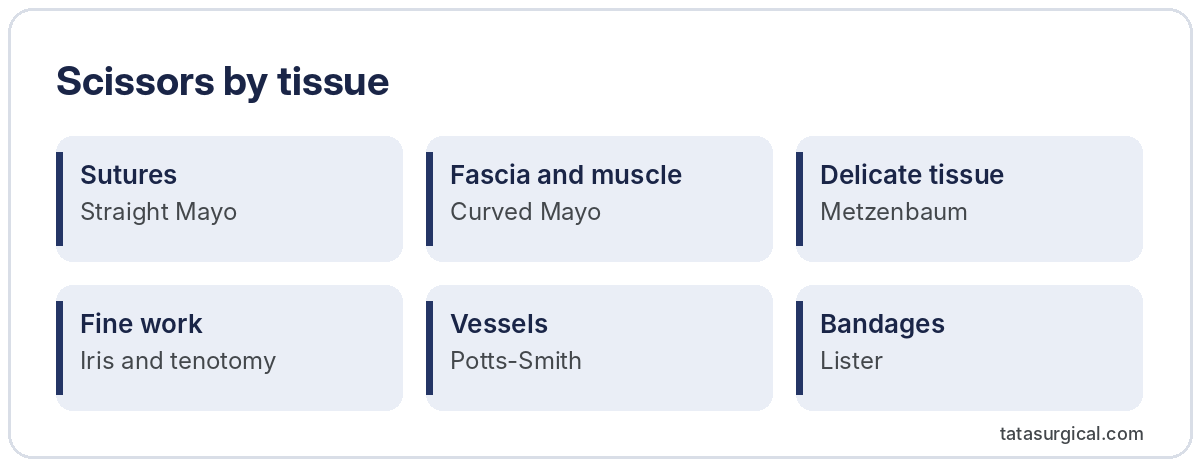
- Sutures: Straight Mayo
- Fascia and muscle: Curved Mayo
- Delicate tissue: Metzenbaum
- Fine work: Iris and tenotomy
- Vessels: Potts-Smith
- Bandages: Lister
Proof box
Proof: ISO 7741 (Instruments for surgery, scissors and shears) sets general requirements and test methods for surgical scissors.
In detail: making scissors last
Scissors are the instruments most damaged by misuse. Cutting sutures, wire or paper with fine dissecting scissors dulls them quickly. Many theatres solve this by keeping dedicated suture scissors in every set and training staff to use them.
Sharpness should be tested at every inspection, not only when a surgeon complains. A simple cut test with a standard test material at the tip and middle of the blade shows whether scissors need sharpening. Tungsten carbide and supercut edges stay sharp longer but still need professional care.
Frequently asked questions
How do I know if scissors are TC? Gold-coloured handles usually indicate tungsten carbide inserts.
Are black-handled scissors different? Often they are supercut scissors with one razor-sharp blade; check the catalogue.
How many times can scissors be sharpened? Several times, until the blades become too narrow.
Can I sharpen scissors myself? No. Use a professional service to keep the correct angle and alignment.
Glossary
- Supercut: scissors with one razor-sharp blade for very smooth cutting.
- Sharp/blunt: describes the tip shape of each blade.
- Setting: adjusting blade tension so scissors cut evenly.
Key takeaways
- Match the scissor to the tissue
- Protect fine scissors from sutures and heavy tissue
- TC and supercut edges last longer
- Test sharpness during every inspection
Resources
- Related: types of surgical scissors (see What are the different types of surgical scissors?), Metzenbaum (see Metzenbaum scissors: uses, types and buying guide), Mayo (see Mayo scissors: uses, straight vs curved and buying guide), iris (see Iris scissors: uses and buying guide)
Scissors from Tata Surgical
Looking for instruments like these?
Browse our catalogue or send us your drawing. We reply with prices, lead time and shipping terms.