

Short answer: Dental instruments fall into six groups: examination, periodontal (cleaning), restorative (fillings), endodontic (root canal), oral surgery (extractions) and orthodontic. Each group has a few core instruments every dentist uses.
Six groups of dental instruments
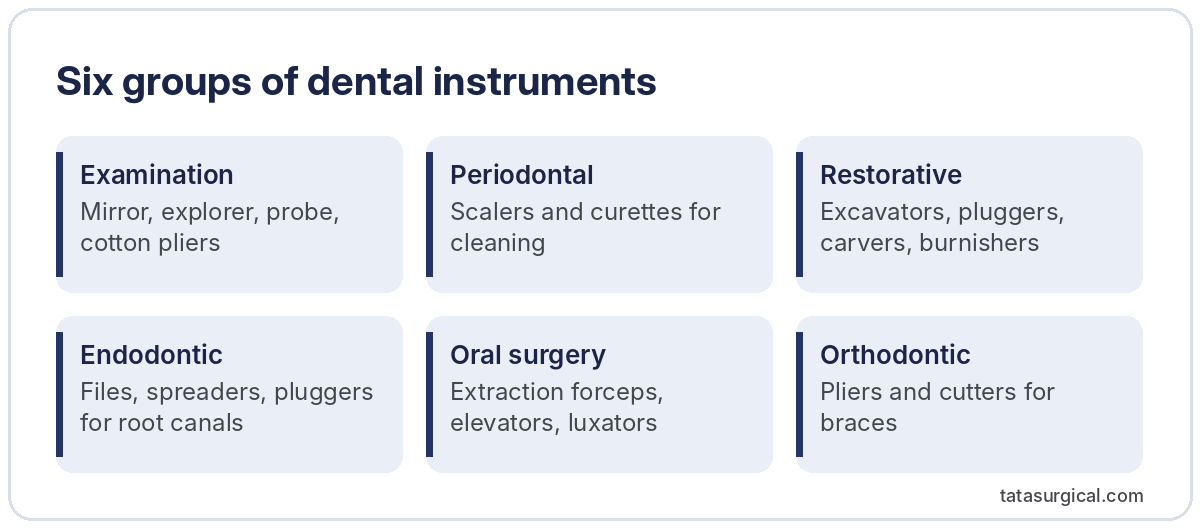
- Examination: Mirror, explorer, probe, cotton pliers
- Periodontal: Scalers and curettes for cleaning
- Restorative: Excavators, pluggers, carvers, burnishers
- Endodontic: Files, spreaders, pluggers for root canals
- Oral surgery: Extraction forceps, elevators, luxators
- Orthodontic: Pliers and cutters for braces
1. Examination instruments
| Instrument | Use |
|---|---|
| Mouth mirror | See hidden areas, reflect light, retract cheek |
| Explorer (e.g. No. 23 shepherd’s hook) | Feel for decay and margins |
| Periodontal probe | Measure gum pockets in millimetres |
| Cotton pliers | Place and remove small items |
Tip: Probes are marked in millimetres, often with colour bands. Learn your probe’s markings before use.
2. Periodontal instruments
- Sickle scalers: Pointed, for deposits above the gum line
- Universal curettes: Two cutting edges, all areas
- Gracey curettes: Area-specific, one cutting edge (see Universal or Gracey curettes: what is the difference?)
3. Restorative instruments
| Instrument | Use |
|---|---|
| Spoon excavator | Remove soft decay |
| Plastic filling instrument | Place and shape filling material |
| Amalgam/composite plugger | Condense material |
| Carvers (e.g. Hollenback, Ward) | Shape fillings |
| Burnisher | Smooth surfaces |
| Matrix retainer | Hold a band around the tooth |
4. Endodontic instruments
Hand files (K-files, H-files), spreaders and pluggers are used to clean and fill root canals. Many are size-coded by colour.
5. Oral surgery instruments
- Extraction forceps for each tooth group (see What are the types of dental extraction forceps?)
- Elevators and luxators (see What is the difference between a dental elevator and a luxator?)
- Periosteal elevators, bone files, rongeurs
- Needle holders and suture scissors
6. Orthodontic instruments
Weingart pliers, distal end cutters, ligature cutters, bird beak and band removers (see What orthodontic pliers does an orthodontist need?).
How a typical filling uses instruments
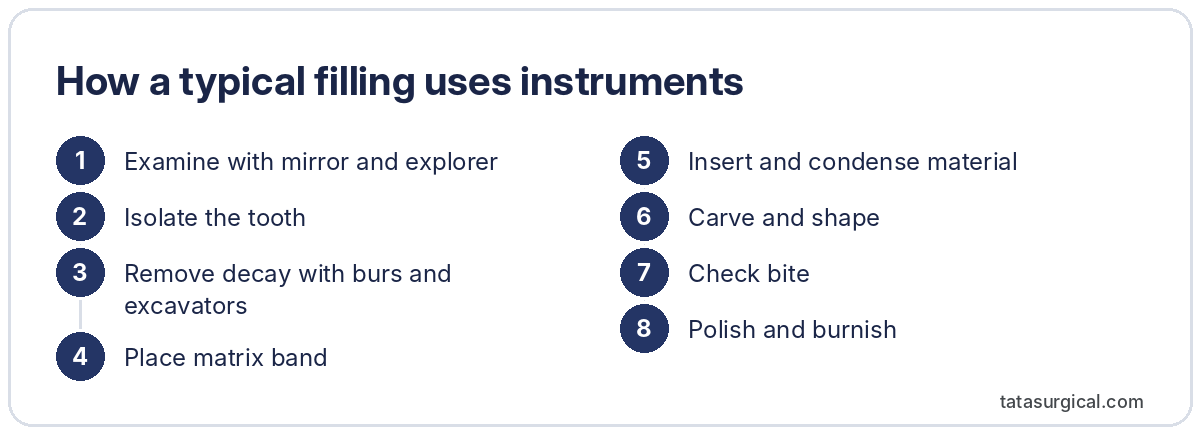
- Examine with mirror and explorer
- Isolate the tooth
- Remove decay with burs and excavators
- Place matrix band
- Insert and condense material
- Carve and shape
- Check bite
- Polish and burnish
Worked example: a basic dental clinic starter list
A new practice might start with:
- 10 examination kits (mirror, explorer, probe, pliers)
- 4 sets of scalers and curettes
- 4 restorative kits
- 1 set of upper and lower extraction forceps
- 2 sets of elevators
- Cassettes to hold each kit
Organising dental kits
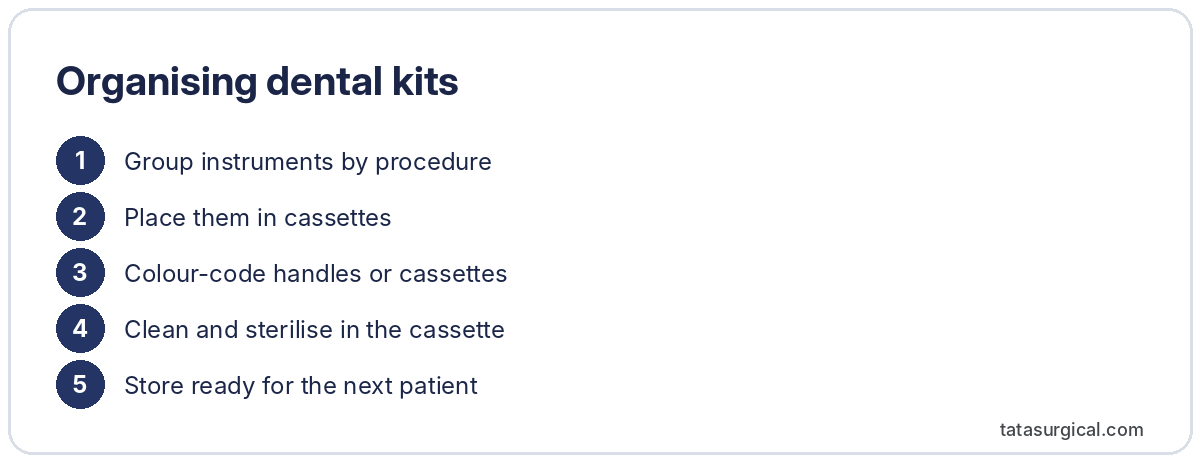
- Group instruments by procedure
- Place them in cassettes
- Colour-code handles or cassettes
- Clean and sterilise in the cassette
- Store ready for the next patient
Proof box
Proof: Dental infection control guidance from the CDC recommends cleaning and heat sterilisation of reusable dental instruments that contact patients.
In detail: building a practical dental instrument inventory
A dental practice needs enough instruments for every chair to run without waiting for sterilisation. A common rule is to plan the number of examination kits from the number of patients per day and the length of the sterilisation cycle. For example, a two-chair clinic seeing 30 patients a day with a 90-minute turnaround may need 12 to 15 examination kits so a sterile kit is always ready.
Specialist instruments, such as extraction forceps and surgical items, are needed in smaller numbers but must cover every tooth group. Many clinics buy a complete forceps set first, then add duplicates of the most used patterns, such as universal upper and lower forceps.
Quality matters most for instruments with cutting edges or fine tips. Curettes and scalers must be sharpened regularly; explorers and probes must keep their precise points and markings.
Frequently asked questions
Which instruments wear out first? Scalers, curettes and explorers, because their edges and points wear with use and sharpening.
Are cassettes worth it? Yes for most clinics. They protect instruments, keep kits complete and speed up reprocessing.
Can dental instruments be single-use? Mirrors, probes and some kits are available single-use; most clinicians still prefer reusable steel for core instruments.
How often should instruments be replaced? When they fail inspection: worn edges, bent tips, faded probe markings or damaged handles.
Glossary
- Explorer: pointed instrument to feel for decay and margins.
- Periodontal probe: instrument marked in millimetres to measure gum pockets.
- Cassette: perforated box that holds a kit through cleaning, sterilisation and storage.
Key takeaways
- Learn by group, then by pattern
- Choose patterns by your school or clinic’s preference
- Keep cutting instruments sharp (see How often should dental instruments be sharpened?)
- Use cassettes to protect and organise kits
Resources
- Related: basic dental instruments (see What are the basic dental instruments?), dental sterilisation (see How do you sterilise dental instruments?), dental student kit (see What instruments does a dental student need?)
- CDC: Infection prevention in dental settings
Dental instruments from Tata Surgical
Looking for instruments like these?
Browse our catalogue or send us your drawing. We reply with prices, lead time and shipping terms.