


Short answer: Endodontic (root canal) hand instruments clean, shape and fill the root canal. The main groups are files and reamers (K-files, H-files, reamers), instruments for filling (spreaders and pluggers) and accessories such as broaches and measuring tools. Files follow international ISO sizing with a standard colour code.
Root canal treatment removes infected or inflamed pulp, cleans and shapes the canal and seals it. Even with rotary systems, most dentists still use hand files for the first steps, for narrow or curved canals and for checking the canal path.
Main endodontic hand instruments
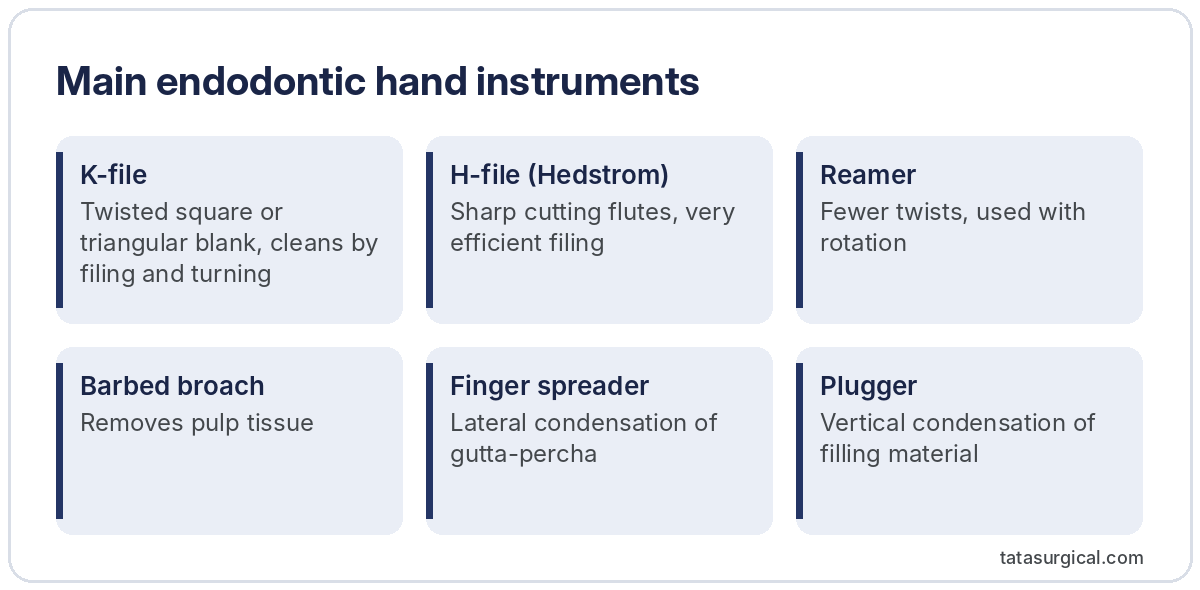
- K-file: Twisted square or triangular blank, cleans by filing and turning
- H-file (Hedstrom): Sharp cutting flutes, very efficient filing
- Reamer: Fewer twists, used with rotation
- Barbed broach: Removes pulp tissue
- Finger spreader: Lateral condensation of gutta-percha
- Plugger: Vertical condensation of filling material
ISO sizes and colours
Files are numbered by tip diameter in hundredths of a millimetre. A size 25 file has a tip of 0.25 mm. Colours repeat in a standard sequence so dentists can recognise sizes quickly.
| ISO size | Colour |
|---|---|
| 15, 45, 90 | White |
| 20, 50, 100 | Yellow |
| 25, 55, 110 | Red |
| 30, 60, 120 | Blue |
| 35, 70, 130 | Green |
| 40, 80, 140 | Black |
| 06, 08, 10 | Pink, grey, purple |
Typical hand-file sequence
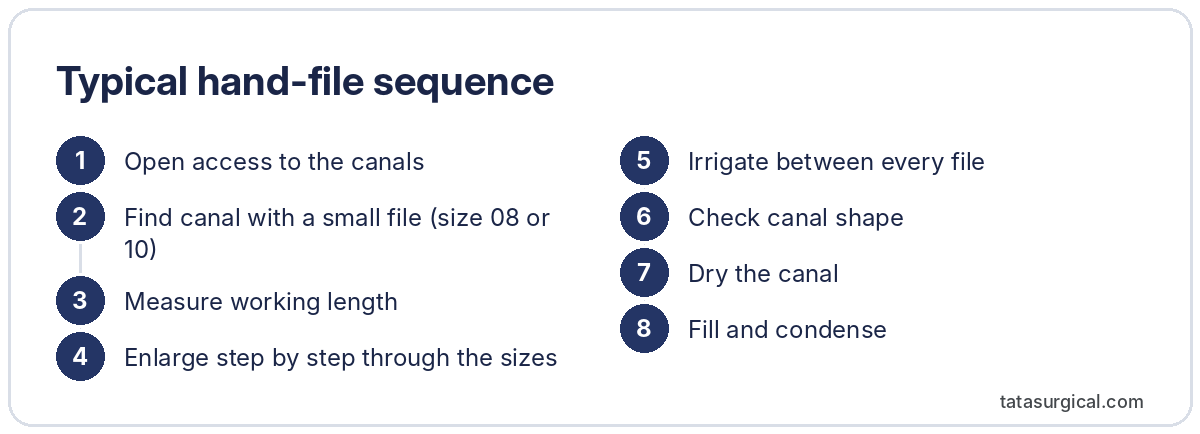
- Open access to the canals
- Find canal with a small file (size 08 or 10)
- Measure working length
- Enlarge step by step through the sizes
- Irrigate between every file
- Check canal shape
- Dry the canal
- Fill and condense
Safety points
- Never force a file; let it work with gentle motions
- Inspect files for unwinding or bending before each use
- Discard files that show any distortion
- Use rubber stops to mark working length
- Many clinics use files once or only a limited number of times
File inspection before use
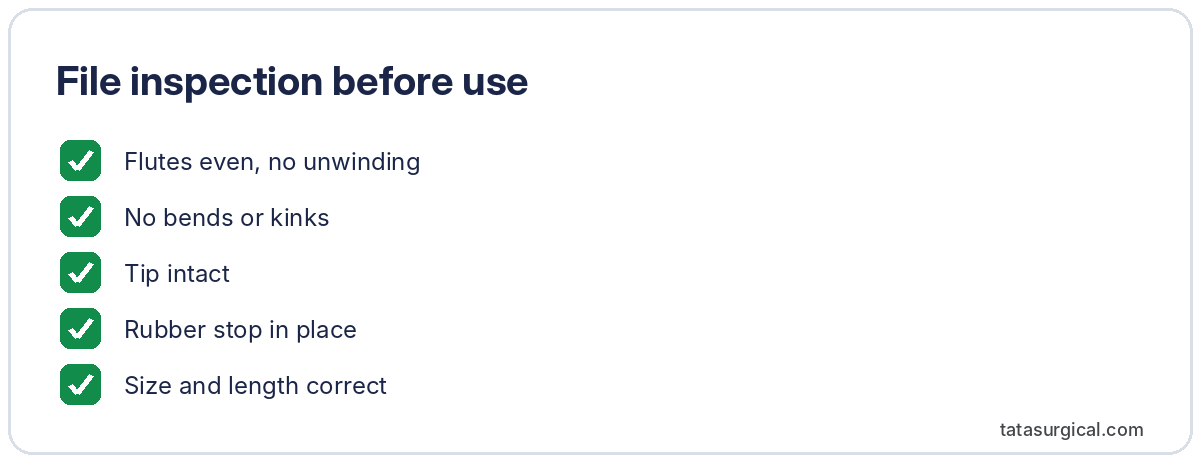
- Flutes even, no unwinding
- No bends or kinks
- Tip intact
- Rubber stop in place
- Size and length correct
In detail: hand files and rotary systems
Rotary nickel-titanium systems shape canals quickly, but hand files remain essential to create a “glide path” before rotary files, to negotiate curved or calcified canals and to confirm shape. Stainless steel hand files are stiffer and good for small, straight canals; nickel-titanium hand files are more flexible for curves.
Worked example
A clinic reduces file separation by discarding small files after each case, checking larger files under magnification, and following a strict sequence with irrigation between every size.
Proof box
Proof: ISO 3630-1 specifies requirements for root canal instruments, including sizes, tip diameters and colour coding.
Frequently asked questions
What is the difference between a K-file and an H-file? K-files cut by filing and turning; H-files cut mainly on the pull stroke and remove material faster.
Are endodontic files reusable? Some are, within limits set by the maker and clinic policy; many clinics use small files once.
What is working length? The length from a reference point to where cleaning and filling should stop.
What are spreaders and pluggers for? Condensing the filling material sideways (spreaders) or vertically (pluggers).
Glossary
- Glide path: a smooth path in the canal created before rotary instruments.
- Gutta-percha: rubber-like filling material.
- Rubber stop: small marker on a file to show length.
Key takeaways
- Learn sizes by number and colour
- Inspect files every time
- Never force a file
Standards and sources
- ISO 3630-1 Dentistry, root canal instruments (ISO search)
- Related: dental instruments guide (see Dental instruments: the complete guide to names and uses)
Dental range from Tata Surgical
Ask about our endodontic hand instruments.
Looking for instruments like these?
Browse our catalogue or send us your drawing. We reply with prices, lead time and shipping terms.