

Short answer: Latin America is a large, import-dependent market for surgical instruments. Success needs a strong local partner in each country, product registration with the national regulator, Spanish or Portuguese labels, competitive landed prices and reliable logistics.
Main markets and regulators
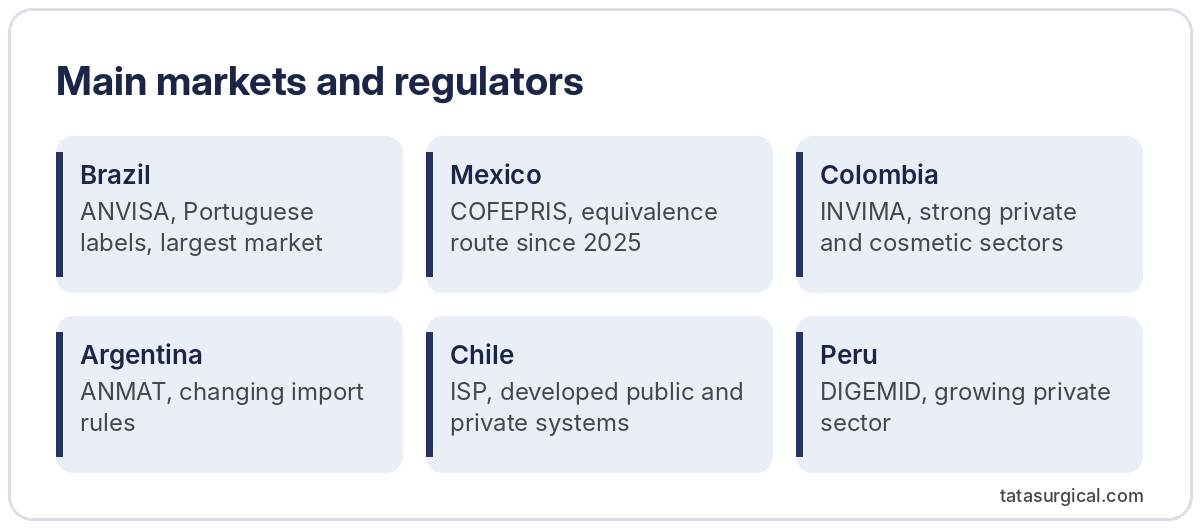
- Brazil: ANVISA, Portuguese labels, largest market
- Mexico: COFEPRIS, equivalence route since 2025
- Colombia: INVIMA, strong private and cosmetic sectors
- Argentina: ANMAT, changing import rules
- Chile: ISP, developed public and private systems
- Peru: DIGEMID, growing private sector
Market entry plan
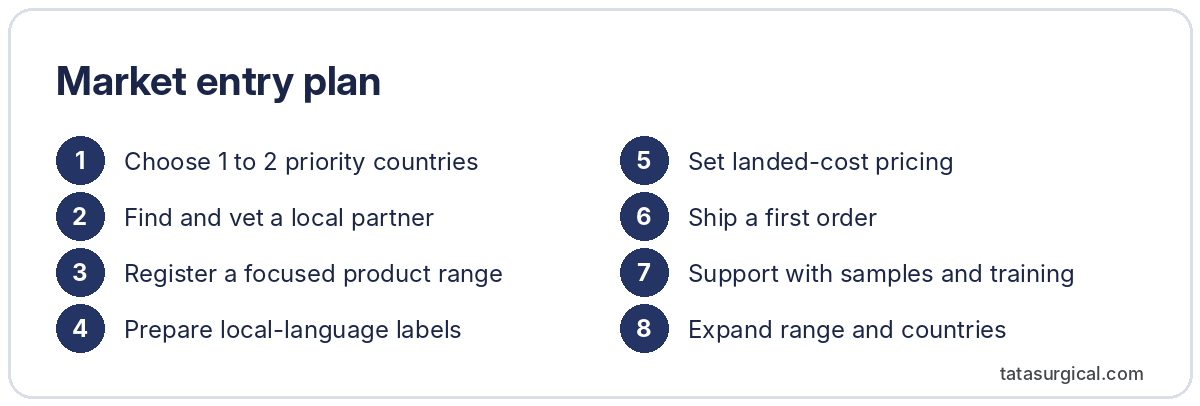
- Choose 1 to 2 priority countries
- Find and vet a local partner
- Register a focused product range
- Prepare local-language labels
- Set landed-cost pricing
- Ship a first order
- Support with samples and training
- Expand range and countries
Pricing for Latin America
Landed cost includes factory price, freight, insurance, duties, taxes (which can be high, for example in Brazil), customs fees and local margins. Model it carefully before quoting end prices.
Logistics
Most instrument orders go by air or courier; tenders may go by sea (see Shipping surgical instruments from Pakistan to Latin America).
Choosing a local partner
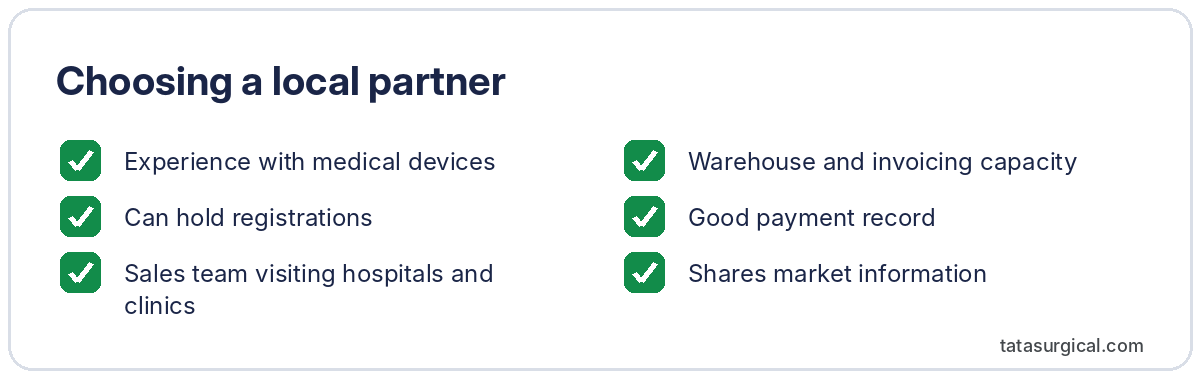
- Experience with medical devices
- Can hold registrations
- Sales team visiting hospitals and clinics
- Warehouse and invoicing capacity
- Good payment record
- Shares market information
Fairs
Hospitalar (São Paulo), Expo MED Hospitalar (Mexico City) and Meditech (Bogotá) are key regional events; many buyers also visit MEDICA in Germany (see Trade fairs in Latin America for medical distributors).
Worked example
A supplier enters Colombia with one partner, registers 30 general surgery items and 10 plastic surgery items, and supports launch with samples for key surgeons. Within a year it adds Peru through the same partner’s regional network.
Proof box
Proof: Each country’s regulator publishes its device rules: ANVISA (gov.br/anvisa), COFEPRIS (gob.mx/cofepris), INVIMA (invima.gov.co), ANMAT (argentina.gob.ar/anmat), ISP (ispch.cl) and DIGEMID (digemid.minsa.gob.pe).
In detail: pricing and payment realities
Taxes and duties vary widely across Latin America and can change quickly. Brazil, for example, adds several layers of taxes to imported goods, which raises end prices significantly. Model landed cost for each country separately. Payment terms also differ: some markets have currency controls or long payment cycles in public tenders. Agree safe terms, such as part advance or letters of credit, until trust is built.
Frequently asked questions
Which country should I start with? Often the one where you already have a trusted partner.
Is Spanish enough for Brazil? No, Brazil requires Portuguese.
Are tenders open to foreign suppliers? Usually through a local company holding registrations.
How long does registration take? It varies by country and class; plan several months.
Glossary
- Landed cost: total delivered cost.
- Registration holder: local company responsible for the product.
- Letter of credit: bank guarantee of payment.
Key takeaways
- Focus country by country
- Partners and registration come first
- Price on landed cost, not factory price
Standards and sources
- ANVISA · COFEPRIS · INVIMA · ANMAT · ISP Chile · DIGEMID
- Related: Latin America overview (see Selling surgical instruments in Latin America: an overview), labelling (see Spanish and Portuguese labelling for Latin American markets), payments (see Payment terms for Latin American importers)
Latin America with Tata Surgical
Talk to us about your country.
Looking for instruments like these?
Browse our catalogue or send us your drawing. We reply with prices, lead time and shipping terms.