Short answer: The Gulf is a high-spending healthcare region with modern hospitals and strong import demand. Selling there needs product registration (for example with the SFDA in Saudi Arabia), a local authorised representative or distributor, and an approach that fits centralised buying and local content rules.
Key features of the Gulf market
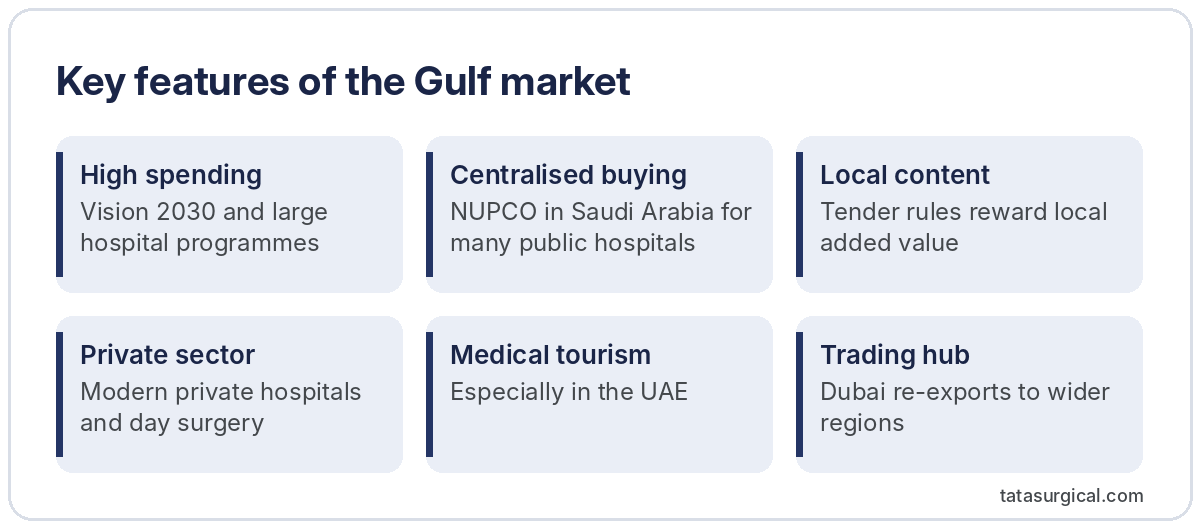
- High spending: Vision 2030 and large hospital programmes
- Centralised buying: NUPCO in Saudi Arabia for many public hospitals
- Local content: Tender rules reward local added value
- Private sector: Modern private hospitals and day surgery
- Medical tourism: Especially in the UAE
- Trading hub: Dubai re-exports to wider regions
Regulators
| Country | Regulator |
|---|---|
| Saudi Arabia | Saudi Food and Drug Authority (SFDA) |
| UAE | Ministry of Health and Prevention, plus emirate-level authorities |
| Kuwait, Qatar, Oman, Bahrain | National health ministries and authorities |
Entering the Gulf
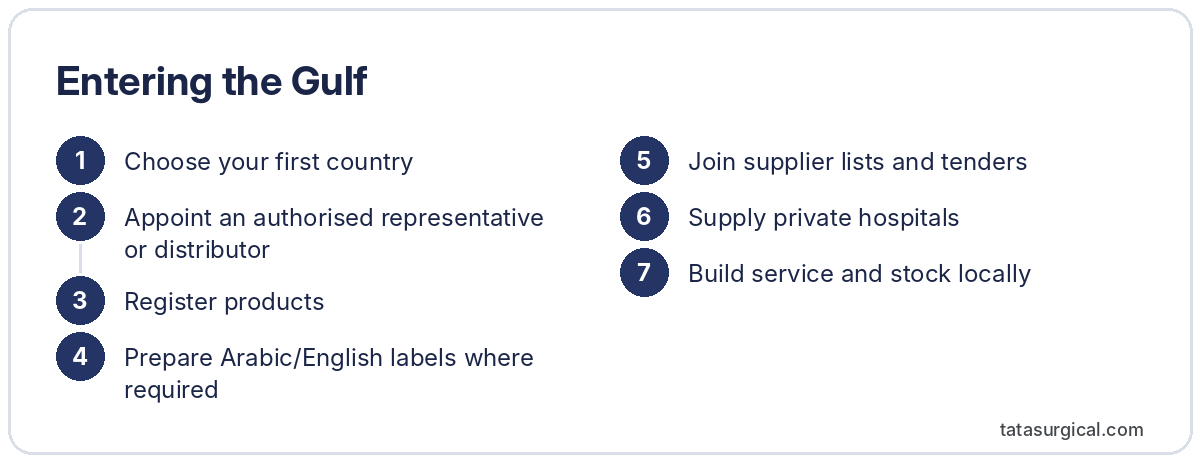
- Choose your first country
- Appoint an authorised representative or distributor
- Register products
- Prepare Arabic/English labels where required
- Join supplier lists and tenders
- Supply private hospitals
- Build service and stock locally
Local content
Saudi local content rules can require a minimum share of local added value for some public contracts. Partners may assemble or pack kits locally to qualify.
Tender readiness
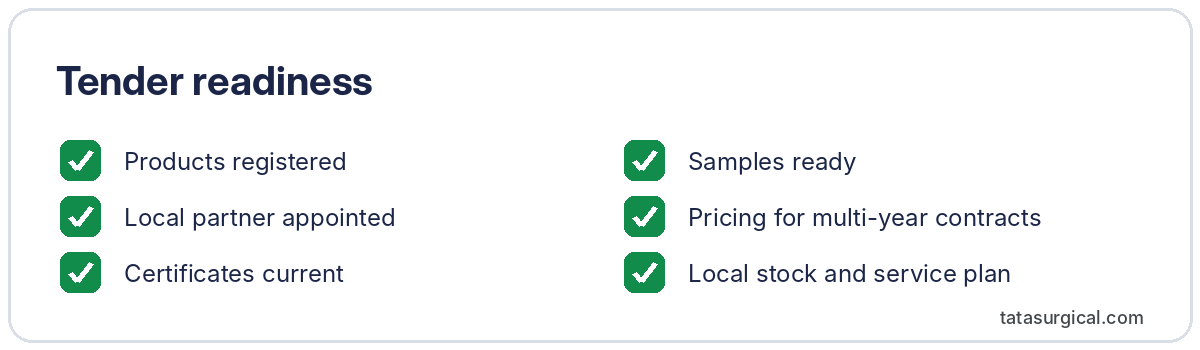
- Products registered
- Local partner appointed
- Certificates current
- Samples ready
- Pricing for multi-year contracts
- Local stock and service plan
Worked example
A supplier enters the UAE first through a Dubai distributor serving private day-surgery centres, then uses the same partner’s Saudi affiliate to register products with the SFDA and bid in private hospital groups before public tenders.
Proof box
Proof: Saudi Arabia’s Local Content and Government Procurement Authority (LCGPA) publishes local content requirements; NUPCO publishes its procurement framework agreements.
In detail: private sector first
Many suppliers start with private hospitals and day-surgery centres, which buy through distributors and decide faster than public tenders. This builds references and registration history, which help later in public tenders. Medical tourism clinics in the UAE also value high-quality instruments and quick delivery.
Frequently asked questions
Do I need Arabic labels? Requirements vary; many countries accept English, some require Arabic for certain information.
What is NUPCO? Saudi Arabia’s national unified procurement company for public healthcare.
Can I sell directly to hospitals? Usually through a local registered distributor.
Is local manufacturing required? Not always, but local content can win points in tenders.
Glossary
- SFDA: Saudi Food and Drug Authority.
- Local content: share of value added in the country.
- Authorised representative: local company acting for a foreign manufacturer.
Key takeaways
- Start with the private sector, then tenders
- A strong local partner is essential
- Plan for local content in Saudi tenders
Standards and sources
- SFDA (Saudi Food and Drug Authority)
- NUPCO
- P&S Intelligence: Saudi Arabia medical devices market
- Related: SFDA basics (see Selling medical devices in Saudi Arabia: SFDA basics), UAE (see Selling medical devices in the UAE), Gulf partners (see Working with local partners for Gulf tenders)
The Gulf with Tata Surgical
Looking for instruments like these?
Browse our catalogue or send us your drawing. We reply with prices, lead time and shipping terms.