Short answer: Every medical device sold in Mexico needs a sanitary registration (registro sanitario) from COFEPRIS, held by a company in Mexico. You need technical documents from the manufacturer, Spanish labelling and, for many devices, can use a faster equivalence route if the product is already approved by a recognised regulator such as the FDA, Health Canada or under EU CE marking.
General information. Rules change; confirm with COFEPRIS or a Mexican regulatory consultant.
Registration step by step
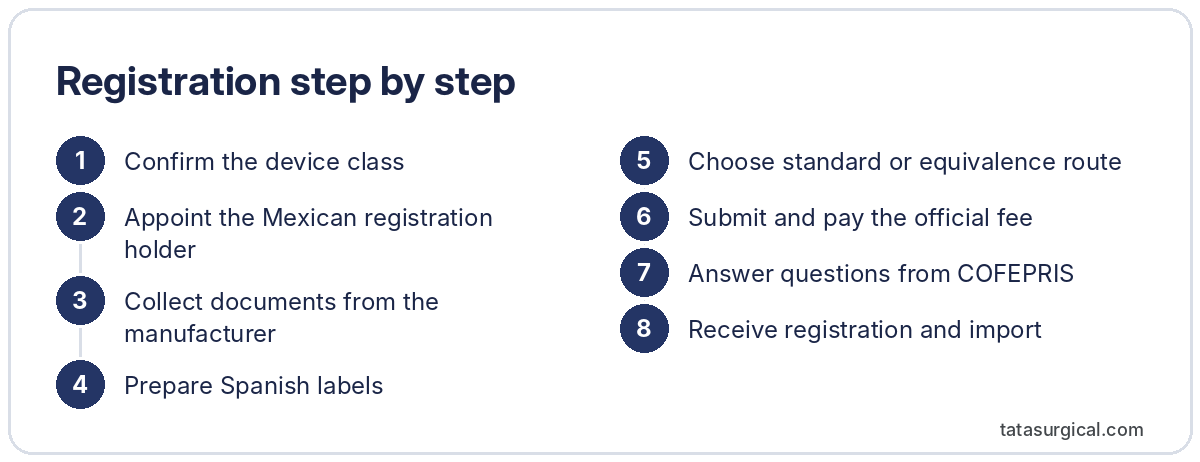
- Confirm the device class
- Appoint the Mexican registration holder
- Collect documents from the manufacturer
- Prepare Spanish labels
- Choose standard or equivalence route
- Submit and pay the official fee
- Answer questions from COFEPRIS
- Receive registration and import
Risk classes
| Class | Risk | Examples |
|---|---|---|
| I | Low | Many simple, non-invasive items |
| II | Moderate | Many surgical instruments |
| III | High | Implants and high-risk devices |
Documents usually needed
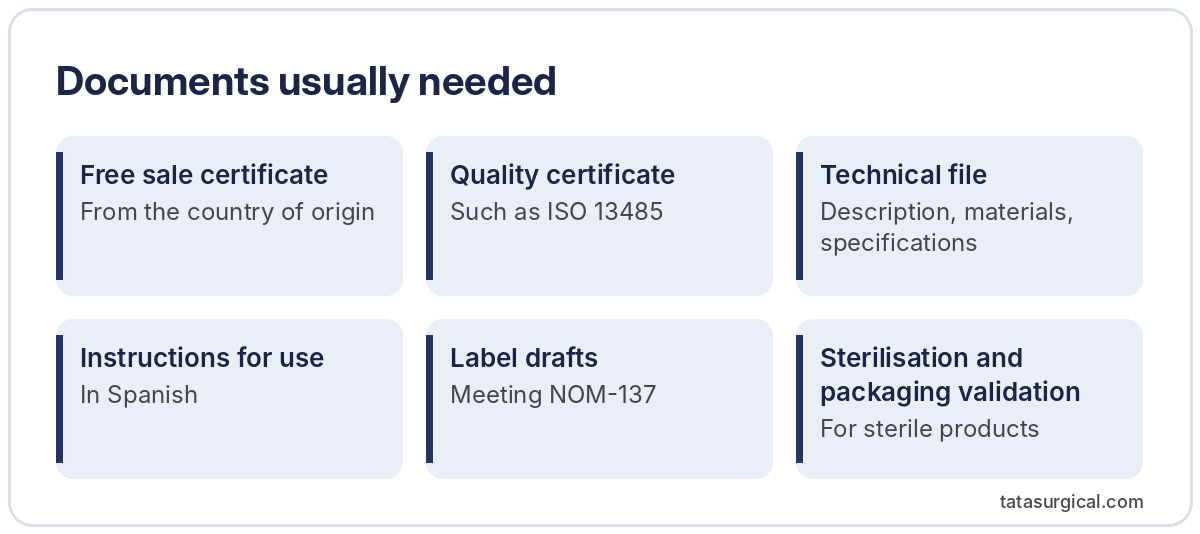
- Free sale certificate: From the country of origin
- Quality certificate: Such as ISO 13485
- Technical file: Description, materials, specifications
- Instructions for use: In Spanish
- Label drafts: Meeting NOM-137
- Sterilisation and packaging validation: For sterile products
The equivalence route
Since September 2025, devices approved by recognised authorities (for example the FDA, Health Canada or CE marking in the EU) can use an abbreviated route if the product is identical to the approved model.
Labelling
Labels must be in Spanish and follow NOM-137-SSA1 (see Spanish labelling for imported surgical instruments in Mexico).
Before you submit
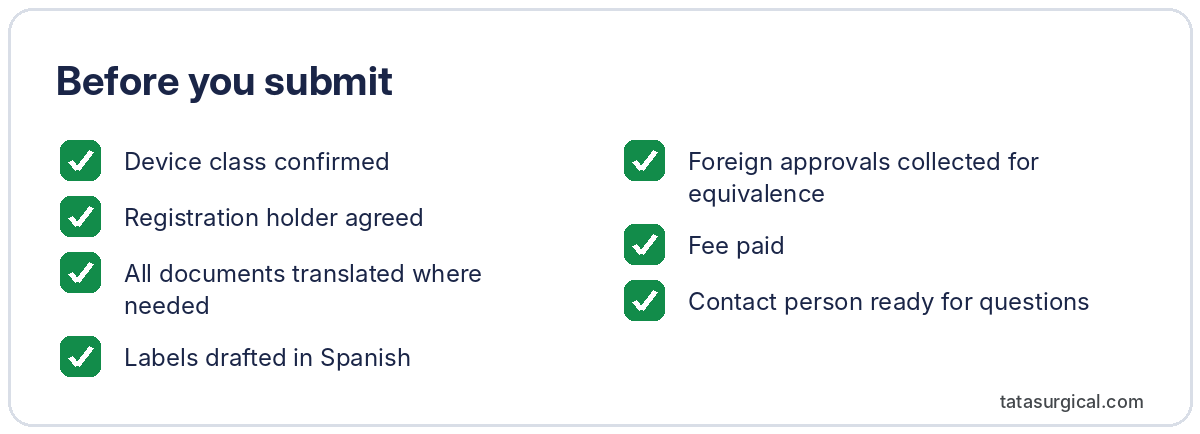
- Device class confirmed
- Registration holder agreed
- All documents translated where needed
- Labels drafted in Spanish
- Foreign approvals collected for equivalence
- Fee paid
- Contact person ready for questions
Worked example
A Guadalajara distributor registers 12 instrument families. It groups similar products where rules allow, uses the equivalence route for CE-marked items, and prepares labels with the manufacturer before the first shipment.
Proof box
Proof: The legal basis for imported device registration includes the Ley General de Salud and the Reglamento de Insumos para la Salud; the official procedure forms are published by COFEPRIS on gob.mx.
In detail: planning your COFEPRIS timeline
Registration takes time, so plan backwards from your launch date. Collect documents first, then prepare Spanish labels and translations, then submit. Answer COFEPRIS questions quickly to avoid delays. Group product families where rules allow to reduce the number of applications.
Frequently asked questions
Can the foreign manufacturer hold the registration? No, a company in Mexico must hold it.
Can I change distributors later? Registration holder changes are possible but involve procedures; plan carefully.
How long is a registration valid? Validity periods are set by law and have been reformed; check current rules.
Do I need labels before registration? Draft labels are part of the application.
Glossary
- Registro sanitario: sanitary registration in Mexico.
- Titular del registro: registration holder.
- NOM-137: Mexican labelling standard for medical devices.
Key takeaways
- A Mexican company must hold the registration
- Prepare documents and Spanish labels early
- Use the equivalence route where you can
Standards and sources
- COFEPRIS official site
- Pure Global: COFEPRIS device regulations overview
- Related: COFEPRIS basics (see COFEPRIS registration for surgical instruments: a guide for Mexican importers), Spanish labelling (see Spanish labelling for imported surgical instruments in Mexico), importing to Mexico (see How to import surgical instruments from Pakistan to Mexico, step by step)
Mexico with Tata Surgical
Ask for the documents your registration needs.
Looking for instruments like these?
Browse our catalogue or send us your drawing. We reply with prices, lead time and shipping terms.