

Short answer: A sterile services department needs a one-way workflow from dirty to clean to sterile, the right equipment (washers, ultrasonic cleaners, sterilisers), trained staff, enough instrument sets and good records. Planning the layout and stock correctly at the start avoids years of problems.
One-way CSSD workflow
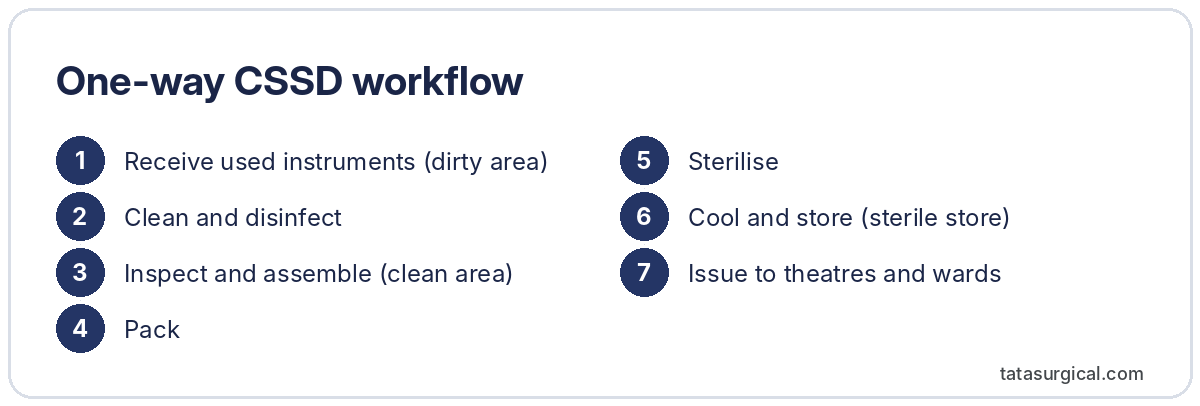
- Receive used instruments (dirty area)
- Clean and disinfect
- Inspect and assemble (clean area)
- Pack
- Sterilise
- Cool and store (sterile store)
- Issue to theatres and wards
Core equipment
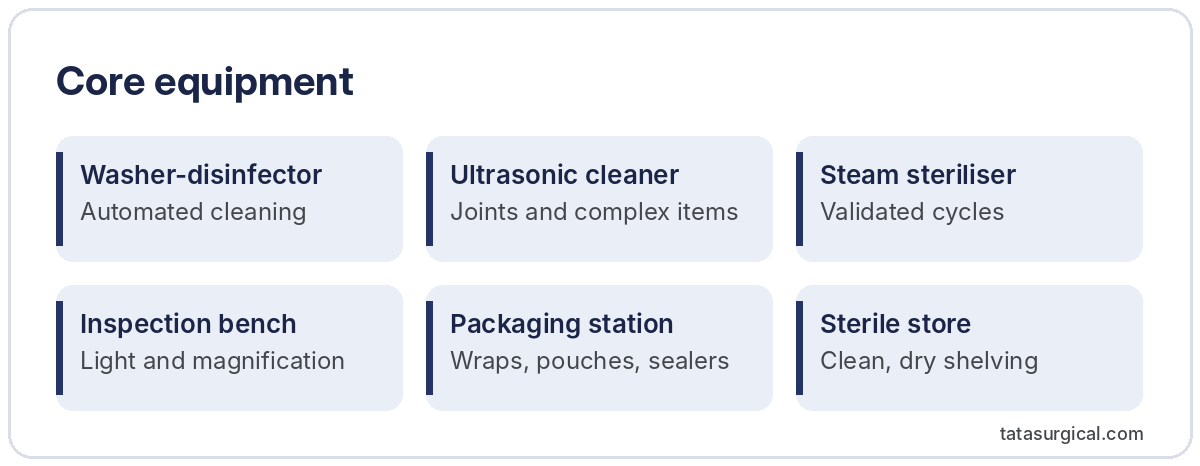
- Washer-disinfector: Automated cleaning
- Ultrasonic cleaner: Joints and complex items
- Steam steriliser: Validated cycles
- Inspection bench: Light and magnification
- Packaging station: Wraps, pouches, sealers
- Sterile store: Clean, dry shelving
Planning checklist
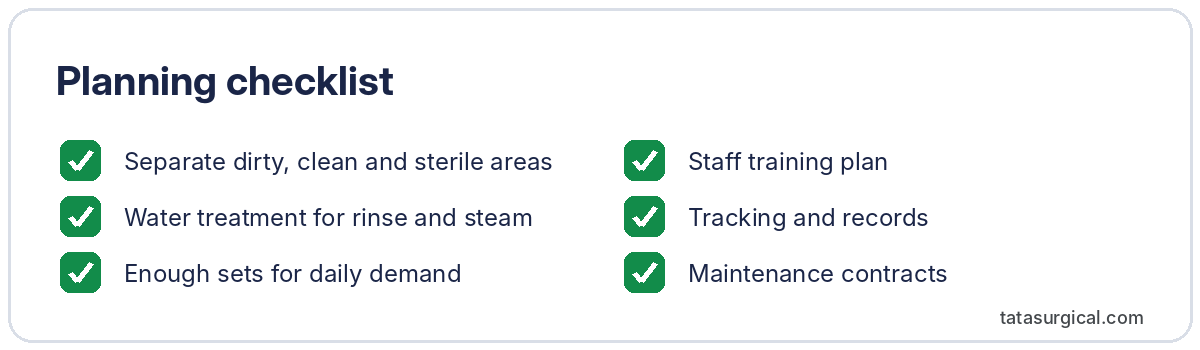
- Separate dirty, clean and sterile areas
- Water treatment for rinse and steam
- Enough sets for daily demand
- Staff training plan
- Tracking and records
- Maintenance contracts
In detail: how many instrument sets?
Count procedures per day and the turnaround time of the CSSD. If a set takes four hours to reprocess and theatres need it three times a day, you may need several copies. Too few sets cause delays; too many waste money.
Worked example
A new 100-bed hospital plans its CSSD with a dirty-to-clean pass-through washer, two sterilisers, a dedicated inspection area and an instrument tracking system, and orders sets based on its expected surgical schedule.
Proof box
Proof: WHO and national guidance on decontamination and reprocessing describe zoned, one-way workflows as a core principle of safe sterile services.
Frequently asked questions
Can a small hospital share a CSSD? Some regions use central sterile services serving several sites.
What qualifications do staff need? Training requirements vary by country.
How big should a CSSD be? It depends on volume; plan with experts.
Is tracking necessary? It is strongly recommended for safety and recalls.
Glossary
- CSSD: central sterile services department.
- Pass-through washer: machine loaded in the dirty area and unloaded in the clean area.
- Turnaround time: time to reprocess a set.
Key takeaways
- One-way flow, separate zones
- Right equipment and enough sets
- Train staff and keep records
Standards and sources
- WHO: Decontamination and reprocessing of medical devices for health-care facilities
- Related: sets by procedure (see Surgical instrument sets by procedure: the complete guide), instrument costs (see Total cost of ownership of surgical instruments: the complete guide)
Sets for new hospitals from Tata Surgical
Send us your planned set lists.
Looking for instruments like these?
Browse our catalogue or send us your drawing. We reply with prices, lead time and shipping terms.