Short answer: The purchase price is only part of an instrument’s cost. Total cost of ownership adds reprocessing for every use, repairs, losses, replacements and the cost of delays when instruments fail. Better instruments often cost less over their life.
Parts of total cost
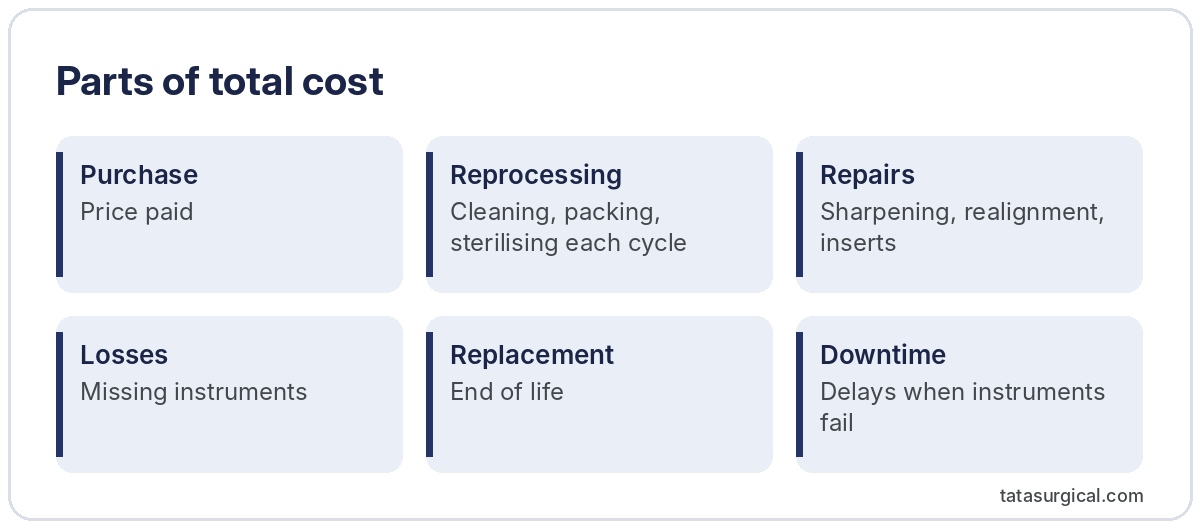
- Purchase: Price paid
- Reprocessing: Cleaning, packing, sterilising each cycle
- Repairs: Sharpening, realignment, inserts
- Losses: Missing instruments
- Replacement: End of life
- Downtime: Delays when instruments fail
Calculating cost per use
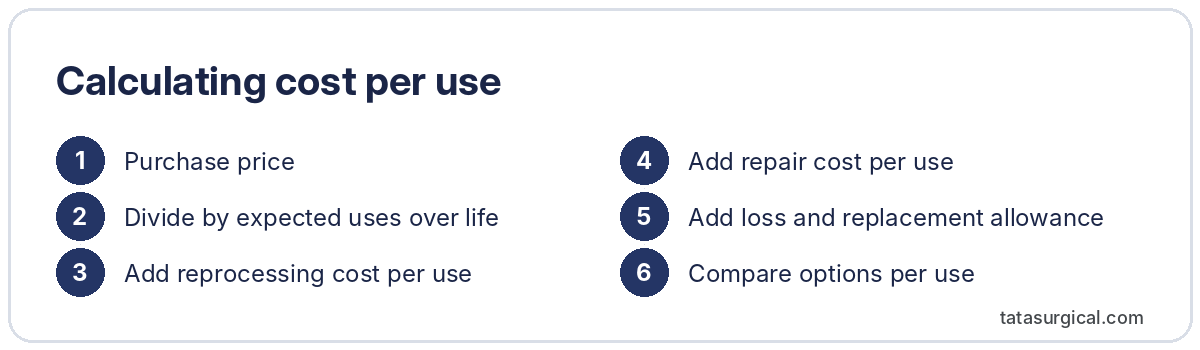
- Purchase price
- Divide by expected uses over life
- Add reprocessing cost per use
- Add repair cost per use
- Add loss and replacement allowance
- Compare options per use
Example
| Cheaper needle holder | Better TC needle holder | |
|---|---|---|
| Purchase | Lower | Higher |
| Expected life | Short | Long |
| Repairs | Replace often | Insert replacement |
| Cost per use | Often higher | Often lower |
Data to collect
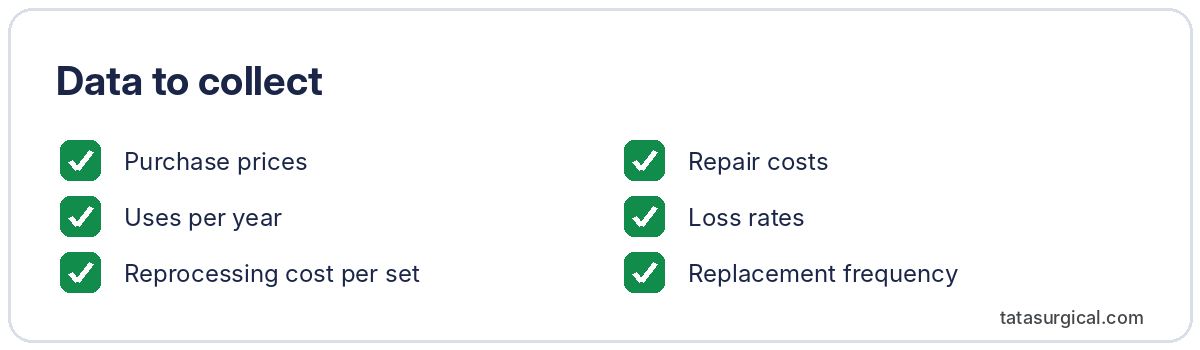
- Purchase prices
- Uses per year
- Reprocessing cost per set
- Repair costs
- Loss rates
- Replacement frequency
In detail: the hidden cost of failure
When an instrument fails during surgery, the cost includes delay, stress and sometimes extra sets opened. These costs are hard to measure but real.
Worked example
A hospital compares two suppliers of scissors over three years. The cheaper scissors need replacing twice as often; total cost per use is higher than the better scissors.
Proof box
Proof: Health economics and procurement guidance recommend whole-life costing instead of purchase price alone for durable medical equipment.
Frequently asked questions
How long does an instrument last? Many years with good care.
Is single-use cheaper? Sometimes, at low volumes.
What is the biggest hidden cost? Often reprocessing labour and failures.
How can I reduce costs? Lean sets, good care, timely repair.
Glossary
- TCO: total cost of ownership.
- Cost per use: total cost divided by uses.
- Whole-life costing: considering all costs over time.
Key takeaways
- Look beyond purchase price
- Track repairs and losses
- Quality often wins long term
Standards and sources
- Related: cost per procedure (see Cost per procedure: single-use kits vs reusable sets), repair guide (see Instrument repair and maintenance: the complete guide)
Value from Tata Surgical
Looking for instruments like these?
Browse our catalogue or send us your drawing. We reply with prices, lead time and shipping terms.