Short answer: Minor surgery covers small procedures under local anaesthetic, such as removing skin lesions, draining abscesses, nail surgery and wound repair. A clinic needs a minor surgery set (or single-use kits), good lighting, a clean procedure area, sterile technique and a way to sterilise or dispose of instruments.
Common minor procedures
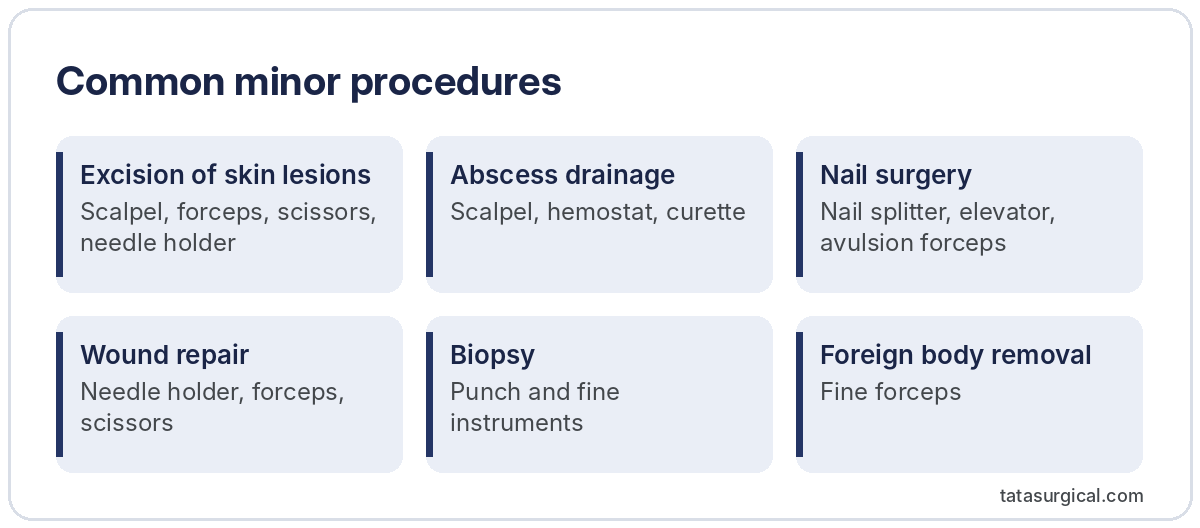
- Excision of skin lesions: Scalpel, forceps, scissors, needle holder
- Abscess drainage: Scalpel, hemostat, curette
- Nail surgery: Nail splitter, elevator, avulsion forceps
- Wound repair: Needle holder, forceps, scissors
- Biopsy: Punch and fine instruments
- Foreign body removal: Fine forceps
Setting up a minor surgery room
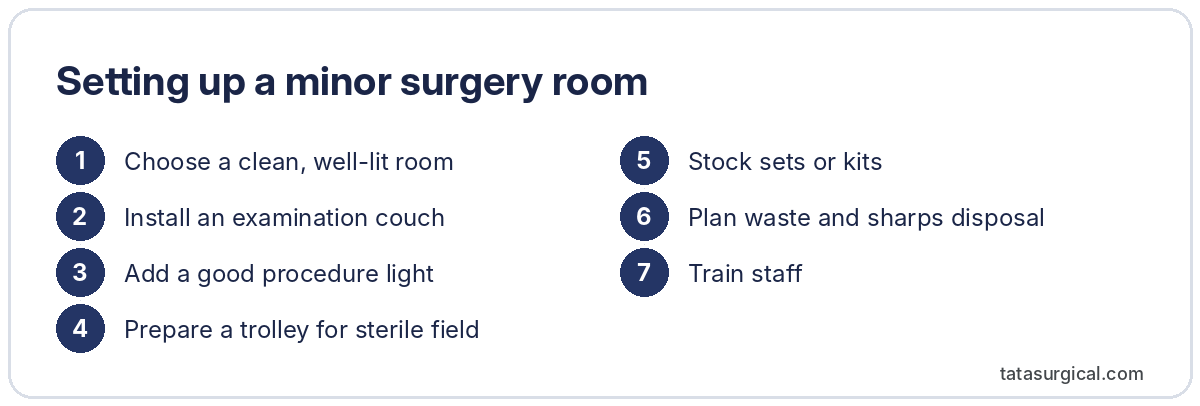
- Choose a clean, well-lit room
- Install an examination couch
- Add a good procedure light
- Prepare a trolley for sterile field
- Stock sets or kits
- Plan waste and sharps disposal
- Train staff
Minor surgery set
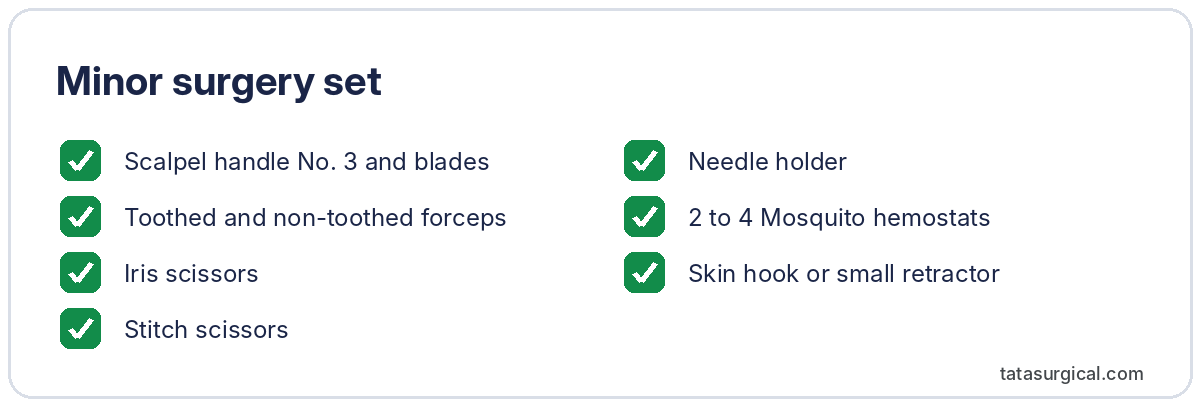
- Scalpel handle No. 3 and blades
- Toothed and non-toothed forceps
- Iris scissors
- Stitch scissors
- Needle holder
- 2 to 4 Mosquito hemostats
- Skin hook or small retractor
In detail: sterile technique basics
Hand hygiene, sterile gloves, a sterile field, skin preparation and careful handling of instruments reduce infection risk. Instruments touching the wound must be sterile.
Worked example
A clinic doing 10 minor procedures a week uses single-use kits to avoid buying an autoclave; a busier clinic doing 50 a week invests in reusable sets and a Class B steriliser.
Proof box
Proof: Infection prevention guidance requires sterile instruments for any procedure that enters tissue, consistent with the Spaulding classification.
Frequently asked questions
Do I need an autoclave? Only if you reuse instruments; otherwise use single-use kits.
What light do I need? A bright, focused procedure light.
How many sets? Enough for your procedure volume and reprocessing time.
Which suture instruments are best? A fine needle holder and toothed forceps suit most skin repairs.
Glossary
- Local anaesthetic: numbs a small area.
- Sterile field: area kept free of microorganisms.
- Excision: removal of tissue.
Key takeaways
- Choose kits or sets by volume
- Light and sterile technique matter
- Keep sets complete
Standards and sources
- Related: minor surgery kits (see Minor surgery kits for clinics), Spaulding (see Infection control and the Spaulding classification: a guide for instrument buyers)
Minor surgery sets from Tata Surgical
Looking for instruments like these?
Browse our catalogue or send us your drawing. We reply with prices, lead time and shipping terms.