



Short answer: Choose based on five factors: procedure volume, reprocessing capacity and cost, infection control needs, instrument performance and sustainability. A simple cost-per-procedure model, using your own numbers, usually makes the answer clear.
The decision in five questions
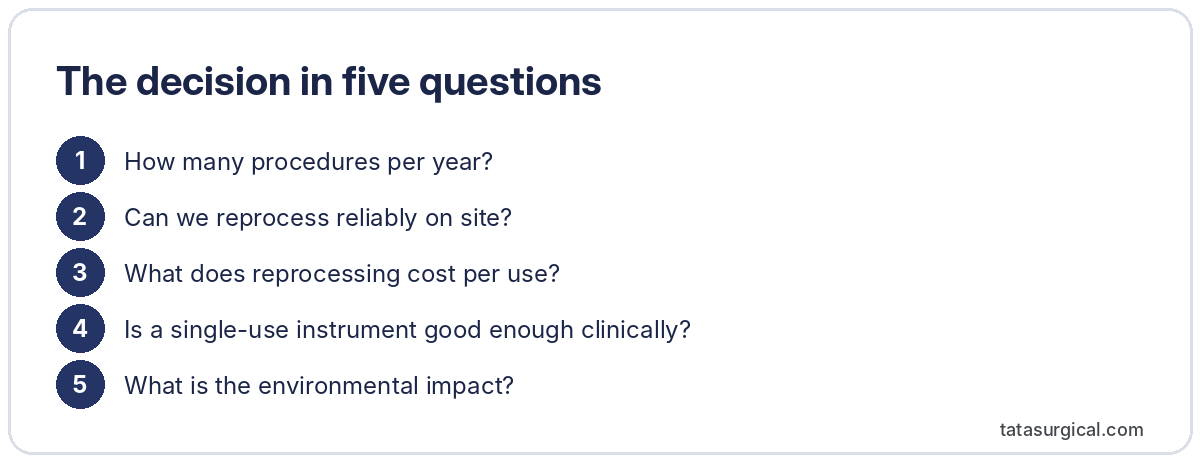
- How many procedures per year?
- Can we reprocess reliably on site?
- What does reprocessing cost per use?
- Is a single-use instrument good enough clinically?
- What is the environmental impact?
A simple cost model
| Item | Reusable set | Single-use kit |
|---|---|---|
| Purchase per use | Price ÷ uses over life | Kit price |
| Reprocessing per use | Labour + water + energy + packaging | None |
| Repairs and losses per use | Allowance | None |
| Waste per use | Small | Higher |
| Total per use | Sum | Sum |
Fill in your own figures. Volume is usually the biggest driver.
When each wins
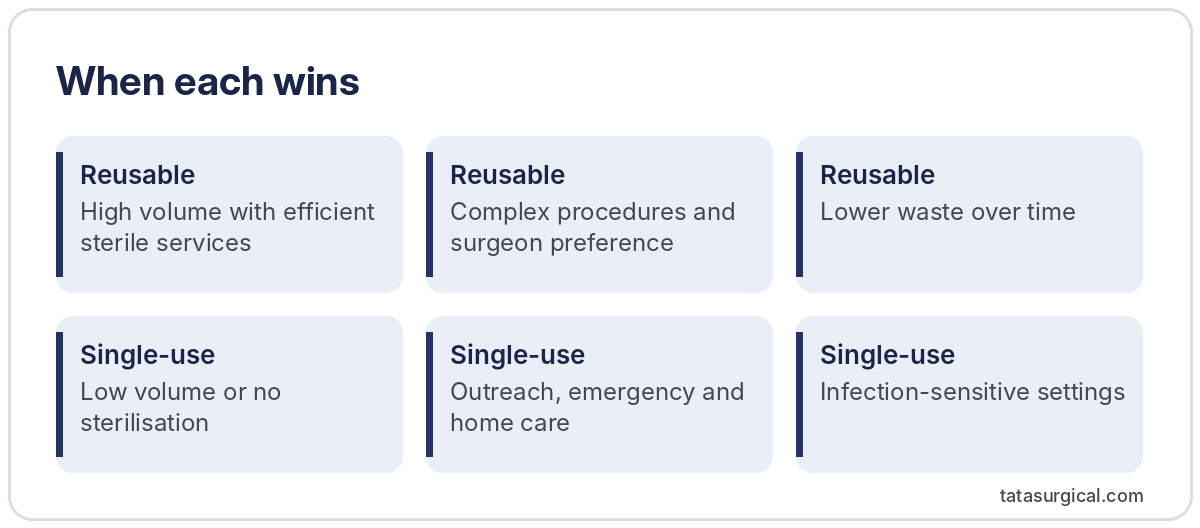
- Reusable: High volume with efficient sterile services
- Reusable: Complex procedures and surgeon preference
- Reusable: Lower waste over time
- Single-use: Low volume or no sterilisation
- Single-use: Outreach, emergency and home care
- Single-use: Infection-sensitive settings
Before switching
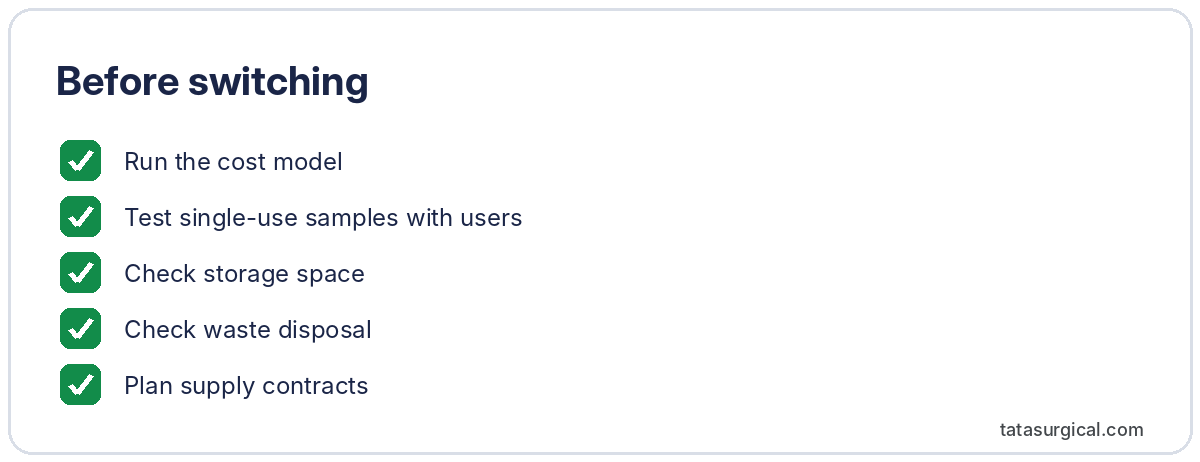
- Run the cost model
- Test single-use samples with users
- Check storage space
- Check waste disposal
- Plan supply contracts
In detail: mixed models
Many hospitals use both: reusable core sets plus single-use kits for extras. This keeps surgeons’ preferred instruments while saving time on simple items.
Worked example
A day-surgery unit calculates that single-use kits cost slightly more per case than reprocessing, but save theatre turnaround time; it adopts kits for its highest-volume procedure only.
Proof box
Proof: Market data show reusable instruments still held the majority share of instrument sales in 2025, while single-use instruments grow about 5 to 6% a year, reflecting mixed models.
Frequently asked questions
Is single-use always safer? It removes reprocessing risk, but reusable instruments are safe when reprocessed correctly.
Is reusable always greener? Usually less waste, but reprocessing uses water and energy.
Can we change later? Yes, review yearly.
Who should decide? A team including surgeons, nurses, sterile services and procurement.
Glossary
- Cost per use: total cost divided by uses.
- Mixed model: combining reusable and single-use.
- Turnaround: time between cases.
Key takeaways
- Use your own numbers
- Volume drives the answer
- Mixed models often work best
Standards and sources
- Related: reusable vs single-use (see Reusable or single-use instruments? What buyers are asking at MEDICA), cost per procedure (see Cost per procedure: single-use kits vs reusable sets), TCO (see Total cost of ownership of surgical instruments: the complete guide)
Both options from Tata Surgical
Looking for instruments like these?
Browse our catalogue or send us your drawing. We reply with prices, lead time and shipping terms.