Short answer: A sterile pack has two jobs: let the sterilising agent in, then keep microorganisms out until the pack is opened. The maker must test and document its materials, seals and shelf life. Users should check every pack for damage, moisture and expiry before opening it. In short, sterile packaging must protect the product all the way to the point of use.
This guide covers the materials, how makers prove that packaging works, how they set shelf life and what hospitals, clinics and distributors should check.
What sterile packaging must do
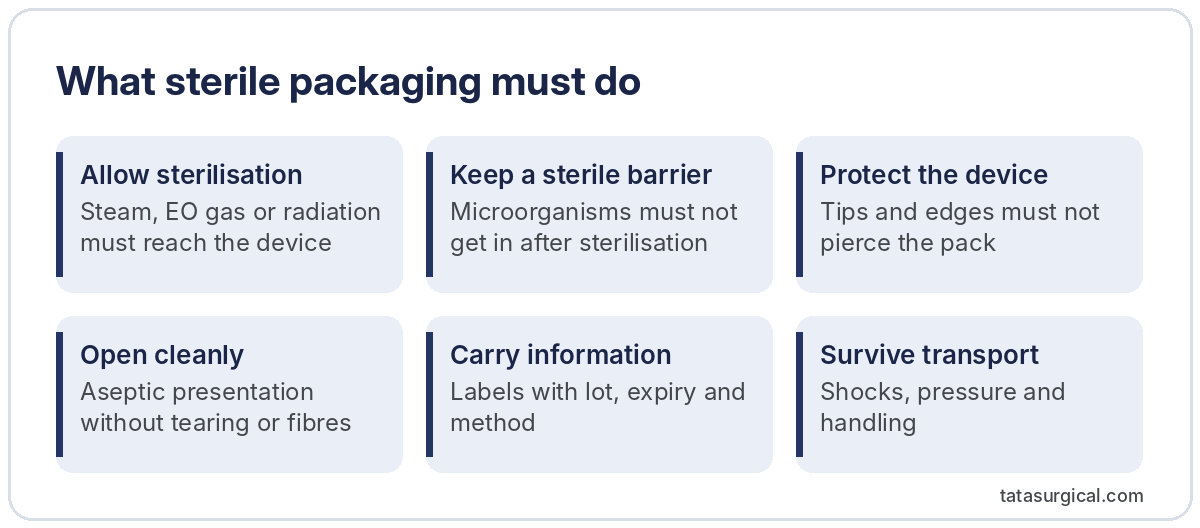
- Allow sterilisation: Steam, EO gas or radiation must reach the device
- Keep a sterile barrier: Microorganisms must not get in after sterilisation
- Protect the device: Tips and edges must not pierce the pack
- Open cleanly: Aseptic presentation without tearing or fibres
- Carry information: Labels with lot, expiry and method
- Survive transport: Shocks, pressure and handling
Types of packaging
| Packaging | Typical use | Notes |
|---|---|---|
| Paper/film peel pouch | Single instruments, small kits | Most common for single-use instruments |
| Tyvek/film pouch | EO-sterilised products | Strong, low-linting, good for gas sterilisation |
| Thermoformed tray + lid | Kits arranged in order of use | Protects contents, good presentation |
| Blister pack | Small single items | Retail and small kits |
| Sterilisation wrap | Hospital-reprocessed sets | Folded around trays, often double-wrapped |
| Rigid container | Hospital-reprocessed sets | Reusable, protects instruments well |
How packaging is proven
Manufacturers of terminally sterilised products typically validate their packaging against the international standard ISO 11607 (Packaging for terminally sterilized medical devices). Validation usually includes:
- Seal strength tests
- Seal integrity tests (for example, dye penetration or visual inspection)
- Transport simulation
- Ageing tests to support the shelf life
How shelf life is established
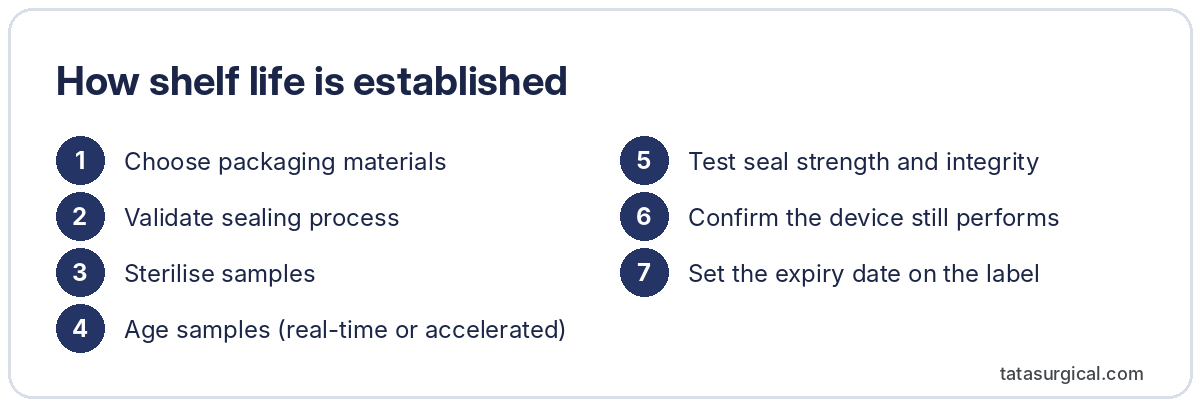
- Choose packaging materials
- Validate sealing process
- Sterilise samples
- Age samples (real-time or accelerated)
- Test seal strength and integrity
- Confirm the device still performs
- Set the expiry date on the label
Shelf life: what it means
The expiry date shows how long the maker has evidence that the package stays intact and the product performs. Many hospitals also use event-related shelf life for packs they reprocess themselves: a pack is considered sterile until something happens to it, such as damage, moisture or opening.
Note: A pack past its expiry date should not be used, even if it looks perfect. The evidence supporting sterility stops at that date.
Storage rules that protect sterility
- Clean, dry, dust-controlled storage
- Off the floor and away from sinks and outside walls
- No crushing: do not stack heavy trays on pouches
- First-expiry, first-out rotation
- Limit handling: every touch is a risk
Check every pack before opening
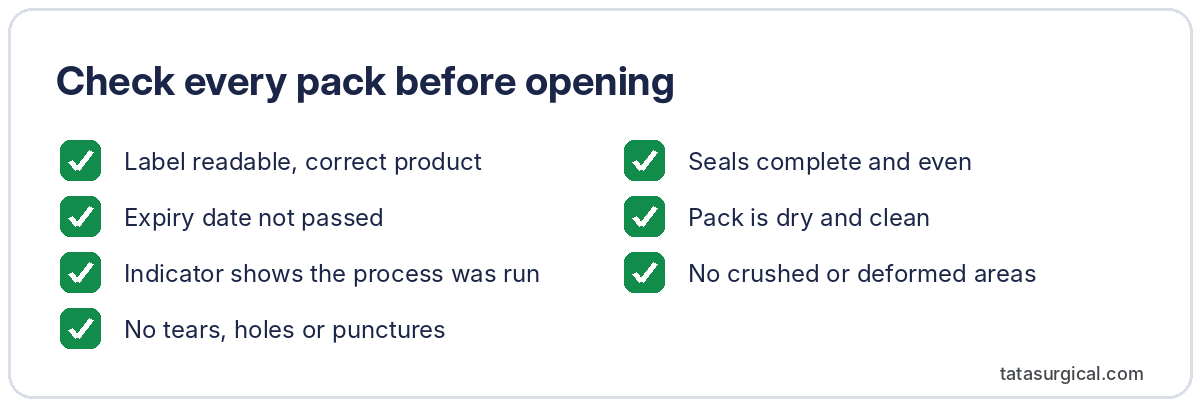
- Label readable, correct product
- Expiry date not passed
- Indicator shows the process was run
- No tears, holes or punctures
- Seals complete and even
- Pack is dry and clean
- No crushed or deformed areas
Worked example: a distributor’s storeroom
A distributor finds returned kits with crushed pouches. Investigation shows that staff stacked boxes six high in a hot container. Fixes: maximum stack height printed on cartons, temperature-controlled storage, and inspection of outer cartons at receipt. Returns drop to near zero.
Proof box
Proof: International standards define these requirements. ISO 11607-1 covers materials and packaging system design; ISO 11607-2 covers validation of forming, sealing and assembly processes. Manufacturers should be able to show records against them.
In detail: what users can do to protect sterility
Most sterility failures after manufacture happen during storage and handling, not in the factory. Staff drop packs, crush them, squeeze them into full shelves or store them near sinks where they get wet. Every handling step increases risk. Simple rules help: store packs in closed cupboards, use bins rather than rubber bands, keep pouches flat, and train staff to inspect each pack before opening.
When opening, staff should peel the pack back without touching the contents, present items to the sterile field and discard any pack that tears unevenly or shows fibres.
Frequently asked questions
Is a pack still sterile if the outer box is damaged but the pouch is intact? Inspect the pouch carefully; if it is intact, dry and in date, it is usually acceptable under your policy.
Can I re-sterilise an expired single-use kit? No. Makers do not design or validate single-use products for re-sterilisation.
Why do some packs say “do not use if package is damaged”? Because damage can break the sterile barrier.
What is event-related shelf life? A policy where a hospital-reprocessed pack stays sterile until an event, such as damage or moisture, compromises it.
Glossary
- Sterile barrier system: packaging that prevents microorganisms from entering.
- Aseptic presentation: opening a pack without contaminating its contents.
- Accelerated ageing: heat-based test to simulate time passing.
Key takeaways
- Packaging is part of the sterile product, not just a wrapper
- Shelf life must be supported by tests
- Storage and handling protect sterility
- Check every pack, every time
Standards and sources
- ISO 11607-1 and ISO 11607-2: Packaging for terminally sterilized medical devices (ISO search)
- ISO 11135 (ethylene oxide), ISO 11137 (radiation), ISO 17665 (moist heat) sterilisation standards (ISO search)
- CDC: Guideline for Disinfection and Sterilization in Healthcare Facilities
- Related articles: shelf life on kits (see Shelf life and expiry dates on sterile kits), packaging options (see Packaging options for sterile instruments: pouches, trays and blisters), sterilisation methods (see Sterilisation methods for single-use instruments: EO, gamma and steam)
Sterile packaging checks for buyers
When you review sterile packaging from a supplier, ask for three things. First, the validation report for the seals. Next, the shelf life study. Finally, the storage conditions on the label. As a result, you can compare suppliers on evidence rather than claims.
In addition, remember that shelf life only holds if staff follow the storage rules. For example, a hot, damp storeroom can shorten the safe life of a pack. Therefore, check your own storage before you blame the product. Also, train staff to inspect each pack before opening it. Similarly, ask distributors how they store and ship kits. Then, keep simple records of any damaged packs you find. Over time, these records show where problems start.
For background, see the overview of shelf life. To order sterile kits, request a quote.
Sterile kits from Tata Surgical
We pack sterile products in pouches and trays, assembled in our clean room. Ask about packaging options.
Looking for instruments like these?
Browse our catalogue or send us your drawing. We reply with prices, lead time and shipping terms.