Short answer: Ophthalmic instruments are fine micro-instruments for eye surgery and examination. The main groups are specula, forceps, scissors, needle holders, knives, hooks and spatulas, and lens instruments. They are made in stainless steel or titanium, have tiny tips and need careful handling and inspection under magnification.
Main groups
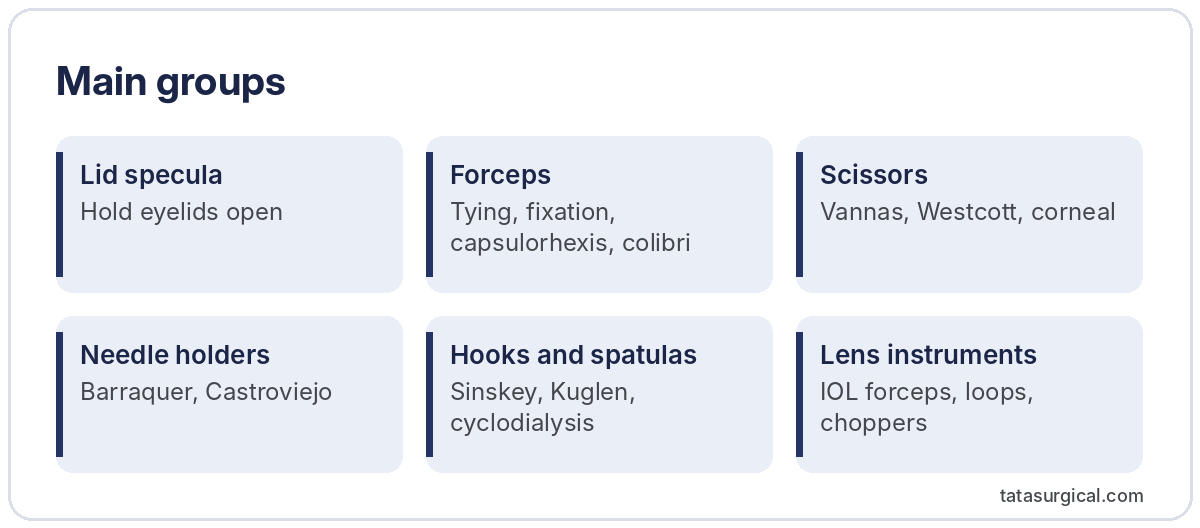
- Lid specula: Hold eyelids open
- Forceps: Tying, fixation, capsulorhexis, colibri
- Scissors: Vannas, Westcott, corneal
- Needle holders: Barraquer, Castroviejo
- Hooks and spatulas: Sinskey, Kuglen, cyclodialysis
- Lens instruments: IOL forceps, loops, choppers
Common procedures and instruments
| Procedure | Typical instruments |
|---|---|
| Cataract | Speculum, capsulorhexis forceps, chopper, Sinskey hook, IOL forceps |
| Corneal | Corneal scissors, trephines, fine forceps |
| Glaucoma | Fine scissors, punches, needle holders |
| Oculoplastic | Chalazion clamp and curette, lid instruments |
| Strabismus | Muscle hooks, calipers |
Caring for eye instruments
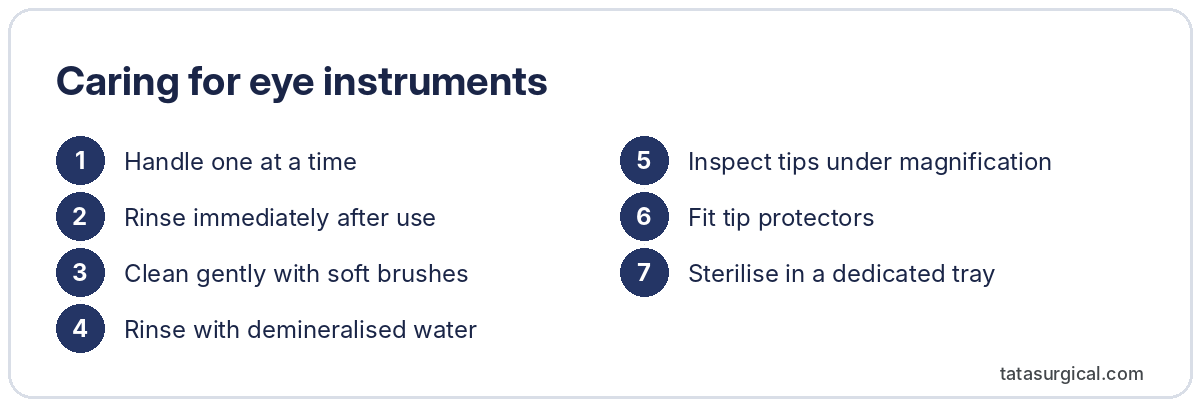
- Handle one at a time
- Rinse immediately after use
- Clean gently with soft brushes
- Rinse with demineralised water
- Inspect tips under magnification
- Fit tip protectors
- Sterilise in a dedicated tray
Inspection under magnification
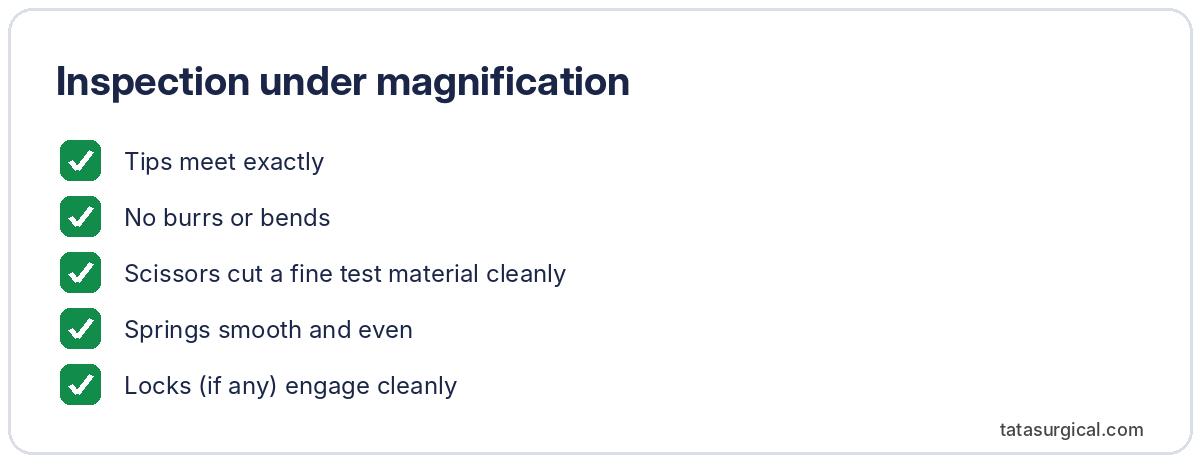
- Tips meet exactly
- No burrs or bends
- Scissors cut a fine test material cleanly
- Springs smooth and even
- Locks (if any) engage cleanly
Worked example
An eye unit loses many capsulorhexis forceps to bent tips. Introducing dedicated silicone-mat trays and one-at-a-time handling extends their life significantly.
Proof box
Proof: Ophthalmic instrument makers and reprocessing guides consistently recommend separate handling, tip protection and magnified inspection for micro-instruments.
In detail: building an eye unit inventory
Eye units plan instruments by procedure volume. A busy cataract list may need several identical sets so that one is always ready while others are reprocessed. Spare capsulorhexis forceps, choppers and hooks prevent cancellations when a tip is damaged. Single-use knives and cannulas are stocked separately.
Frequently asked questions
Why are eye instruments so expensive? Fine tips need precise machining and hand finishing.
Can eye instruments be ultrasonic cleaned? Only if the IFU allows; some require manual cleaning.
Steel or titanium? Both are used; titanium is lighter.
How do I protect tips? Use tip protectors and silicone mats.
Glossary
- Capsulorhexis: opening of the lens capsule.
- IOL: intraocular lens.
- Micro-instrument: very fine instrument used under a microscope.
Key takeaways
- Fine tips need special care
- Choose steel or titanium by preference
- Inspect under magnification every time
Standards and sources
- AKI: instrument care brochures
- Related: cataract instruments (see What instruments are used in cataract surgery?), titanium vs steel (see Titanium or stainless steel ophthalmic instruments?), eye instrument care (see How do you care for ophthalmic micro-instruments?)
Ophthalmic range from Tata Surgical
Request our ophthalmic catalogue.
Looking for instruments like these?
Browse our catalogue or send us your drawing. We reply with prices, lead time and shipping terms.