

Short answer: ENT instruments cover three areas: the ear (specula, forceps, hooks, curettes, suction), the nose (specula, forceps, rasps, elevators) and the throat (tongue depressors, mirrors, tonsil and adenoid instruments). Clinics need examination sets; theatres need procedure sets.
ENT instrument groups
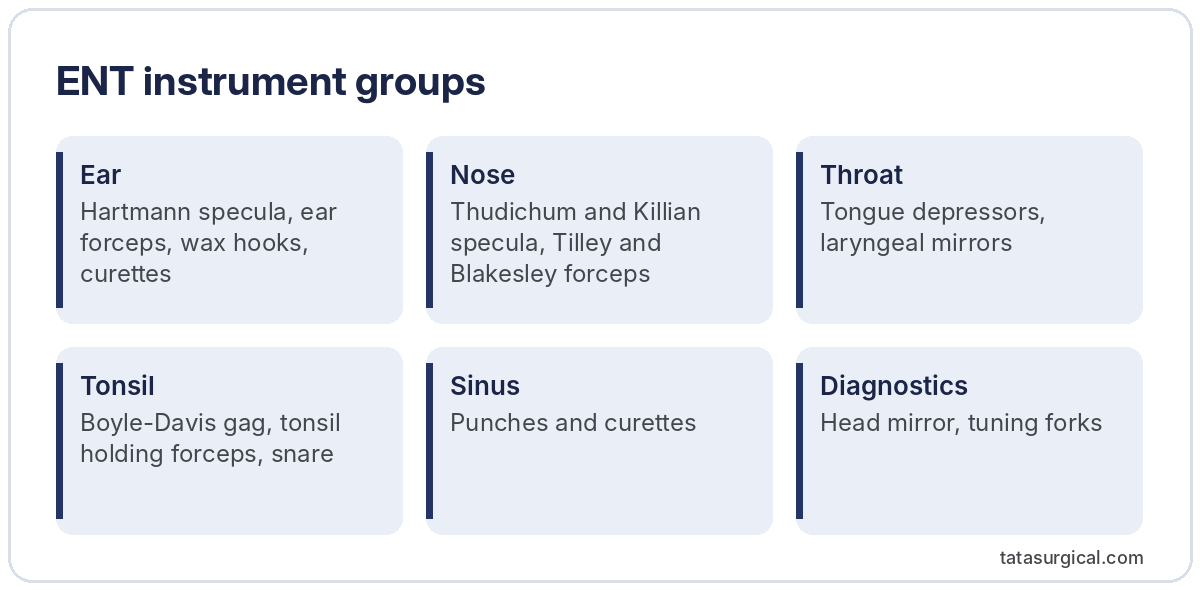
- Ear: Hartmann specula, ear forceps, wax hooks, curettes
- Nose: Thudichum and Killian specula, Tilley and Blakesley forceps
- Throat: Tongue depressors, laryngeal mirrors
- Tonsil: Boyle-Davis gag, tonsil holding forceps, snare
- Sinus: Punches and curettes
- Diagnostics: Head mirror, tuning forks
Building an ENT clinic set
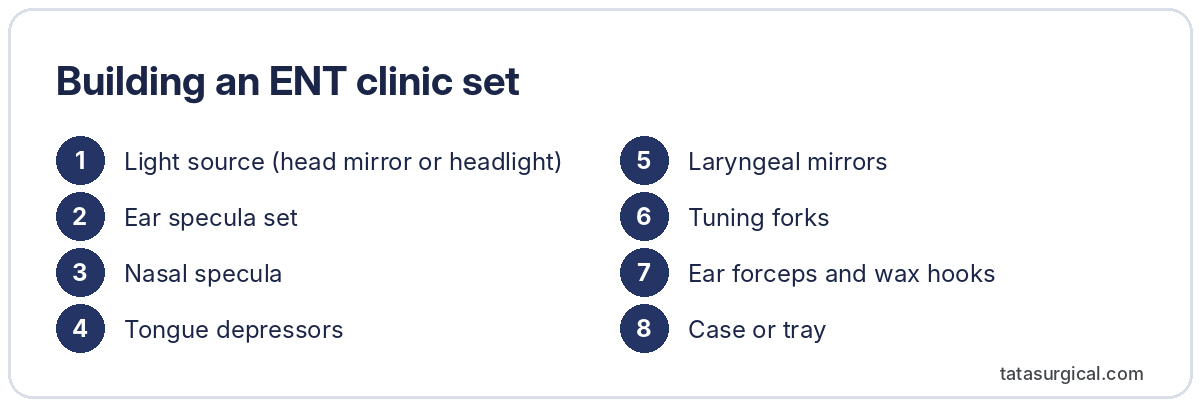
- Light source (head mirror or headlight)
- Ear specula set
- Nasal specula
- Tongue depressors
- Laryngeal mirrors
- Tuning forks
- Ear forceps and wax hooks
- Case or tray
| Theatre set | Key instruments |
|---|---|
| Tonsillectomy | Mouth gag, tonsil holding forceps, dissector, snare |
| Septoplasty | Killian speculum, elevators, chisels, scissors |
| Ear surgery | Micro instruments, specula, suction tubes |
Care checklist
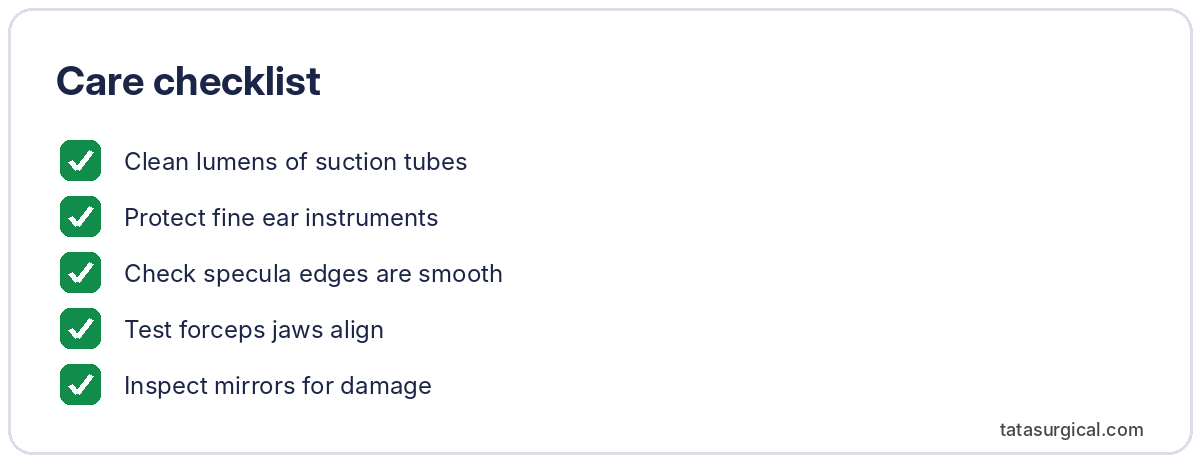
- Clean lumens of suction tubes
- Protect fine ear instruments
- Check specula edges are smooth
- Test forceps jaws align
- Inspect mirrors for damage
Worked example
A general practice adds an ENT examination set and an ear procedure set, allowing on-site wax and foreign-body removal instead of referrals.
Proof box
Proof: Standard ENT examination technique (otoscopy, anterior rhinoscopy, oropharyngeal examination, tuning fork tests) uses the instruments listed here.
In detail: ENT in primary care
Many ear, nose and throat problems can be handled in general practice with the right instruments: wax removal, foreign body removal, nosebleed management and basic examination. A compact ENT set with specula, forceps, hooks, suction and a good light source reduces referrals and helps patients faster.
Frequently asked questions
Head mirror or headlight? Headlights are easier to learn; head mirrors are traditional and inexpensive.
Which ear speculum sizes do I need? A set of three or four sizes covers most patients.
What is a Tilley forceps? An angled nasal dressing forceps.
What tuning fork frequency is used? Often 512 Hz for hearing tests.
Glossary
- Otoscopy: examination of the ear.
- Rhinoscopy: examination of the nose.
- Laryngeal mirror: small angled mirror to view the larynx.
Key takeaways
- Separate clinic and theatre sets
- Fine ear instruments need protection
- Clean suction lumens carefully
Standards and sources
- Related: Hartmann speculum (see What is a Hartmann aural speculum? Design and uses), ENT examination (see What instruments are used in an ENT examination?), nasal specula (see What is a nasal speculum, and what types are there?)
ENT range from Tata Surgical
Looking for instruments like these?
Browse our catalogue or send us your drawing. We reply with prices, lead time and shipping terms.