Short answer: The Spaulding classification sorts medical devices by infection risk: critical items (enter sterile tissue) must be sterile; semi-critical items (touch mucous membranes) need high-level disinfection at least; non-critical items (touch intact skin) need low-level disinfection. Almost all surgical instruments are critical items.
The three Spaulding categories
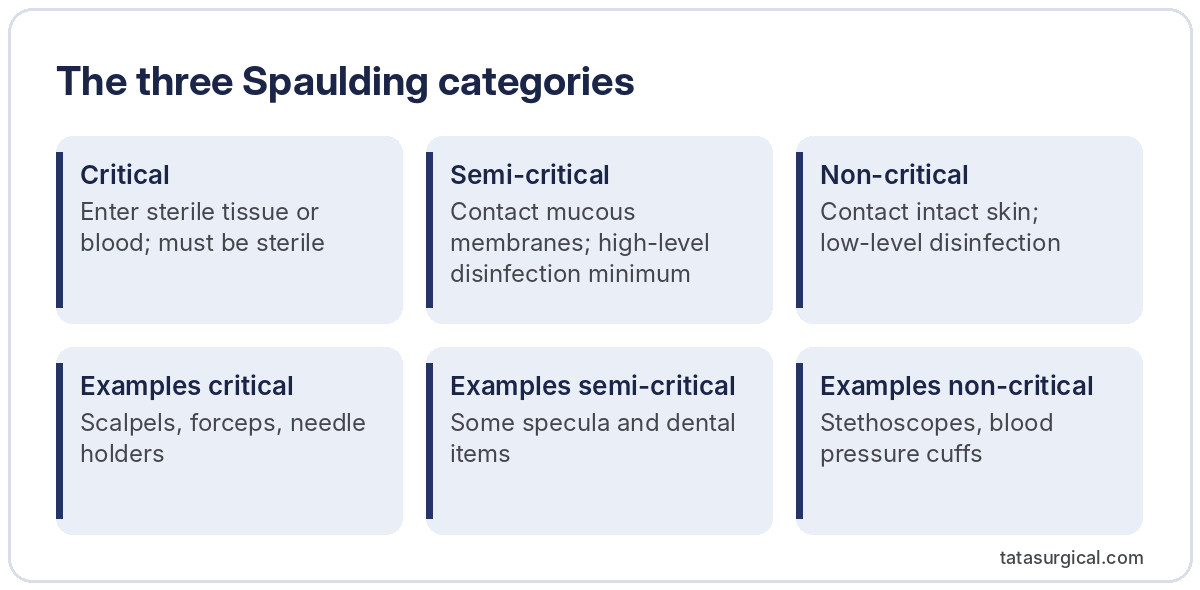
- Critical: Enter sterile tissue or blood; must be sterile
- Semi-critical: Contact mucous membranes; high-level disinfection minimum
- Non-critical: Contact intact skin; low-level disinfection
- Examples critical: Scalpels, forceps, needle holders
- Examples semi-critical: Some specula and dental items
- Examples non-critical: Stethoscopes, blood pressure cuffs
Using Spaulding when buying
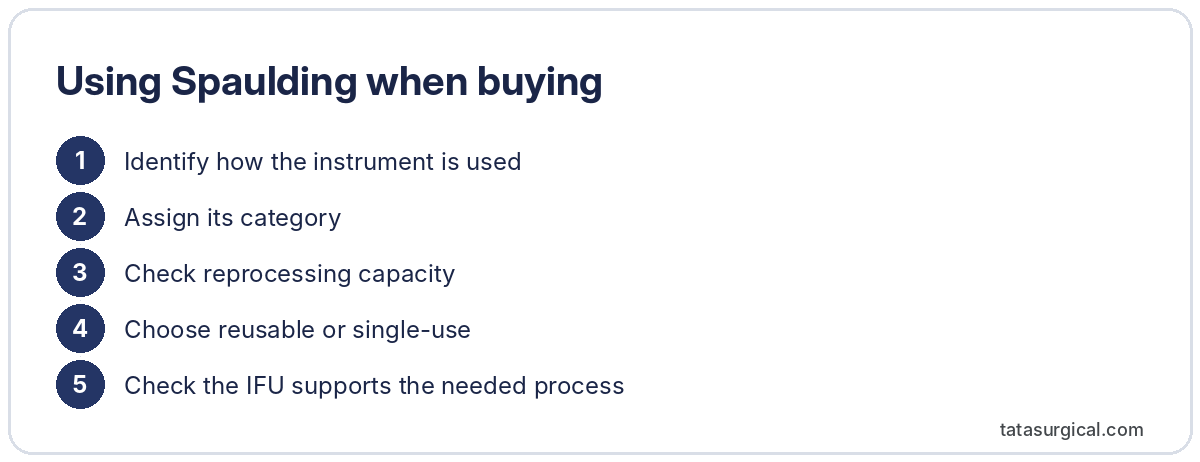
- Identify how the instrument is used
- Assign its category
- Check reprocessing capacity
- Choose reusable or single-use
- Check the IFU supports the needed process
Buyer questions
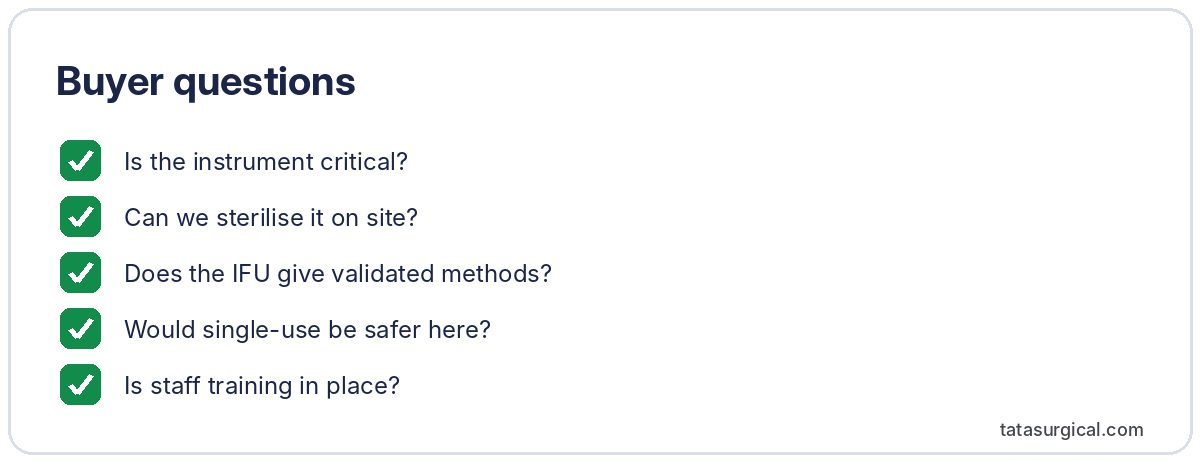
- Is the instrument critical?
- Can we sterilise it on site?
- Does the IFU give validated methods?
- Would single-use be safer here?
- Is staff training in place?
In detail: dental and ENT examples
Many dental instruments that penetrate tissue are critical; mouth mirrors are semi-critical. Most guidance recommends heat sterilisation for heat-tolerant semi-critical items as well, which is why most dental and ENT steel instruments are autoclaved.
Worked example
A clinic planning to disinfect vaginal specula between patients reviews guidance and switches to sterilising metal specula or using single-use specula.
Proof box
Proof: The Spaulding classification is described in the CDC Guideline for Disinfection and Sterilization in Healthcare Facilities and is used worldwide.
Frequently asked questions
Are all surgical instruments critical? Most are, because they enter sterile tissue.
Can I disinfect instead of sterilise? Not for critical items.
Are specula semi-critical? Many are, but heat sterilisation is often recommended where possible.
Who decides the category? Your infection control team, guided by national rules.
Glossary
- High-level disinfection: kills most microorganisms except many spores.
- Sterilisation: kills all microorganisms including spores.
- Mucous membrane: lining of body cavities.
Key takeaways
- Most instruments are critical
- Sterilisation is required for critical items
- Check IFUs and reprocessing capacity
Standards and sources
- CDC: Disinfection and sterilization guideline
- Related: sterilising instruments (see How do you sterilise surgical instruments?)
Instruments from Tata Surgical
Ask about reusable and single-use options.
Looking for instruments like these?
Browse our catalogue or send us your drawing. We reply with prices, lead time and shipping terms.