


Short answer: Safe handling protects staff, patients and instruments. Use a neutral zone for sharps, pass instruments with the handle towards the surgeon, count before and after, keep instruments clean during the case and place them gently in trays.
Safety practices
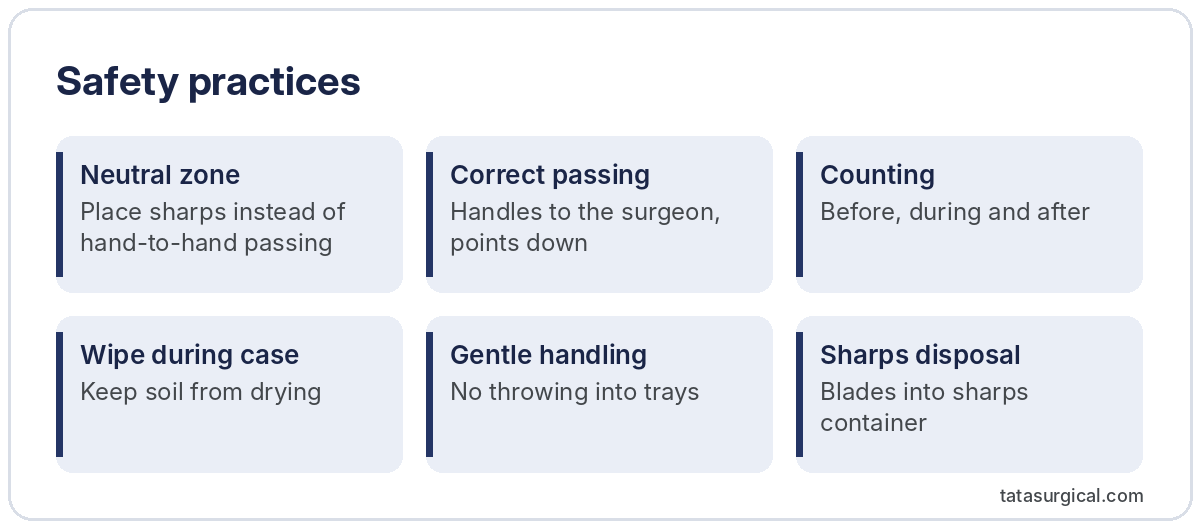
- Neutral zone: Place sharps instead of hand-to-hand passing
- Correct passing: Handles to the surgeon, points down
- Counting: Before, during and after
- Wipe during case: Keep soil from drying
- Gentle handling: No throwing into trays
- Sharps disposal: Blades into sharps container
End-of-case routine
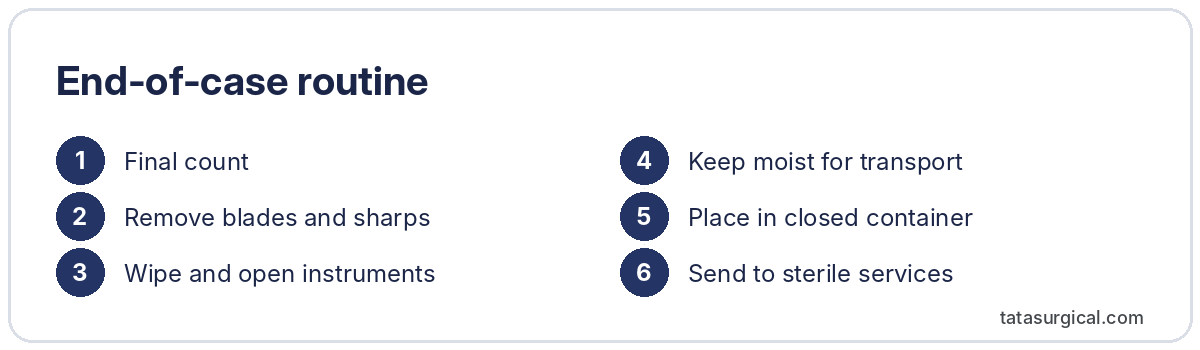
- Final count
- Remove blades and sharps
- Wipe and open instruments
- Keep moist for transport
- Place in closed container
- Send to sterile services
Protecting instruments
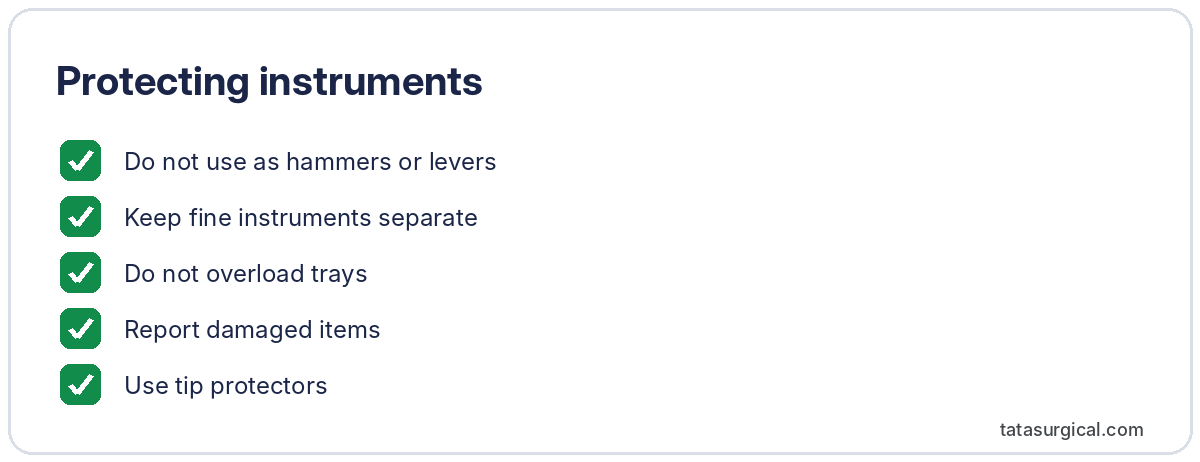
- Do not use as hammers or levers
- Keep fine instruments separate
- Do not overload trays
- Report damaged items
- Use tip protectors
In detail: why point-of-use care matters
Instruments cleaned within minutes are much easier to reprocess than those left for hours. Point-of-use care reduces stains, damage and cleaning failures.
Worked example
A theatre introduces a neutral zone tray and point-of-use wiping. Sharps injuries fall and sterile services report cleaner instruments.
Proof box
Proof: Perioperative nursing guidance recommends neutral zones for passing sharps and point-of-use treatment of instruments.
Frequently asked questions
What is a neutral zone? A defined area where sharps are placed and picked up.
Should instruments be soaked in saline? No; keep moist with water or products made for this.
Who counts instruments? Scrub and circulating nurses.
Why open instruments after use? To expose joints for cleaning.
Glossary
- Scrub nurse: nurse handling instruments in the sterile field.
- Point-of-use: at the place of use.
- Sharps: blades, needles and pointed items.
Key takeaways
- Neutral zone for sharps
- Wipe and keep moist
- Handle gently
Standards and sources
- AORN (Association of periOperative Registered Nurses)
- Related: instrument counts (see Why are surgical instruments counted before and after surgery?), cleaning guide (see The complete guide to cleaning and sterilising surgical instruments)
Instruments built for daily use
Looking for instruments like these?
Browse our catalogue or send us your drawing. We reply with prices, lead time and shipping terms.