

Short answer: Plan what you will test, test every sample the same way, include real users, run the samples through your own reprocessing several times, score the results and compare with your current instruments. Only then decide.
Sample evaluation process
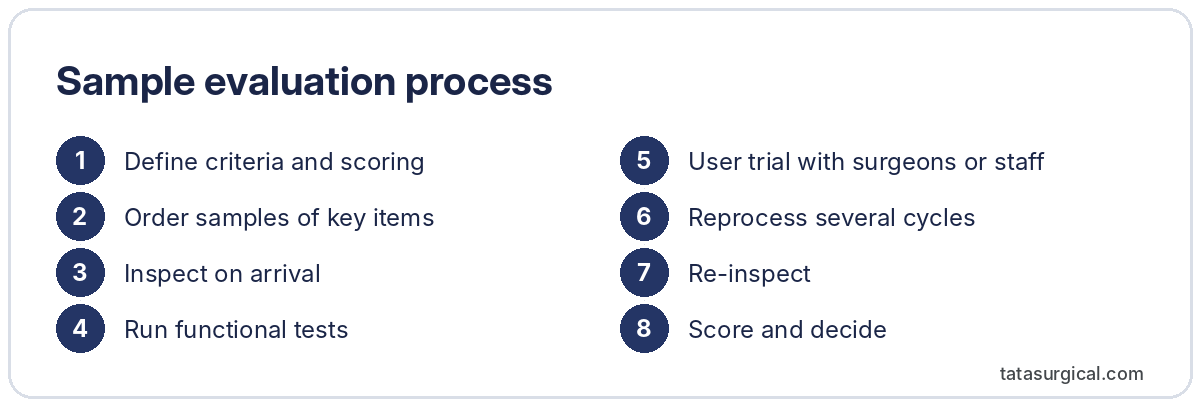
- Define criteria and scoring
- Order samples of key items
- Inspect on arrival
- Run functional tests
- User trial with surgeons or staff
- Reprocess several cycles
- Re-inspect
- Score and decide
Tests by instrument
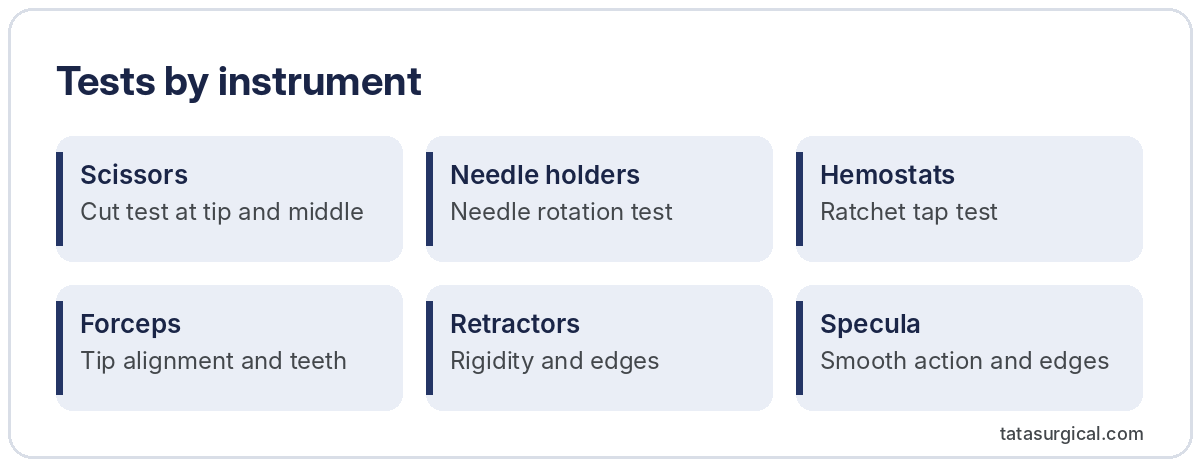
- Scissors: Cut test at tip and middle
- Needle holders: Needle rotation test
- Hemostats: Ratchet tap test
- Forceps: Tip alignment and teeth
- Retractors: Rigidity and edges
- Specula: Smooth action and edges
Example scoring sheet
| Criterion | Weight | Score 1 to 5 |
|---|---|---|
| Function | 30% | |
| Finish and build | 20% | |
| User feedback | 20% | |
| After reprocessing | 20% | |
| Documentation | 10% |
Reprocessing test
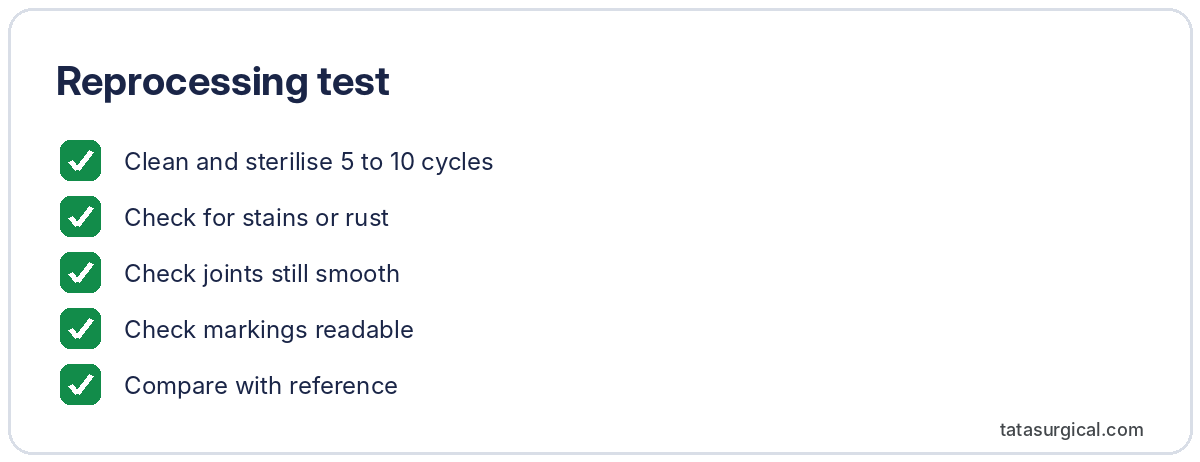
- Clean and sterilise 5 to 10 cycles
- Check for stains or rust
- Check joints still smooth
- Check markings readable
- Compare with reference
In detail: why reprocessing tests matter
Some instruments look perfect on arrival but stain or stiffen after a few cycles. Running samples through your own process reveals problems early.
Worked example
A hospital tests needle holders from three makers. All pass initial tests, but one shows staining after five cycles. The hospital chooses between the other two.
Proof box
Proof: ISO 13402 provides test methods for hand instruments’ resistance to autoclaving and corrosion, which hospitals can mirror in simple in-house checks.
Frequently asked questions
How many samples? At least two of each key item.
Who should test? Users plus sterile services.
Should samples be free? Many makers charge and credit later.
How long should evaluation take? Often a few weeks.
Glossary
- Reference instrument: current instrument used for comparison.
- Scoring sheet: weighted evaluation form.
- Reprocessing cycle: one clean-and-sterilise round.
Key takeaways
- Test the same way every time
- Include users and reprocessing
- Score before deciding
Standards and sources
- ISO 13402 (ISO search)
- Related: quality inspection (see Quality inspection of surgical instruments: the complete guide), supplier guide (see How to choose a surgical instrument supplier: the complete guide)
Samples from Tata Surgical
Looking for instruments like these?
Browse our catalogue or send us your drawing. We reply with prices, lead time and shipping terms.