


Short answer: Inspect instruments at three points: at the factory before shipping, on arrival at your warehouse, and before every use. Use a written standard, golden samples and a sampling plan such as AQL, and test function as well as appearance.
Three levels of inspection
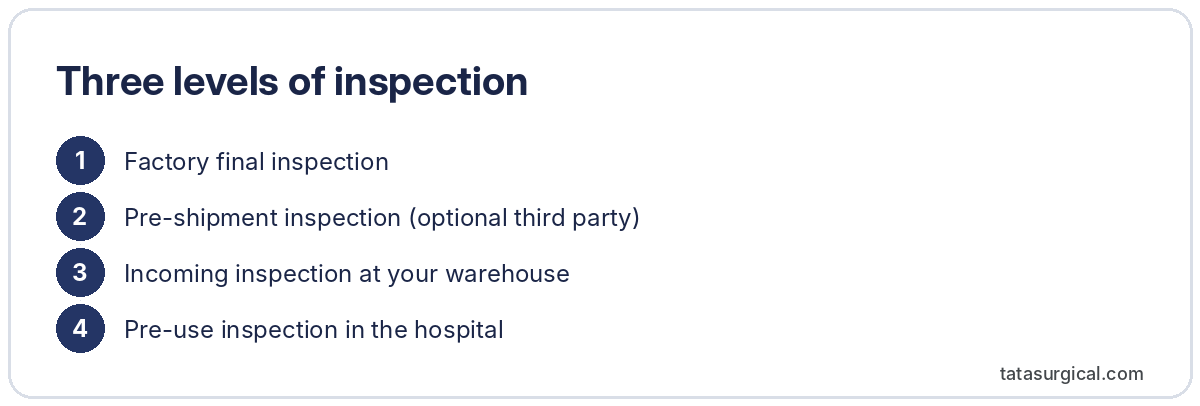
- Factory final inspection
- Pre-shipment inspection (optional third party)
- Incoming inspection at your warehouse
- Pre-use inspection in the hospital
What to check
| Area | Checks |
|---|---|
| Visual | Finish, cracks, burrs, pits, marking |
| Dimensions | Length, tip shape, curve |
| Function | Jaw alignment, ratchet, cutting test, spring tension |
| Packaging | Labels, seals, quantities |
| Documents | Invoice, packing list, certificates, lot numbers |
Functional tests by instrument
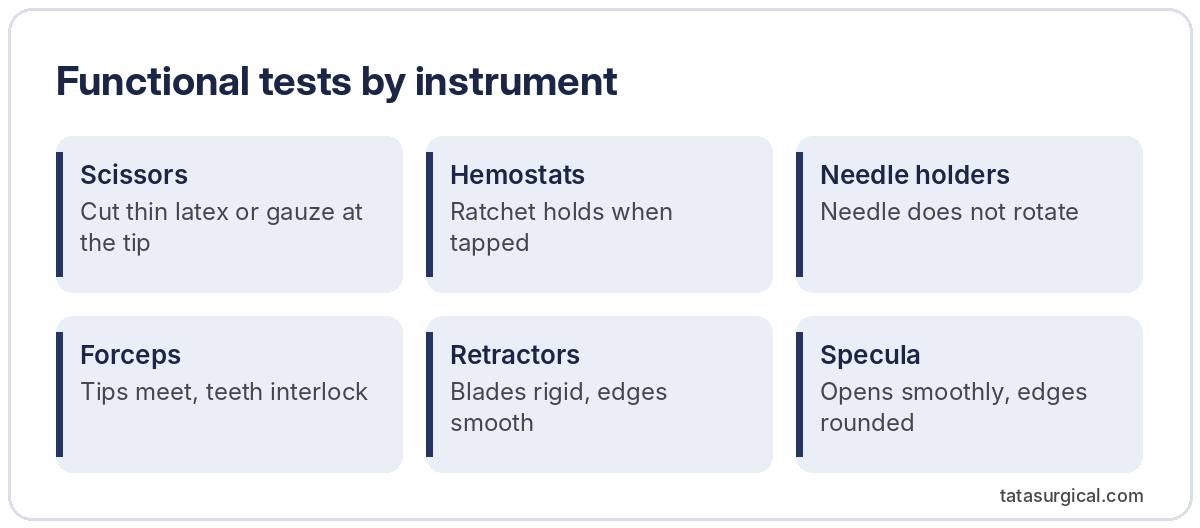
- Scissors: Cut thin latex or gauze at the tip
- Hemostats: Ratchet holds when tapped
- Needle holders: Needle does not rotate
- Forceps: Tips meet, teeth interlock
- Retractors: Blades rigid, edges smooth
- Specula: Opens smoothly, edges rounded
AQL sampling
AQL (Acceptable Quality Limit) sampling, based on ISO 2859-1, tells you how many pieces to check from a lot and how many defects you can accept. Buyers often set strict limits for critical and major defects.
| Defect type | Example | Typical approach |
|---|---|---|
| Critical | Crack at box lock | Zero tolerance |
| Major | Ratchet slips | Strict AQL |
| Minor | Small cosmetic mark | Looser AQL |
Incoming inspection routine
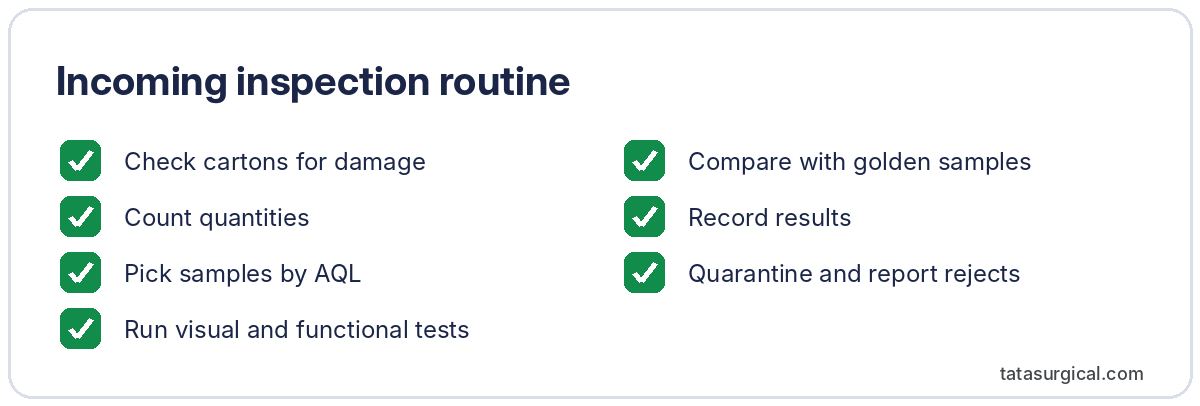
- Check cartons for damage
- Count quantities
- Pick samples by AQL
- Run visual and functional tests
- Compare with golden samples
- Record results
- Quarantine and report rejects
Worked example
A distributor receives 1,000 Kelly forceps. Using its sampling plan it checks 80 pieces and finds 3 with weak ratchets, above its limit for major defects. It quarantines the lot and the maker replaces it.
Proof box
Proof: ISO 2859-1 defines sampling procedures for inspection by attributes, widely used for AQL plans. ISO 13402 describes tests for surgical hand instruments’ resistance to autoclaving and corrosion.
In detail: making inspection practical
Inspection only works if it is quick and consistent. Use simple tools: a magnifier, good light, test materials for scissors, a set of needles for needle holders and golden samples on the bench. Train inspectors with photos of acceptable and unacceptable defects. Record results so you can spot trends by supplier and product.
Frequently asked questions
How many pieces should I check? Use an AQL table based on lot size and your chosen inspection level.
Who should inspect? Trained staff, the supplier, or a third-party inspection company.
What is a critical defect? A defect that could harm a patient or user, such as a crack.
What do I do with a failed lot? Quarantine it, inform the supplier and agree replacement or rework.
Glossary
- AQL: acceptable quality limit.
- Lot: group of products made under the same conditions.
- Quarantine: separating products until a decision is made.
Key takeaways
- Inspect at every stage
- Use golden samples and AQL
- Test function, not just looks
Standards and sources
- ISO 2859-1 sampling by attributes (ISO search)
- ISO 13402 hand instruments (ISO search)
- Related: quality checks for importers (see Quality checks for Mexican importers: samples, inspection and AQL), supplier audit (see Supplier audit checklist for surgical instrument factories)
Quality at Tata Surgical
Every instrument is inspected before packing. Ask about our quality process.
Looking for instruments like these?
Browse our catalogue or send us your drawing. We reply with prices, lead time and shipping terms.