

Short answer: Ring-handled tissue forceps hold and manipulate tissue during surgery. They differ in how much they grip and how much they damage tissue: Kocher and Allis grip firmly (more traumatic), Babcock and Duval are gentler (less traumatic). Surgeons choose based on whether the tissue will be kept or removed.
Main patterns
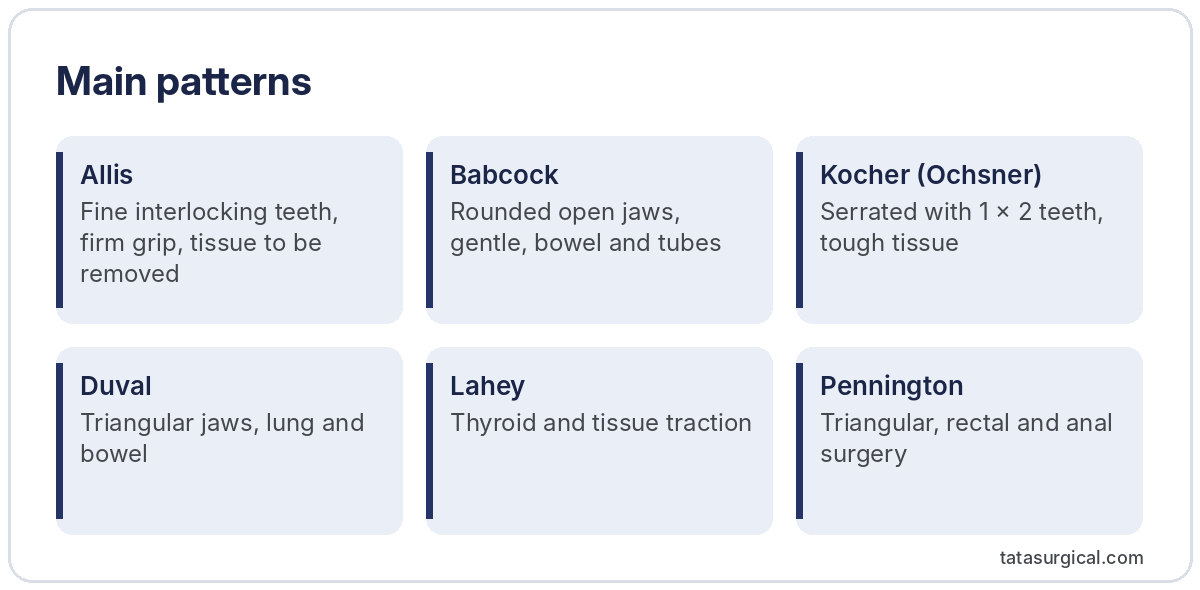
- Allis: Fine interlocking teeth, firm grip, tissue to be removed
- Babcock: Rounded open jaws, gentle, bowel and tubes
- Kocher (Ochsner): Serrated with 1 x 2 teeth, tough tissue
- Duval: Triangular jaws, lung and bowel
- Lahey: Thyroid and tissue traction
- Pennington: Triangular, rectal and anal surgery
Trauma scale
| Forceps | Grip | Tissue trauma |
|---|---|---|
| Kocher | Very firm | High |
| Allis | Firm | Moderate to high |
| Lahey | Firm | Moderate |
| Duval | Moderate | Low |
| Babcock | Gentle | Low |
Choosing tissue forceps
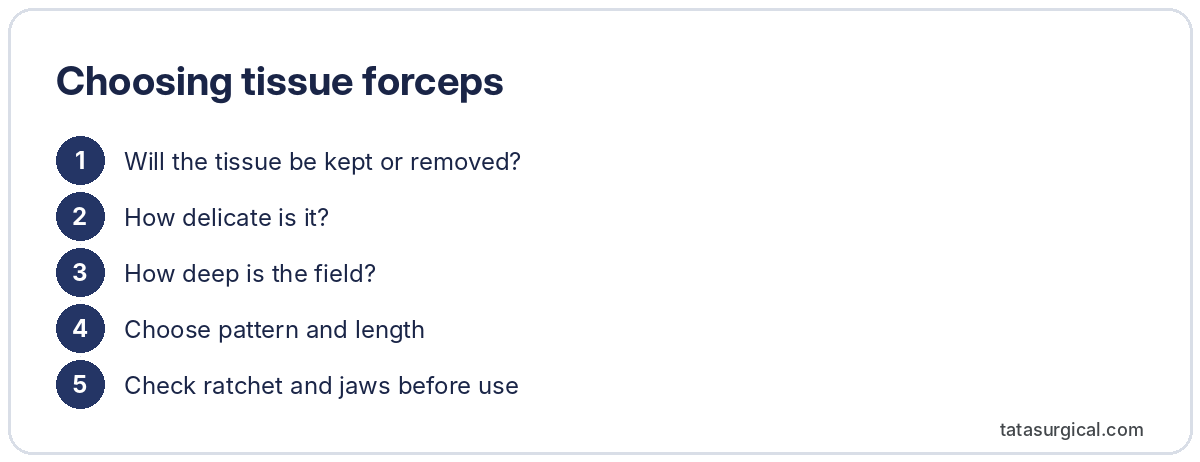
- Will the tissue be kept or removed?
- How delicate is it?
- How deep is the field?
- Choose pattern and length
- Check ratchet and jaws before use
Quality checks
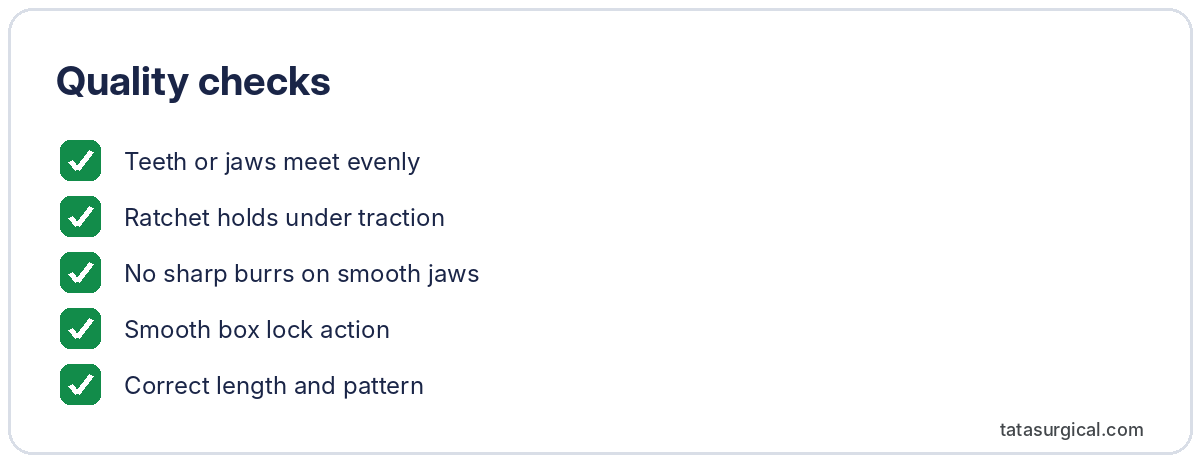
- Teeth or jaws meet evenly
- Ratchet holds under traction
- No sharp burrs on smooth jaws
- Smooth box lock action
- Correct length and pattern
Worked example
In a bowel procedure, a surgeon uses Babcock forceps to hold bowel that will be kept and Allis forceps on tissue that will be removed, reducing injury to healthy tissue.
Proof box
Proof: Surgical texts classify Babcock and Duval forceps as atraumatic or less traumatic grasping instruments compared with Allis and Kocher.
In detail: grip versus tissue damage
Every grasping instrument balances grip and trauma. Teeth and strong serrations give a secure hold but leave marks; rounded or fenestrated jaws spread pressure and protect tissue but can slip on heavy tissue. Surgeons therefore keep both types in sets and choose case by case. Length also matters: deeper fields need longer instruments with the same jaw design.
Frequently asked questions
Is Allis or Babcock better for bowel? Babcock is usually preferred for bowel that will be kept.
What is Kocher used for? Grasping tough tissue such as fascia, or tissue to be removed.
What sizes are common? About 15 to 24 cm, depending on pattern.
Can these be single-use? Some patterns are available single-use for kits.
Glossary
- Fenestrated: having an opening in the jaw.
- Traumatic: likely to damage tissue.
- Traction: pulling tissue to expose an area.
Key takeaways
- Match grip to tissue
- Gentle forceps for tissue that stays
- Check ratchets under load
Standards and sources
- Related: Allis (see Allis tissue forceps: uses and buying guide), Babcock (see Babcock forceps: uses and buying guide), Kocher (see Kocher forceps: uses and buying guide)
Tissue forceps from Tata Surgical
Looking for instruments like these?
Browse our catalogue or send us your drawing. We reply with prices, lead time and shipping terms.