


Short answer: Instruments are marked with laser etching and increasingly with Data Matrix codes so each item can be identified and tracked through use, cleaning and sterilisation. Regulators in the EU and USA require Unique Device Identification (UDI) on labels and, for many reusable devices, directly on the device. Clear instrument marking is therefore the first step towards full traceability.
What can be marked
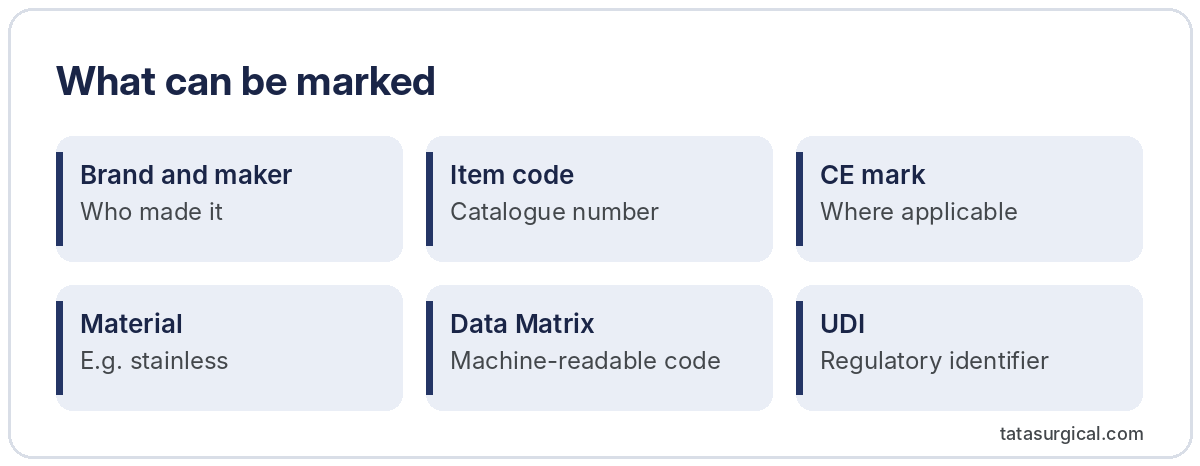
- Brand and maker: Who made it
- Item code: Catalogue number
- CE mark: Where applicable
- Material: E.g. stainless
- Data Matrix: Machine-readable code
- UDI: Regulatory identifier
Why traceability matters
- Rebuild sets correctly after reprocessing
- Know which patient a set was used on
- Find instruments fast in a recall
- Track usage and plan replacement
How hospital tracking works
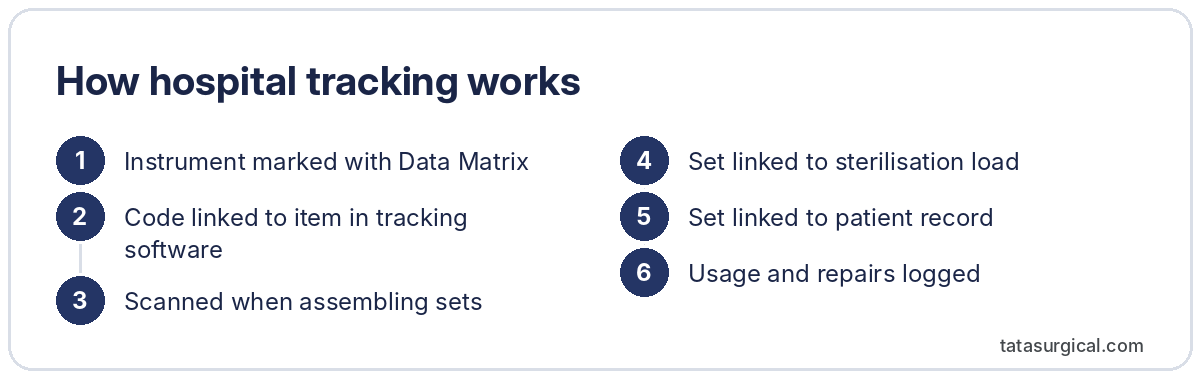
- Instrument marked with Data Matrix
- Code linked to item in tracking software
- Scanned when assembling sets
- Set linked to sterilisation load
- Set linked to patient record
- Usage and repairs logged
UDI in brief
| Part | What it identifies |
|---|---|
| UDI-DI (device identifier) | The model or version |
| UDI-PI (production identifier) | Lot, batch or serial number, and dates |
UDI is issued through accredited agencies such as GS1, HIBCC or ICCBBA.
Marking checklist for buyers
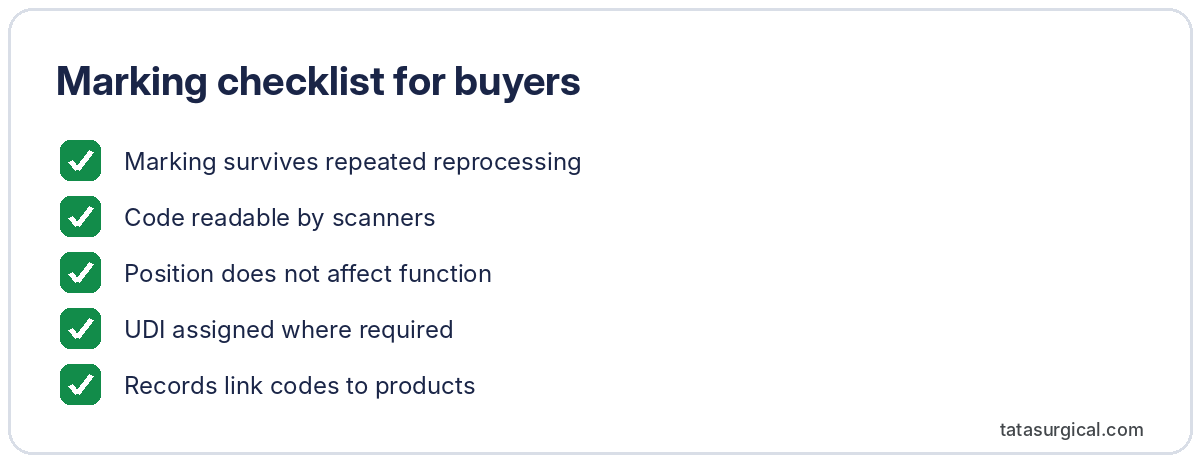
- Marking survives repeated reprocessing
- Code readable by scanners
- Position does not affect function
- UDI assigned where required
- Records link codes to products
Worked example
A hospital adds Data Matrix codes to its 4,000 most used instruments. Missing instruments are found faster, and sets are rebuilt correctly more often.
Proof box
Proof: EU MDR Article 27 and Annex VI set the EU UDI system; in the USA, 21 CFR Part 801 Subpart B and Part 830 cover UDI. Direct marking applies to certain reusable devices.
In detail: starting a tracking programme
Hospitals often start tracking at set level, scanning trays rather than single instruments. Item-level tracking with Data Matrix codes adds detail but needs marking, scanners and software. Start with the most expensive or most often lost instruments, then expand.
Frequently asked questions
Can existing instruments be marked? Yes, many can be laser marked later.
Does marking weaken the instrument? Correct laser marking does not affect function.
Who issues UDI codes? Accredited agencies such as GS1, HIBCC and ICCBBA.
Is direct marking required for all instruments? It depends on market rules, device class and dates.
Glossary
- Data Matrix: square 2D barcode.
- UDI-DI: device identifier part of a UDI.
- UDI-PI: production identifier part of a UDI.
Key takeaways
- Laser marking is permanent and clean
- Data Matrix enables tracking
- Check UDI rules for your market and class
Standards and sources
- EU MDR text
- FDA: UDI system
- GS1 Healthcare
- Related: laser marking (see Laser marking surgical instruments with your brand), UDI explained (see Laser marking and UDI: tracking surgical instruments explained)
Getting instrument marking right from the start
Instrument marking should be planned before the first order. For example, decide which details you need: brand, pattern code, size, and perhaps a Data Matrix code. Then, agree the position and size of the mark with your supplier. As a result, every instrument can be read quickly during set assembly.
In addition, check the rules in your market. The US FDA explains its UDI system online, and the EU has similar rules. However, a mark must also survive repeated sterilisation, so ask for test results. To discuss instrument marking on your order, contact our team.
Marking from Tata Surgical
Laser marking and Data Matrix codes. Send us your requirements.
Looking for instruments like these?
Browse our catalogue or send us your drawing. We reply with prices, lead time and shipping terms.