



Short answer: Most reusable instruments start as stainless steel bars. Makers then forge them into shape, machine, assemble, heat treat, grind, polish, passivate, inspect, mark and pack them. Skilled hand work is still essential at many steps. Below, we explain how surgical instruments are made, from raw steel to the final check.
From steel to finished instrument
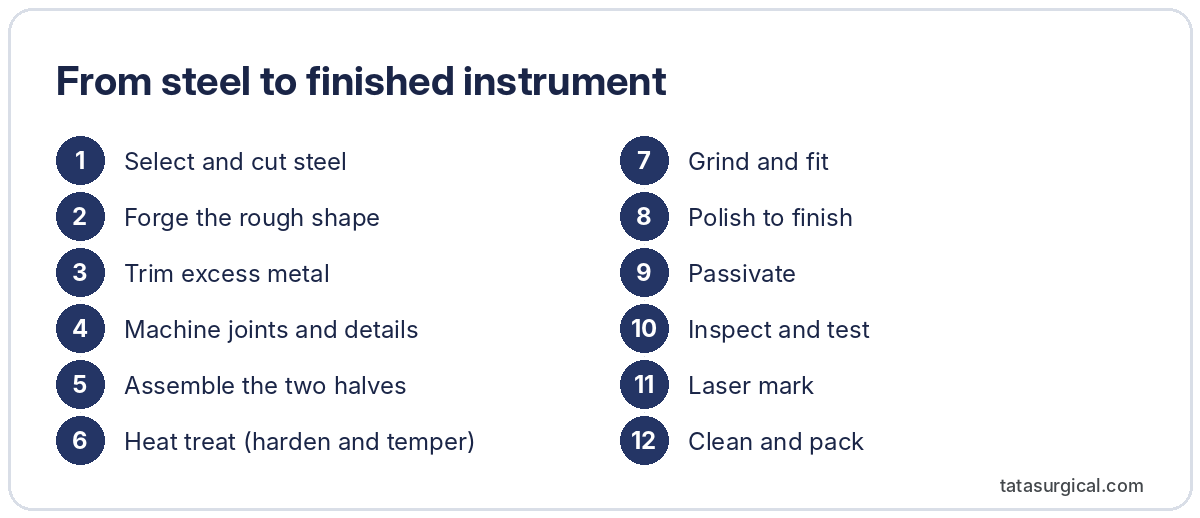
- Select and cut steel
- Forge the rough shape
- Trim excess metal
- Machine joints and details
- Assemble the two halves
- Heat treat (harden and temper)
- Grind and fit
- Polish to finish
- Passivate
- Inspect and test
- Laser mark
- Clean and pack
Key steps explained
Forging: A press squeezes hot steel between dies to create a strong, dense rough shape.
Machining: Machinists then cut box locks, ratchets, serrations and teeth.
Heat treatment: Next, the factory hardens and then tempers each instrument to balance hardness and toughness. Scissors and needle holders need different hardness from retractors.
Grinding and fitting: Skilled workers adjust jaw alignment, ratchets and scissor action by hand.
Polishing: Gives a satin (matte) or mirror finish.
Passivation: Removes free iron and strengthens corrosion resistance (see What is passivation, and why does it matter?).
Where skill matters most
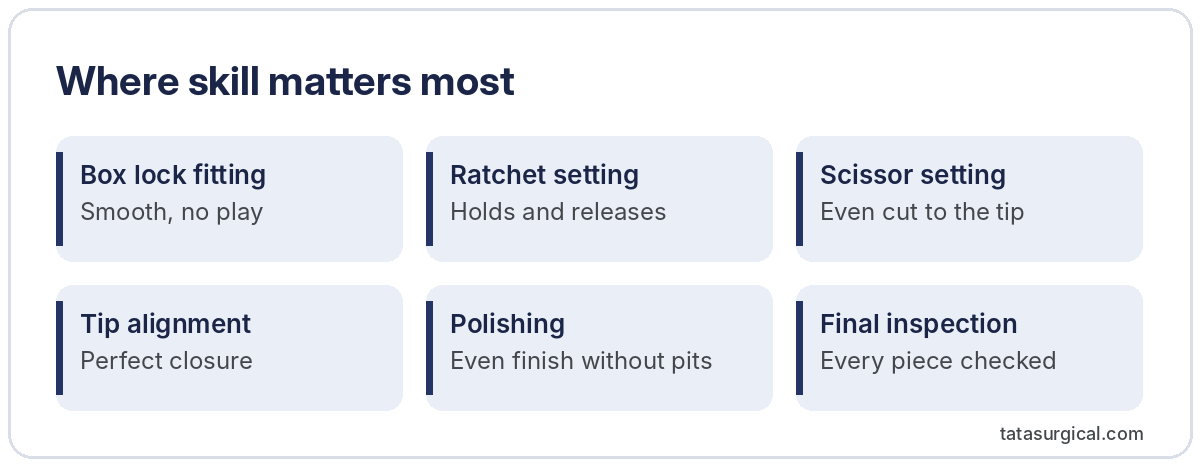
- Box lock fitting: Smooth, no play
- Ratchet setting: Holds and releases
- Scissor setting: Even cut to the tip
- Tip alignment: Perfect closure
- Polishing: Even finish without pits
- Final inspection: Every piece checked
Single-use instruments
Many single-use steel instruments follow simpler, more automated routes, and afterwards validated processes pack and sterilise them.
Questions to ask a factory about its process

- Which steps are in-house?
- How do you control heat treatment?
- How do you test hardness?
- Do you passivate and record each batch?
- How many instruments do you inspect?
- Can I see the line on video?
Worked example
A buyer on a factory tour sees that the maker outsources heat treatment without records. It asks for hardness test reports per batch before ordering, avoiding soft needle holders that would wear quickly.
Proof box
Proof: ISO 7153-1 lists suitable stainless steels for surgical instruments; ISO 13402 sets test methods for resistance to autoclaving, corrosion and thermal exposure.
In detail: why hand work still matters
Even with modern machines, many quality-critical steps on reusable instruments depend on skilled hands: fitting box locks so they move smoothly without play, setting scissors so they cut to the tip, aligning jaws and adjusting ratchets. Sialkot’s long tradition of skilled craftsmen is one reason the city became a global centre for instruments.
Frequently asked questions
How long does it take to make one instrument? It varies; many steps are batched, but hand fitting takes time per piece.
Are instruments forged or cast? Makers usually forge high-quality reusable instruments.
Why is passivation needed? To remove free iron and improve corrosion resistance.
Are single-use instruments made the same way? Often with simpler, more automated processes.
Glossary
- Forging: shaping hot metal under pressure.
- Tempering: heating after hardening to reduce brittleness.
- Setting: adjusting scissors or jaws for correct function.
Key takeaways
- Forging, heat treatment and hand fitting define quality
- Passivation protects against rust
- Ask how each step is controlled
Standards and sources
- ISO 7153-1 (ISO search) · ISO 13402 (ISO search)
- Related: materials (see What are surgical instruments made of?), passivation (see What is passivation, and why does it matter?)
How surgical instruments are made at each quality gate
Knowing how surgical instruments are made helps buyers ask better questions. For example, ask where the steel comes from and how the factory tests hardness. Also, ask how many inspections happen before packing. A good factory will answer clearly, because it controls each step.
In addition, the forging stage sets the grain of the steel, so it affects strength later on. Similarly, heat treatment decides how long jaws and blades last. Therefore, ask for hardness reports on every batch. Next, look closely at the finish on samples. After that, test joints and ratchets by hand. Then, compare the results with your current supplier. As a result, you will see real differences, not just price differences. Finally, visit our quality page to see our own process.
See our process
Book a video tour of the Tata Surgical factory in Sialkot.
Looking for instruments like these?
Browse our catalogue or send us your drawing. We reply with prices, lead time and shipping terms.