

Short answer: Surgical instruments have been used for thousands of years. Ancient Egyptian, Indian and Roman surgeons used knives, forceps, hooks and specula. The 19th century brought antiseptic surgery and stainless designs that could be cleaned and sterilised, and many patterns we use today were named after surgeons of that era.
A timeline of instruments
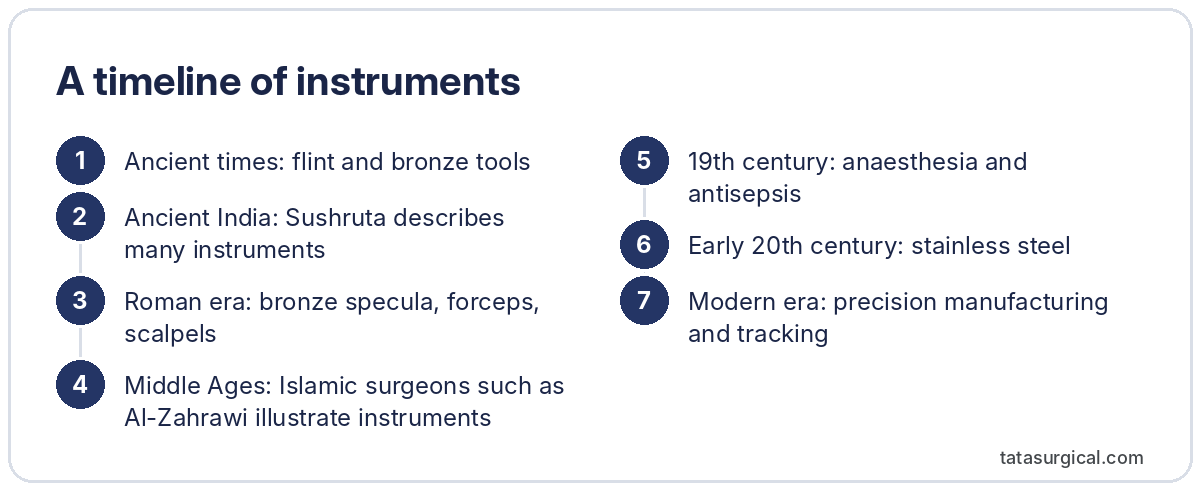
- Ancient times: flint and bronze tools
- Ancient India: Sushruta describes many instruments
- Roman era: bronze specula, forceps, scalpels
- Middle Ages: Islamic surgeons such as Al-Zahrawi illustrate instruments
- 19th century: anaesthesia and antisepsis
- Early 20th century: stainless steel
- Modern era: precision manufacturing and tracking
Famous names in your tray
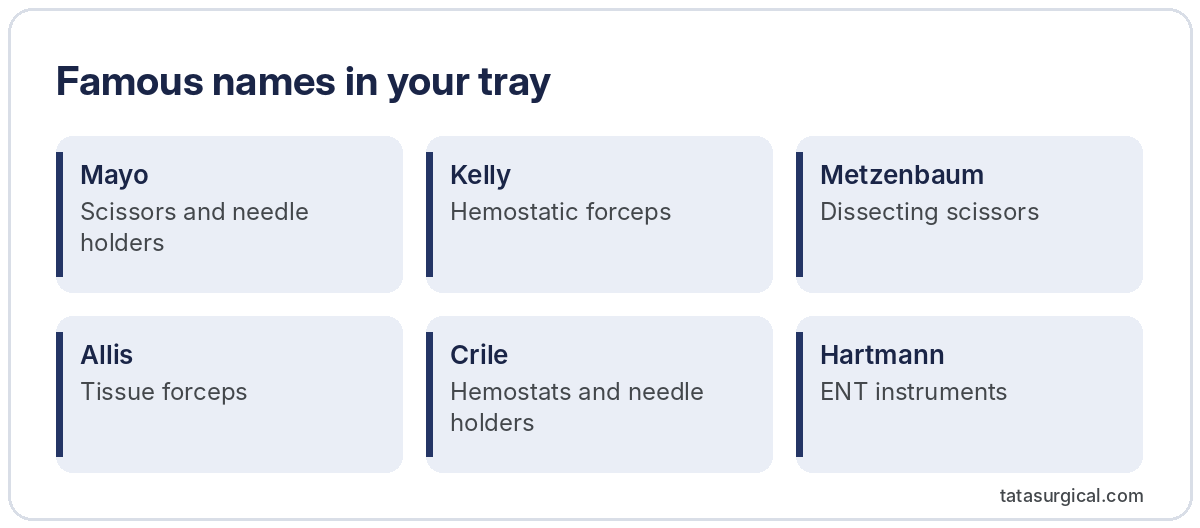
- Mayo: Scissors and needle holders
- Kelly: Hemostatic forceps
- Metzenbaum: Dissecting scissors
- Allis: Tissue forceps
- Crile: Hemostats and needle holders
- Hartmann: ENT instruments
In detail: why named patterns matter
Many instruments carry the names of surgeons who designed or popularised them. These names give a shared language across countries and catalogues.
Worked example
Roman surgical instruments found at Pompeii include specula and forceps that look surprisingly similar to modern versions, showing how good designs last.
Key turning points
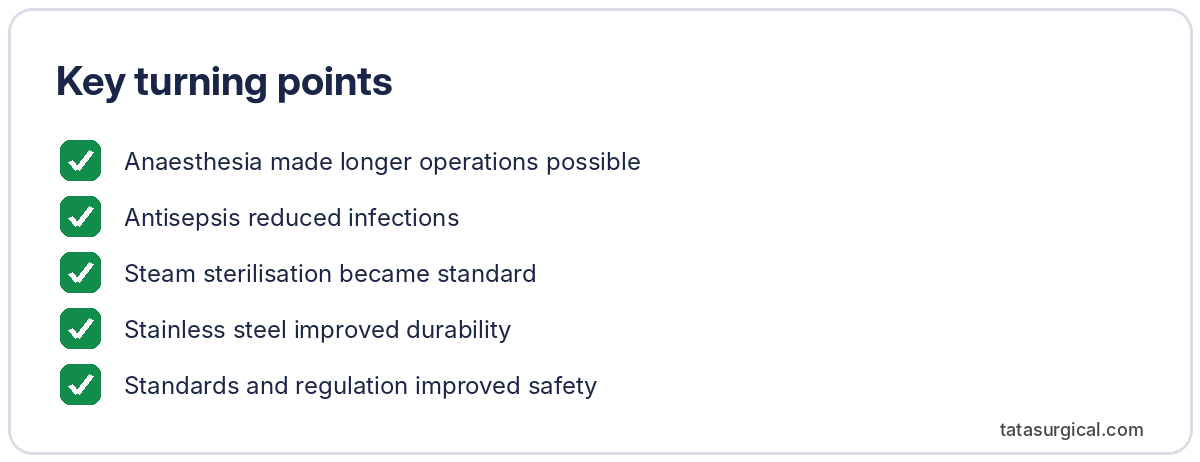
- Anaesthesia made longer operations possible
- Antisepsis reduced infections
- Steam sterilisation became standard
- Stainless steel improved durability
- Standards and regulation improved safety
Proof box
Proof: Al-Zahrawi’s medieval treatise illustrated a large number of surgical instruments; Roman instruments are preserved in museum collections, including finds from Pompeii.
Frequently asked questions
Who is the father of surgery? Sushruta and Al-Zahrawi are both often called fathers of surgery in different traditions.
When was stainless steel introduced? Early 20th century.
Why are instruments named after surgeons? Designers or popularisers were honoured by name.
Is Sialkot’s industry old? Yes, over a century.
Glossary
- Antisepsis: preventing infection with chemicals.
- Pattern: instrument design.
- Speculum: instrument to open a body cavity.
Key takeaways
- Instruments have ancient roots
- Modern patterns honour surgeons
- Steel and sterilisation changed everything
Standards and sources
- Science Museum Group collection: surgical instruments
- Related: Dr Crile (see Who was Dr George Crile? The surgeon behind the Crile forceps), Arthur Hartmann (see Who was Arthur Hartmann? The ear doctor behind the name)
Tradition and quality
Tata Surgical, Sialkot, since 1984. Contact us.
Looking for instruments like these?
Browse our catalogue or send us your drawing. We reply with prices, lead time and shipping terms.