



Short answer: Start from the procedures the hospital will perform, design instrument sets for each, calculate how many copies are needed based on theatre schedules and sterile services turnaround, then buy through a clear specification and tender. Plan delivery, inspection, tracking and staff training before opening.
Instrument planning for a new hospital
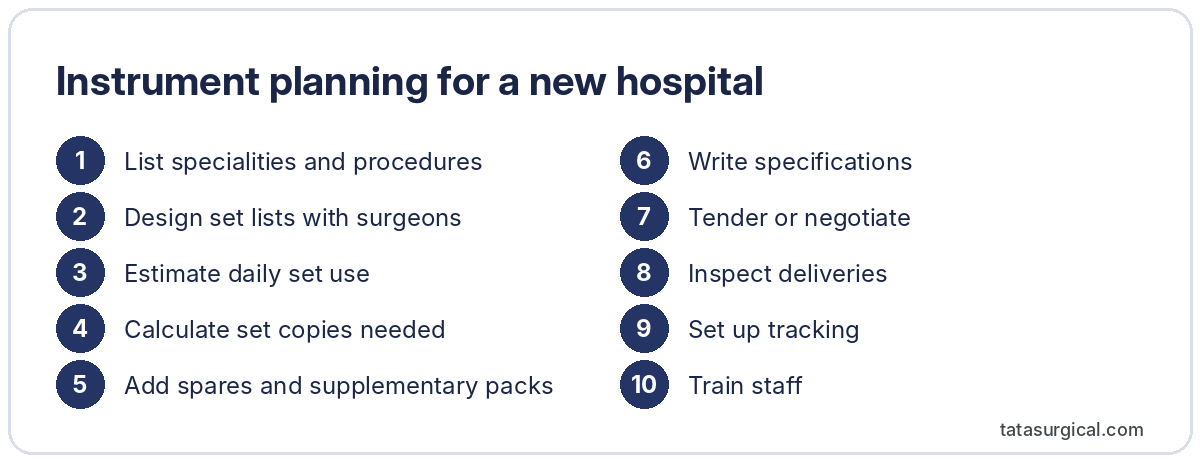
- List specialities and procedures
- Design set lists with surgeons
- Estimate daily set use
- Calculate set copies needed
- Add spares and supplementary packs
- Write specifications
- Tender or negotiate
- Inspect deliveries
- Set up tracking
- Train staff
Main cost drivers
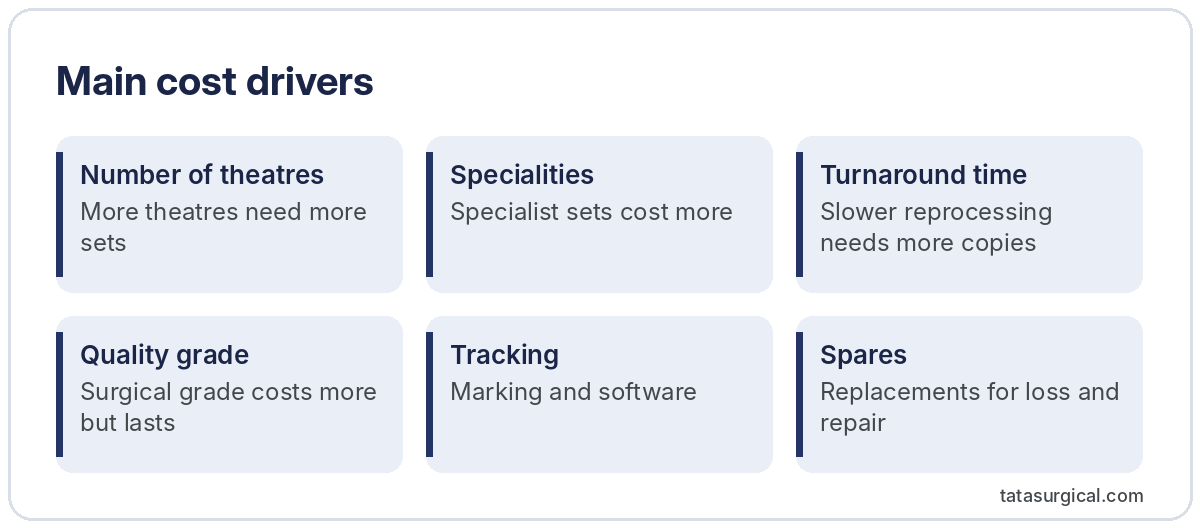
- Number of theatres: More theatres need more sets
- Specialities: Specialist sets cost more
- Turnaround time: Slower reprocessing needs more copies
- Quality grade: Surgical grade costs more but lasts
- Tracking: Marking and software
- Spares: Replacements for loss and repair
Example calculation
If a theatre uses a laparotomy set twice a day and the sterile services department needs four hours to reprocess a set, the hospital may need three or four laparotomy sets for that theatre, plus spares.
Before opening
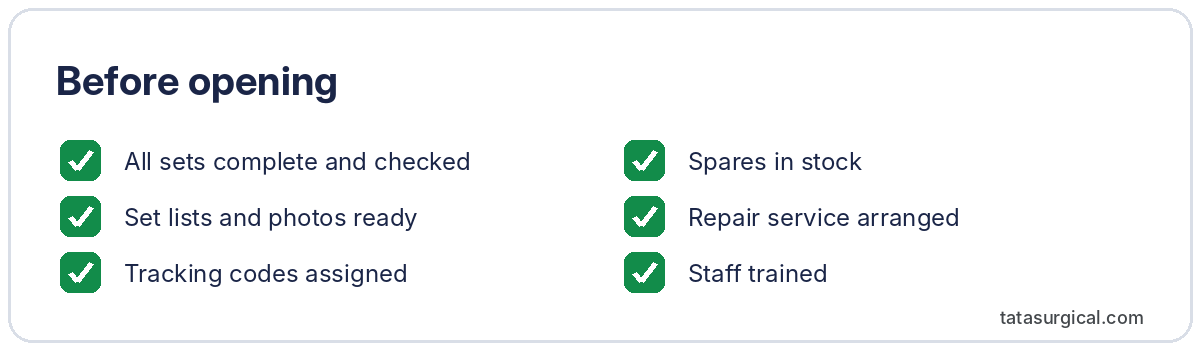
- All sets complete and checked
- Set lists and photos ready
- Tracking codes assigned
- Spares in stock
- Repair service arranged
- Staff trained
In detail: involving the right people
Surgeons, theatre nurses, sterile services managers and procurement should all be involved. Surgeons define needs; theatre nurses know practical use; sterile services know reprocessing limits; procurement ensures value and compliance.
Worked example
A new 150-bed hospital with four theatres plans 60 sets across general surgery, obstetrics, orthopaedics and ENT, plus supplementary packs and 10% spares, and phases delivery so sets arrive a month before opening for inspection and tracking.
Proof box
Proof: WHO guidance on reprocessing and hospital planning stresses matching instrument stock to procedure volume and reprocessing capacity.
Frequently asked questions
Should we buy from one supplier? One main supplier simplifies quality and documents; keep a second for key items.
How many spares? Often around 10% of instruments, more for high-loss items.
Should we buy single-use too? Yes, for kits and procedures where they make sense.
When should instruments arrive? Early enough to inspect, mark and train staff.
Glossary
- Supplementary pack: small extra pack added to standard sets.
- Commissioning: preparing a new facility for operation.
- Set copy: one complete set of a given type.
Key takeaways
- Plan from procedures and turnaround
- Involve surgeons, nurses and sterile services
- Deliver early, inspect and train
Standards and sources
- WHO: Decontamination and reprocessing of medical devices
- Related: sets by procedure (see Surgical instrument sets by procedure: the complete guide), CSSD setup (see Setting up a sterile services department in a small hospital)
Hospital supply from Tata Surgical
Send us your planned set lists.
Looking for instruments like these?
Browse our catalogue or send us your drawing. We reply with prices, lead time and shipping terms.