

Short answer: Regular maintenance and timely repair keep instruments safe and extend their life. Scissors can be sharpened, jaws realigned, TC inserts replaced and ratchets adjusted. Cracked or badly corroded instruments should be replaced. Good instrument repair and maintenance therefore saves money and protects patients.
Repairable problems
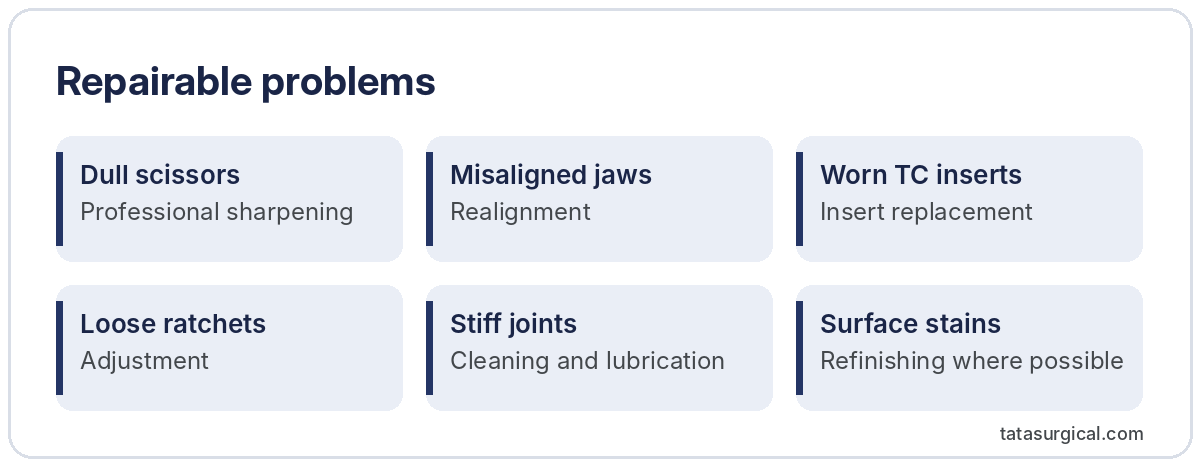
- Dull scissors: Professional sharpening
- Misaligned jaws: Realignment
- Worn TC inserts: Insert replacement
- Loose ratchets: Adjustment
- Stiff joints: Cleaning and lubrication
- Surface stains: Refinishing where possible
Replace instead
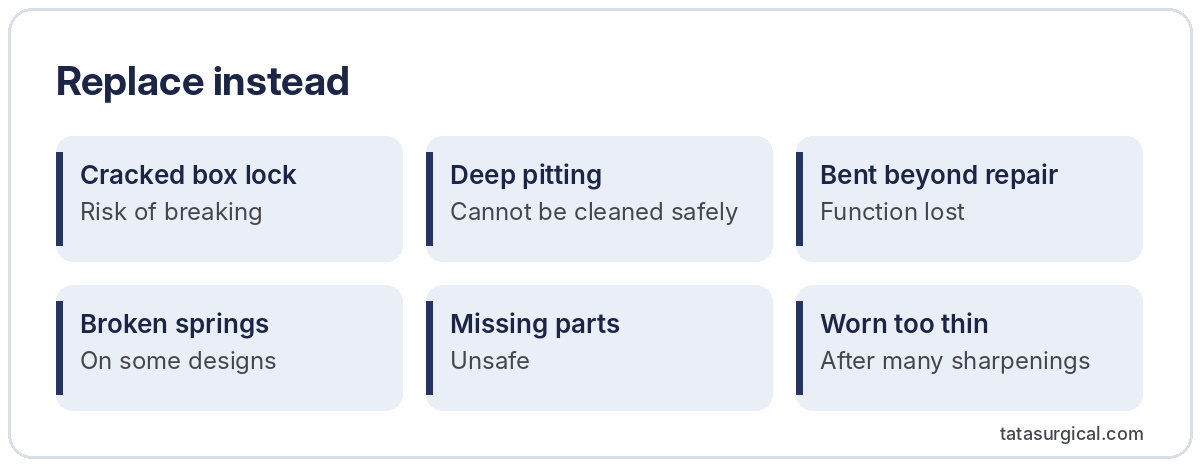
- Cracked box lock: Risk of breaking
- Deep pitting: Cannot be cleaned safely
- Bent beyond repair: Function lost
- Broken springs: On some designs
- Missing parts: Unsafe
- Worn too thin: After many sharpenings
Running a repair programme
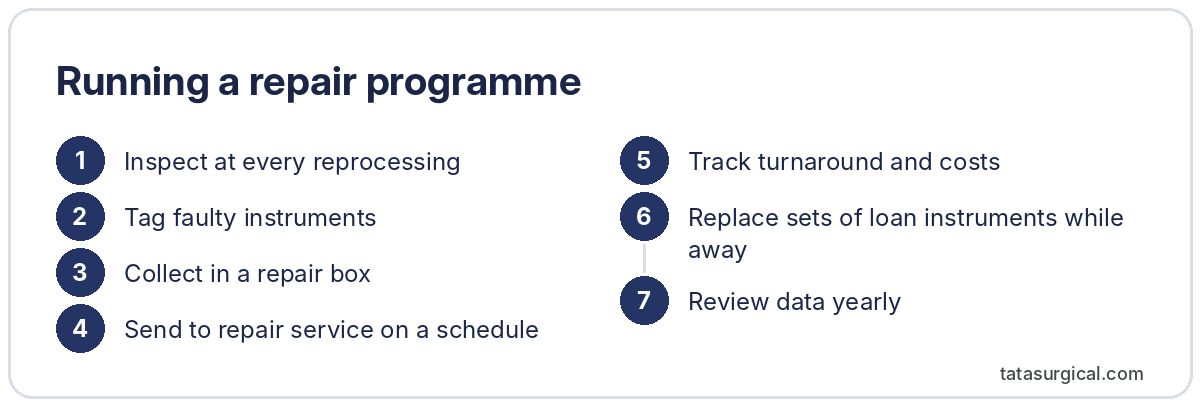
- Inspect at every reprocessing
- Tag faulty instruments
- Collect in a repair box
- Send to repair service on a schedule
- Track turnaround and costs
- Replace sets of loan instruments while away
- Review data yearly
Preventive maintenance routine
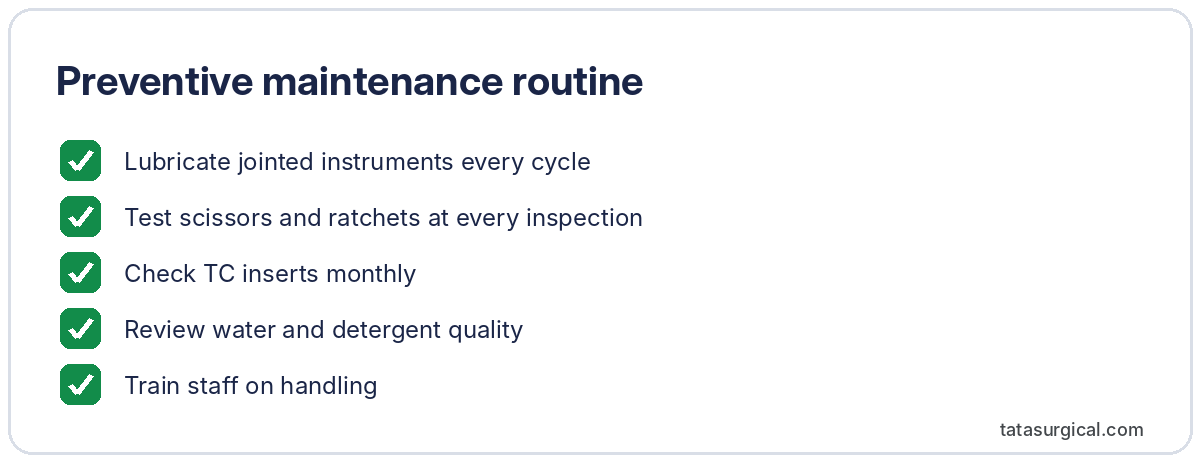
- Lubricate jointed instruments every cycle
- Test scissors and ratchets at every inspection
- Check TC inserts monthly
- Review water and detergent quality
- Train staff on handling
Worked example
A hospital logs every instrument sent for repair. Data shows one theatre returns many bent retractors. Training on correct use halves the repairs within six months.
Proof box
Proof: Instrument care guides from the Instrument Reprocessing Working Group (AKI) describe inspection, care and repair practices used widely in Europe.
In detail: the cost of not repairing
A dull pair of scissors or a slipping needle holder wastes theatre time and frustrates surgeons. Worse, a cracked box lock can break during surgery. A structured repair programme catches these problems early. Many hospitals find that repairing instead of replacing saves a significant share of their instrument budget, especially for expensive TC and speciality instruments.
Frequently asked questions
How often should instruments be serviced? Many hospitals send high-use instruments for service on a regular schedule, plus any faulty items immediately.
Can single-use instruments be repaired? No.
Who should repair instruments? Qualified repair services or the manufacturer.
Should repaired instruments be tested? Yes, inspect and test before returning them to sets.
Glossary
- Preventive maintenance: planned care before failure.
- Loan set: temporary set used while instruments are repaired.
- Turnaround time: time from sending to receiving repaired items.
Key takeaways
- Inspect, tag, repair early
- Replace unsafe instruments
- Use data to reduce damage
Standards and sources
- AKI: Proper maintenance of instruments
- Related: repair programmes for distributors (see Instrument repair and replacement programmes for distributors), sharpening scissors (see Can surgical scissors be sharpened?)
Building an instrument repair routine
An instrument repair programme works best when it is simple. First, inspect every instrument after cleaning. Next, tag items with dull edges, loose joints or worn inserts. Then, send them for repair in planned batches, so that sets are never short. As a result, fewer instruments fail during surgery.
In addition, record each repair. Over time, these records show which items fail most often. For example, if one scissor pattern dulls quickly, you can switch to a tungsten carbide version. The surgical instrument article gives useful background on common types. When repair is no longer worth it, request a quote for replacements.
Replacements from Tata Surgical
Looking for instruments like these?
Browse our catalogue or send us your drawing. We reply with prices, lead time and shipping terms.