Short answer: Heat treatment hardens stainless steel instruments so they keep their edge and shape, then tempers them so they are not brittle. Correct hardness depends on the instrument: cutting instruments need it harder, retractors softer. Poor heat treatment causes dull scissors, bent tips or cracks.
Heat treatment in brief
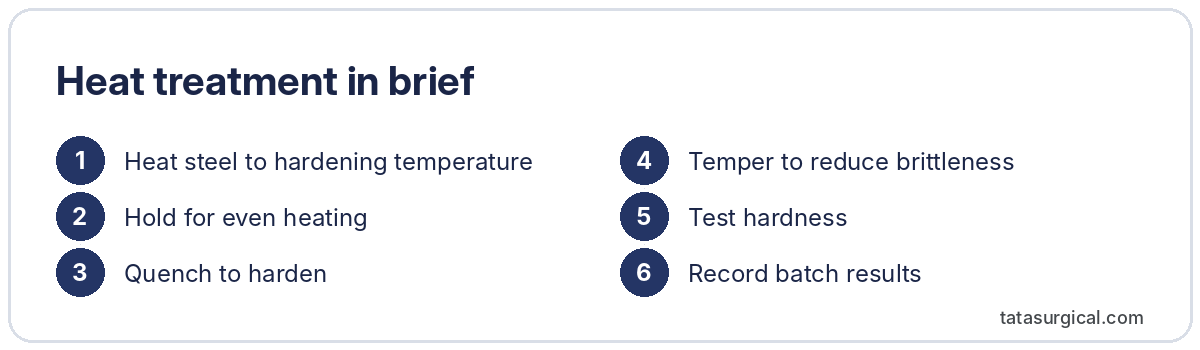
- Heat steel to hardening temperature
- Hold for even heating
- Quench to harden
- Temper to reduce brittleness
- Test hardness
- Record batch results
Typical hardness by instrument type
| Instrument | Why | Relative hardness |
|---|---|---|
| Scissors, chisels, osteotomes | Keep a sharp edge | Highest |
| Needle holders, hemostats | Strength and wear resistance | High |
| Forceps (thumb) | Spring and grip | Medium |
| Retractors, specula (304/316) | Shape, corrosion resistance; not hardened | Low |
Exact values depend on the steel grade and the maker’s specification.
Signs of poor heat treatment
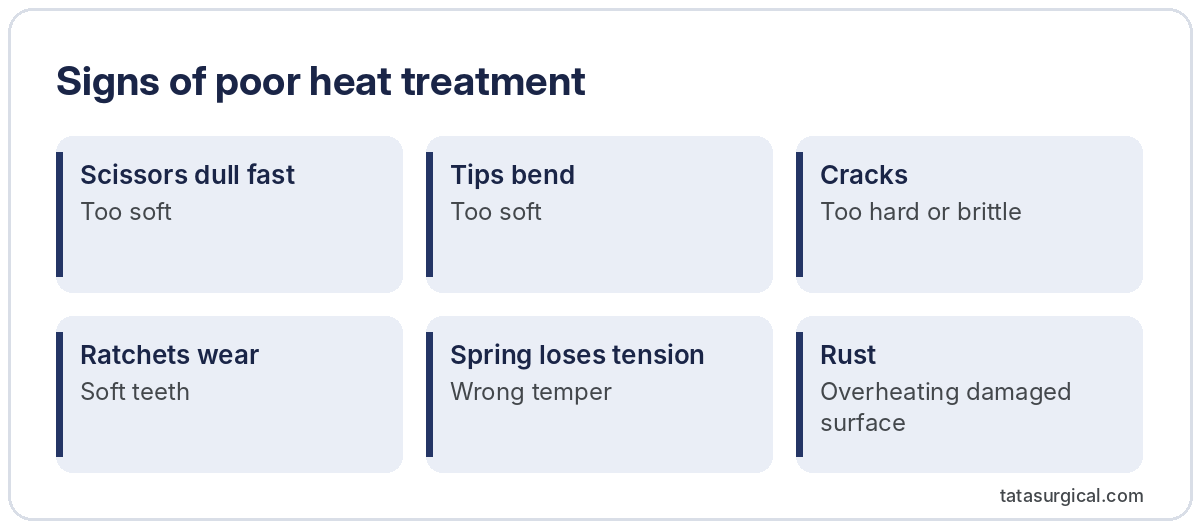
- Scissors dull fast: Too soft
- Tips bend: Too soft
- Cracks: Too hard or brittle
- Ratchets wear: Soft teeth
- Spring loses tension: Wrong temper
- Rust: Overheating damaged surface
How hardness is measured
Rockwell C (HRC) or Vickers (HV) tests press an indenter into the steel and measure the result. Makers usually test samples from each batch.
What buyers can ask for
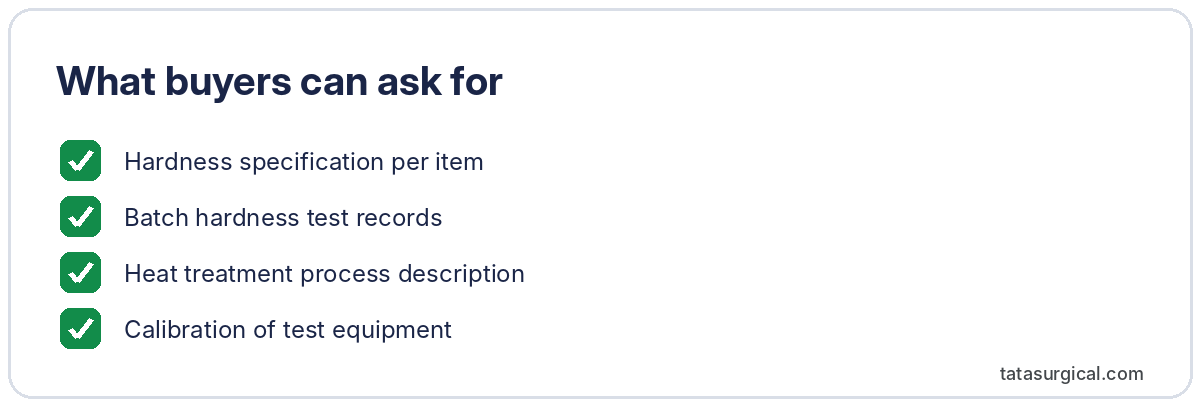
- Hardness specification per item
- Batch hardness test records
- Heat treatment process description
- Calibration of test equipment
Worked example
A hospital complains that a batch of Mayo scissors blunt within weeks. Hardness tests show the batch was under-hardened. The maker adjusts the furnace profile and replaces the batch.
Proof box
Proof: ISO 7153-1 lists steel grades and their typical hardness capability; hardness testing methods follow ISO 6508 (Rockwell) and ISO 6507 (Vickers).
In detail: hardness versus toughness
Hardness and toughness pull in opposite directions. A very hard instrument keeps its edge but may crack; a softer one bends rather than breaks but wears faster. Tempering finds the balance for each instrument type. This is why makers use different heat treatment settings for scissors, forceps and retractors, even when the steel grade is similar.
Frequently asked questions
What is HRC? Rockwell C hardness scale used for hardened steels.
Are retractors hardened? Often not; they use corrosion-resistant steels shaped without hardening.
Can heat treatment be checked by a buyer? Through hardness test records and sometimes independent lab tests.
Does sterilisation change hardness? Normal steam sterilisation does not significantly change the hardness of properly heat-treated steel.
Glossary
- Hardening: heating and quenching to make steel hard.
- Toughness: ability to resist cracking.
- Martensitic steel: hardenable stainless steel such as 420.
Key takeaways
- Hardness must match the job
- Ask for batch hardness records
- Too soft or too hard both cause failures
Standards and sources
- ISO 7153-1 (ISO search) · ISO 6508 Rockwell (ISO search) · ISO 6507 Vickers (ISO search)
- Related: how instruments are made (see How surgical instruments are made: the complete manufacturing guide)
Ask Tata Surgical
Ask about hardness specifications.
Looking for instruments like these?
Browse our catalogue or send us your drawing. We reply with prices, lead time and shipping terms.