

Short answer: Public tenders reward suppliers who read the specification carefully, provide every document, submit compliant samples and offer reliable delivery at a competitive price. Most tenders are lost on paperwork, not on price.
The tender cycle
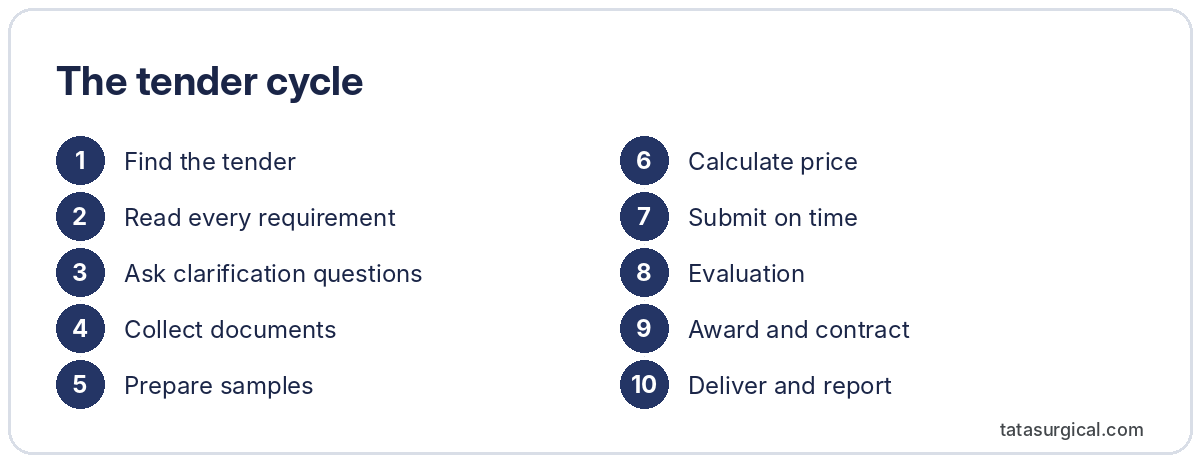
- Find the tender
- Read every requirement
- Ask clarification questions
- Collect documents
- Prepare samples
- Calculate price
- Submit on time
- Evaluation
- Award and contract
- Deliver and report
Where to find tenders
- National procurement portals
- Hospital and ministry websites
- Buying groups and agencies (for example, central purchasing bodies)
- International organisations and NGOs
- Local partners and agents
Why bids fail
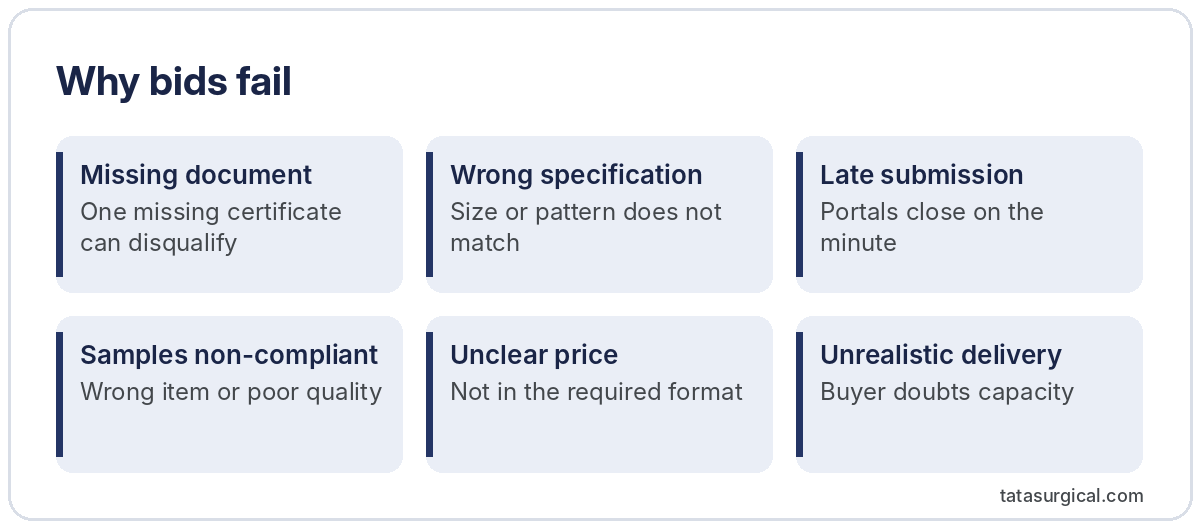
- Missing document: One missing certificate can disqualify
- Wrong specification: Size or pattern does not match
- Late submission: Portals close on the minute
- Samples non-compliant: Wrong item or poor quality
- Unclear price: Not in the required format
- Unrealistic delivery: Buyer doubts capacity
Pricing a tender
- Calculate landed cost for every item
- Include packaging, labelling and delivery to the stated sites
- Allow for currency and freight changes over the contract period
- Check whether price is the only criterion or quality also scores
Final check before submission
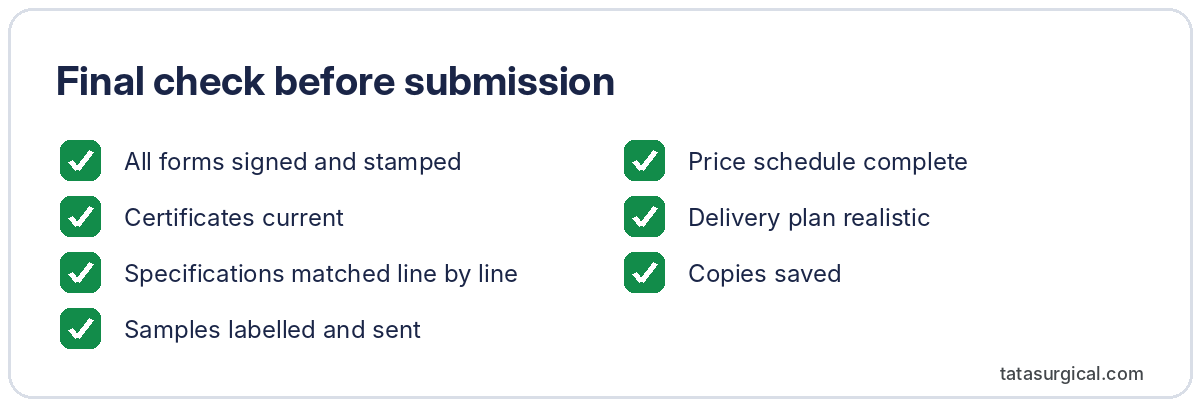
- All forms signed and stamped
- Certificates current
- Specifications matched line by line
- Samples labelled and sent
- Price schedule complete
- Delivery plan realistic
- Copies saved
Worked example
A distributor loses a tender because its retractor was 2 cm shorter than specified. At the next tender it creates a compliance table matching every line of the specification to its product, and wins.
Proof box
Proof: EU public procurement follows Directive 2014/24/EU; most countries publish similar rules requiring compliance with technical specifications and complete documentation.
In detail: building a tender library
Keep a digital folder with every document tenders usually ask for: company documents, certificates, product registrations, specification sheets, catalogue pages, photos and declarations. Update expiry dates monthly. With a library, preparing a bid takes days instead of weeks, and fewer bids fail on missing paperwork.
A compliance table that maps every tender line to your product, with specification, page reference and sample number, also makes evaluators’ work easier and shows professionalism.
Frequently asked questions
Can I bid without samples? Some tenders allow it; many require samples for evaluation.
What if the specification names a brand? Many rules allow “or equivalent”; ask a clarification question.
How long are tender contracts? Often one to three years.
Can I bid with a partner? Yes, consortium or partner bids are common.
Glossary
- Clarification question: formal question to the buyer before the deadline.
- Compliance table: document matching each requirement to your offer.
- Framework agreement: contract for repeated orders over a period.
Key takeaways
- Compliance first, price second
- Build a reusable document library
- Deliver well to win again
Standards and sources
- Directive 2014/24/EU on public procurement
- Related: Africa tenders (see Winning public hospital tenders in Africa), European tenders (see Selling surgical instruments to European hospitals: tenders and buying groups), certified vs unbranded (see Certified vs unbranded instruments: why certification pays in tenders)
Tender support from Tata Surgical
Samples, specifications and stable pricing for your bids. Contact us.
Looking for instruments like these?
Browse our catalogue or send us your drawing. We reply with prices, lead time and shipping terms.